Silver reflects a shifting macro regime as inflation stabilizes
The latest European inflation data and the ECB’s rate decision are reshaping the macro landscape in a subtle but important way. Headline inflation has moved closer to target, policy remains restrictive but stable, and markets are beginning to price a transition rather than a shock. In this environment, commodities are no longer responding uniformly to inflation prints. Instead, they are differentiating based on structural demand, monetary sensitivity and real economy exposure.
Silver sits at the center of this transition.
Unlike energy commodities, which respond primarily to growth expectations and physical balances, and unlike gold, which acts as a pure monetary hedge, silver operates at the intersection of policy, inflation expectations and industrial demand. That dual role makes it one of the most informative assets when the macro regime is shifting rather than breaking.
Inflation stability changes the commodity narrative
European CPI data confirm that inflation pressures are moderating without collapsing. At the same time, the ECB has signaled patience rather than urgency, reinforcing the idea that policy will remain restrictive but predictable. This combination removes the extreme tail risks that dominated markets in previous cycles.
For commodities, this matters because the inflation impulse is no longer the dominant driver. Instead of trading inflation fear, markets are increasingly pricing relative value across assets that respond differently to real rates, growth and policy divergence.
Silver benefits from this setup. As inflation stabilizes, the market no longer needs to hedge aggressively through gold alone. Instead, it reallocates toward assets that offer both monetary optionality and exposure to industrial demand resilience.
Silver’s dual role becomes more relevant
Silver’s strength lies in its dual identity. It retains monetary characteristics that make it sensitive to real yields and central bank signaling, but it also reflects industrial demand linked to electrification, technology and energy transition. This combination becomes particularly valuable when inflation is no longer accelerating but uncertainty remains elevated.
In a stable inflation environment, investors are less focused on emergency hedging and more on positioning for medium term structural themes. Silver fits that profile better than most commodities. It is not dependent on a surge in inflation to perform, nor does it require a strong growth shock. It thrives in environments where policy divergence and selective demand dominate price discovery.
The Renko structure confirms controlled repricing
The Renko chart of XAGUSD captures this transition with clarity. After rallying strongly into mid December, silver encountered resistance near the upper boundary of the recent range. That area capped price temporarily, producing a controlled pullback rather than a disorderly reversal.
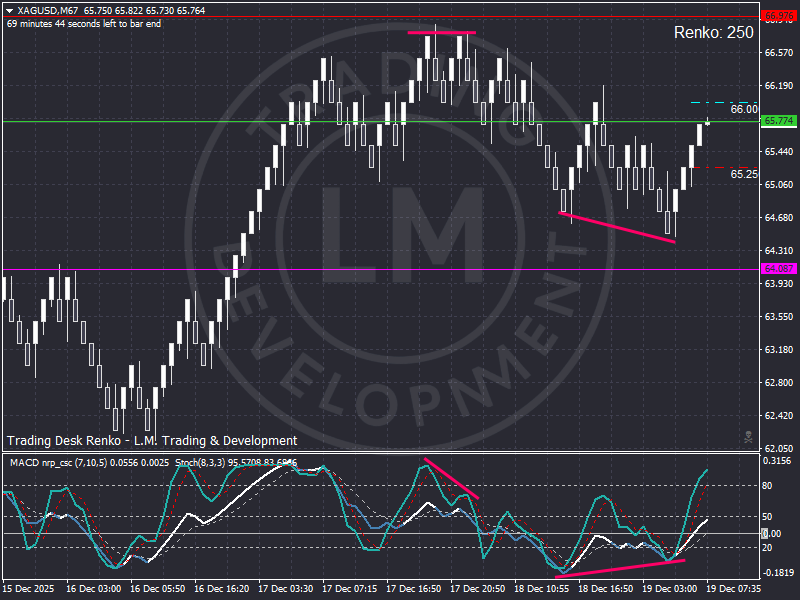
What followed is more important than the initial rejection. Price found support above the broader structural base and began to rebuild higher lows. This behavior suggests consolidation within a constructive trend rather than distribution.
Momentum indicators reinforce this view. The oscillator shows a recovery from lower levels, indicating that downside pressure is fading even as price remains below the recent peak. This divergence aligns with a market that is absorbing macro information without capitulating.
The green reference level around the mid range acts as a pivot zone. Holding above that area keeps the broader structure intact and preserves upside optionality. A renewed push toward the recent highs would signal that silver is being repriced not as an inflation hedge, but as a macro asset aligned with policy divergence and real economy resilience.
Why silver stands out among commodities now
Energy markets are struggling to find direction as growth expectations soften and supply remains adequate. Industrial metals face a balance between long term demand optimism and short term macro caution. Agricultural commodities are driven by physical constraints and climate related risks.
Silver, by contrast, is responding to a cleaner macro signal. It reflects the stabilization of inflation, the persistence of restrictive but predictable policy, and the gradual reallocation toward assets that benefit from both monetary and industrial dynamics.
This makes silver particularly relevant at this stage of the cycle. It is not reacting to yesterday’s inflation fears, but to tomorrow’s policy landscape.
Implications for the months ahead
If inflation continues to stabilize and central banks maintain a cautious stance, silver is likely to remain supported on pullbacks. Volatility may persist, but the underlying structure favors accumulation rather than distribution.
A decisive break above the recent resistance zone would indicate that markets are increasingly comfortable expressing macro views through silver rather than pure safe havens. Conversely, a failure below the structural support would suggest a broader reassessment of commodity exposure.
For now, the balance of evidence points to a controlled repricing phase rather than a trend reversal.
Conclusion
Silver is emerging as one of the clearest expressions of the current macro transition. As inflation stabilizes and policy paths diverge, commodities are differentiating based on their sensitivity to real rates and structural demand.
The Renko structure confirms that silver is consolidating strength rather than unwinding it. In a market moving away from crisis pricing and toward selective allocation, silver’s dual role makes it a natural focal point.
Rather than reacting to inflation headlines, silver is reflecting a deeper shift in how markets are positioning for the next phase of the cycle.
Author

Luca Mattei
LM Trading & Development
Luca Mattei is a market analyst focusing on FX, metals, and macroeconomic trends. He develops trading tools for retail and professional traders, coding indicators and EAs for MT4/MT5 and strategies in Pine Script for TradingView.