|

Signs of a decline in globalization

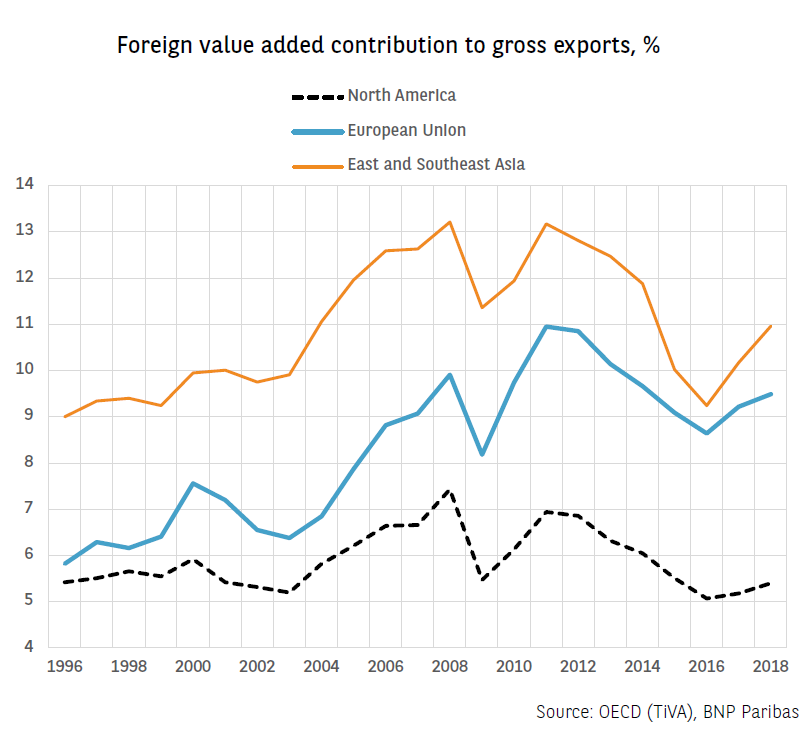
The Covid-19 crisis is still generating lively discussions on the future of globalisation of trade and finances, and global value chains. The share of foreign value added embedded in the exports of a country or region is a good indicator of the level of involvement in global value chains. This share increased rapidly from the early 1990s until the global financial crisis of 2008, under the effect of trade liberalisation (cuts in tariffs and proliferation of free trade agreements) and falling transport costs. This increase was particularly significant in Asia, the emergence of China as the factory of the world leading to the imports of more intermediary goods mainly from Europe and North America.

After the Great Recession of 2008, globalisation has slowed, as the foreign inputs in the major regions have declined. One reason is that trade in intermediate goods have become more regionalised. German industry has increased the inputs from Central and Eastern Europe, whereas the US manufacturing sector has focused more on Mexico. By moving up in the value chain, China has become less dependent on the inputs from the OECD countries and even became a competitor for Western industries. The foreign input share of East and South-East Asia lost even three percentage points between 2010 and 2016, before climbing again. The Covid-19 crisis may strengthen the trend towards more regionalisation as industries seek to improve the resilience of supply chains, e.g. reliance on multiple suppliers, greater redundancy in transportation and logistics.
Chart

Download The Full Eco Flash

Author

BNP Paribas Team

BNP Paribas Team

BNP Paribas

BNP Paribas Economic Research Department is a worldwide function, part of Corporate and Investment Banking, at the service of both the Bank and its customers.


More from BNP Paribas Team
Share:

Editor's Picks

EUR/USD holds firm above 1.1900 as US NFP looms

EUR/USD holds its upbeat momentum above 1.1900 in the European trading hours on Wednesday, helped by a broadly weaker US Dollar. Markets could turn cautious later in the day as the delayed US employment report for January will takes center stage. 

GBP/USD remains above nine-day EMA near 1.3650

GBP/USD recovers its recent losses from the previous session, trading around 1.3680 during the European hours on Wednesday. The technical analysis of the daily chart indicates a sustained bullish bias, as the pair trades within an ascending channel pattern.

Gold sticks to gains near $5,050 as focus shifts to US NFP

Gold holds moderate gains near the $5,050 level in the European session on Wednesday, reversing a part of the previous day's modest losses amid dovish US Federal Reserve-inspired US Dollar weakness. This, in turn, is seen as a key factor acting as a tailwind for the non-yielding yellow metal ahead of the critical US NFP release. 

US Nonfarm Payrolls expected to show modest job gains in January

The United States Bureau of Labor Statistics will release the delayed Nonfarm Payrolls data for January on Wednesday at 13:30 GMT. Investors expect NFP to rise by 70K following the 50K increase recorded in December.

S&P 500 at 7,000 is a valuation test, not a liquidity problem

The rebound from last week’s drawdown never quite shook the sense that it was being supported by borrowed conviction. The S&P 500 once again tested near the 7,000 level (6,986 as the high watermark) and failed, despite a macro backdrop that would normally be interpreted as supportive of risk.

Bitcoin price slips below $67,000 ahead of US Nonfarm Payrolls data

Bitcoin price extends losses, and trades below the lower consolidating boundary at $67,300 at the time of writing. A firm close below this level could trigger a deeper correction for BTC. Despite the weakness in price action, institutional demand shows signs of support, recording mild inflows in ETFs so far this week.