September currency results and October risks: An outlook by Elev8 broker


Elev8, a global CFD broker, continues its Traders Outlook article series. This issue focuses on the most significant currency changes in September and outlines the main events to watch for in October 2026.
What happened in September
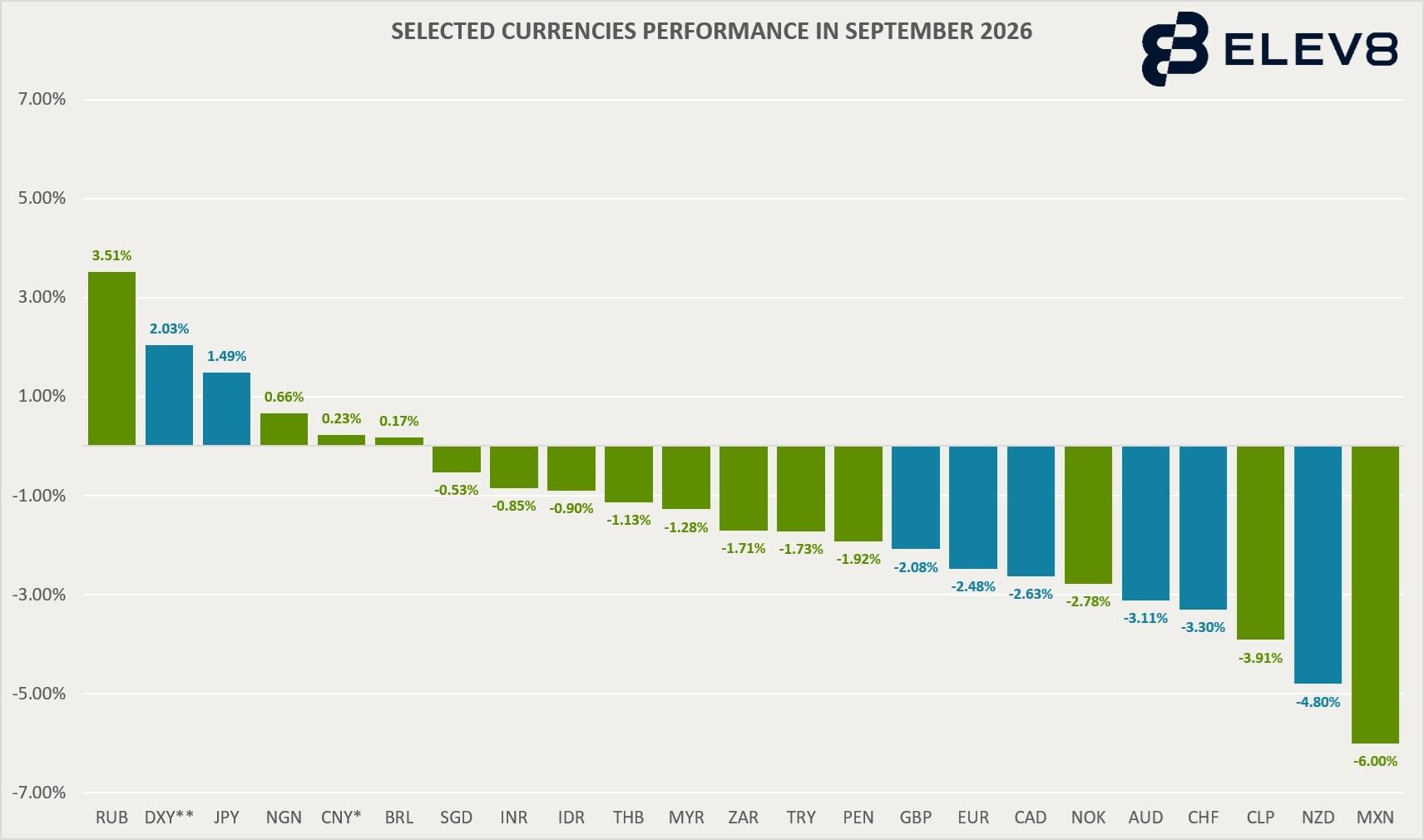
The chart below shows how selected currencies performed in September 2026. Deep teal marks major currencies and the U.S. Dollar Index (DXY). All currencies' performance is measured against their relevant benchmark USD exchange rate. For the Chinese renminbi the onshore rate (USDCNY) is used.
* USDCNY, onshore rate
** DXY (U.S. Dollar Index)
Introduction
In September, we saw sharp and uneven moves across major currency pairs. The Mexican peso weakened while the Russian ruble strengthened. The yen gained modestly even as the U.S. dollar rose against most peers, while the Tasmanian currencies (AUD and NZD) fell. These shifts reflected the Federal Reserve's (Fed) monetary policy stance, higher oil prices linked to the Iran conflict, and differing central bank signals. In this article, Elev8 broker provides retail traders with market data and analytics to see more market context so they can respond effectively to changing conditions.
What happened in September
The U.S. dollar dominated the market. The Fed raised rates to 3.75–4.00%, U.S. Treasury yields reached decades-high levels, while an oil and diesel price shock divided the currency market into clear winners and losers. The peso fell roughly 6% against the dollar, with USDMXN moving from about 17.00 to about 18.10. The ruble rose about 3.5%, with USDRUB falling from about 86.80 to about 83.20. A carry-trade unwind, following the Fed's rate increase, weighed on high-yielding currencies such as the peso. At the same time, oil prices above $100 per barrel supported the ruble because energy exports remain Russia's main revenue source.
Mexican Peso and Russian Ruble
While the Fed raised its target range to 3.75–4.00%, the Bank of Mexico held its rate at 6.50%, narrowing the interest-rate gap between the currencies and easing the demand for pesos.
The dollar index (DXY) rose just over 2% in September on hawkish Fed expectations and safe-haven flows tied to the Iran conflict. The 10-year Treasury yield reached 5.29%, the highest since 2007, and the 30-year yield hit 5.62%, the highest since 2002. These attractive levels pulled capital toward dollar assets. Furthermore, a fourth round of U.S.-Mexico trade talks was postponed from late September to October, which added extra pressure.
In contrast, the Russian ruble (RUB) gained more than 3% against the U.S. Dollar. Because of the ongoing blockade in the Strait of Hormuz, Brent crude stayed above $100 per barrel for most of September. As a result, high energy export revenue strengthened Russia's current account balance and sustained demand for the ruble. Extended ruble payment rules for foreign gas buyers and capital controls provided additional currency support.
In short, the Fed's hawkish move, high oil prices, and risk-off sentiment hurt high-yielding currencies such as the peso, while boosting oil-linked currencies such as the ruble.
Japanese Yen
The yen appreciated by about 1.5% against the U.S. dollar in September, with USDJPY falling from about 160.00 to about 157.00. Overall, however, it was a truly roller-coaster month for the Japanese currency, and at one point USDJPY traded as low as 153.00 before recovering again. Yen was one of the stronger G10 currencies, even though the dollar gained against most peers.
The Bank of Japan (BoJ) raised its policy rate by 25 basis points (bp) to 1.25% on 18 September, the highest level since 1995. The vote was 7 to 2. The yen first weakened on the day because limited forward guidance disappointed some traders, and USDJPY jumped 1.2% to 157.90. Over the following days, markets treated the move as part of a longer normalisation path and began to price in further rate increases.
Additionally, a threat of intervention hangs over the yen. Japanese authorities conducted rate checks on 18 and 19 September, and USDJPY retreated from 158.00. On 28 September, top currency diplomat Atsushi Mimura said markets should treat U.S. and Japanese warnings on yen weakness as credible. Indeed, Finance Minister Katayama and U.S. Treasury Secretary Bessent reaffirmed that the yen's undervaluation is a matter of concern. The July joint intervention remained in traders' minds and capped USDJPY near 158.00.
Finally, higher oil prices also added to Japanese inflation and reinforced the case for further hikes.
Australian Dollar and New Zealand Dollar
The Australian dollar fell about 3.1%, with AUDUSD moving from about 0.7165 to about 0.6945. It was one of the weaker G10 currencies despite the Reserve Bank of Australia (RBA) raising its cash rate by 25 bps to 4.60%, a 15-year high and the fourth hike of 2026. Governor Bullock said the board had considered holding rates and that the bank was trying to anticipate the effects of earlier hikes. Markets interpreted the message as a signal of a possible pause. As a result, the chance of a November hike fell from 44% to 32%, and the chance for a December hike fell from 60% to 50%.
The same oil rise that supported the ruble and added to the case for BoJ hikes acted as a drag on the Aussie. Treasurer Jim Chalmers said the war has been a disaster for the global economy and that Australian workers are paying a hefty price. Indeed, Australia is a net energy importer, so oil above $100 worsens its terms of trade, raises input costs, and increases the risk of an economic recession.
The latest Commitment of Traders (COT) report showed that large speculators raised their net-short positions by 20% to 46,814 contracts in the week to 22 September, the largest since December 2025.
Unlike the RBA (which hiked to 4.60% on 29 September) and the BOJ (which hiked to 1.25% on 18 September), the Reserve Bank of New Zealand (RBNZ) had no scheduled meeting in September. Its next Monetary Policy Review is on 28 October. This created a policy vacuum at precisely the wrong time. While Australia and Japan could at least point to central bank actions as potential catalysts for currency support, New Zealand had no such anchor. The market was left to price the kiwi purely on external forces, and those forces were overwhelmingly negative. As a result, USDNZD dropped by almost 5%, making it the worst-performing currency among the majors.
Additionally, dairy is New Zealand's largest export category, and September weather forecasts brought a direct threat to future production. Fonterra, the world's top dairy exporter, warned that El Niño could reduce milk volume growth at the end of the 2026–2027 season as the weather phenomenon heightens the risk of extreme weather events.
What to expect in October
Elev8 broker highlights six main themes for traders in October:
- Fed policy direction
- BoJ rate expectations
- Oil market volatility
- Carry-trade position adjustments
- U.S.-Mexico trade negotiations
- Standard economic data releases
First, traders should watch the odds of the Fed delivering another 25-bps increase at its November meeting. U.S. Non-farm payrolls (NFP) and September Consumer Price Index (CPI) will matter, as will comments from Fed officials.
Second, overnight index swaps priced in a 42% chance of a BoJ hike to 1.50% in October and a 100% chance for December. Japanese inflation data, political comments about economic reflation, and intervention risk near 158.00 in USDJPY will be closely watched. Yen crosses such EURJPY, AUDJPY, and GBPJPY may show a cleaner reaction and smoother trading environment.
Third, Brent at $102 and the continued Strait of Hormuz disruption remain central. Any change in the blockade, Houthi activity in Yemen, or statements on the conflict's length would move oil and related currencies.
Fourth, the carry unwind that weakened the peso by about 6.0% may continue if speculative shorts grow or if equity volatility rises. With U.S. Treasury yields above 5.0%, emerging market currencies such as the South African rang (ZAR) and high-beta currencies such as AUD and New Zealand Dollar (NZD) will stay exposed and at risk of depreciation.
Fifth, the postponed fourth round of U.S.-Mexico trade talks returns in October. Tariff signals could add to peso weakness, while a constructive result could support a rebound given short positioning. The Bank of Mexico held rates at 6.50% but dropped language that committed it to that level.
Sixth, upcoming U.S. employment figures and inflation reports, along with China data, will shape global risk sentiment and will determine the next shift in global rate expectations.
Key data and events calendar for October
Date (approximate) | Event | Most affected currencies |
2 October | U.S. Nonfarm Payrolls | All—sets tone for November Fed |
Early Oct. | China PMIs / Golden Week data | AUD, NZD, CNY, Asian EM |
14 October | U.S. CPI | All—with oil above $100, headline likely to accelerate |
21 October | UK CPI | GBP—BoE hike expectations in flux |
28 October | Australia CPI (Q3) | AUD—determines whether RBA hikes again in November |
29 October | ECB Meeting | EUR-eurozone inflation fears vs. inflation persistence |
30 October | BoJ Meeting | JPY, JPY crosses |
Oct. (TBC) | U.S.-Mexico trade talks (Round 4) | MXN |
Ongoing | Iran-U.S. Hormuz conflict | Oil-sensitive currencies (RUB, CAD, NOK, AUD, EUR, EM) |
Source: Elev8 broker
Disclaimer:This article does not contain or constitute investment advice or recommendations and does not consider your investment objectives, financial situation, or needs. Any actions taken based on this content are at your sole discretion and risk—Elev8 does not accept any liability for any resulting losses or consequences.
Elev8 is a licensed global broker serving 18+ million traders in 100+ countries. It offers market access through 3 platforms: Elev8Trader, MetaTrader 4, and MetaTrader 5. Operating under licences from Mauritius and Seychelles, Elev8 provides traders with the tools to help spot and capture more market opportunities. The broker received the 'Best Trading Experience Broker 2026' and the 'Best Trading Platform Provider 2026' awards from FxDailyInfo.
One of Elev8's key features is Space, an analytics hub within the Elev8Trader platform that helps traders expand their market horizons. With its personalised feed, daily expert analytics, and community content, Space facilitates faster access to information and market data.
Author
















