Seasonality Issues, Weather Limits Headline Jobs, Fed Still On

Although below the recent trend, the job gain of 103,000 in March supports the case for continued consumer spending. Job gains plus the 4.1 percent unemployment rate corroborate the call for a June rate hike.
Job Gains Broad-Based with March Jobs at 103,000
Nonfarm payrolls rose 103,000 in March with the three-month average at a solid 202,000 jobs. Consistent with 2.5-3.0 percent economic growth in the first half of 2018, job gains come with a likely FOMC June rate hike, soon followed by two more in the second half of 2018.
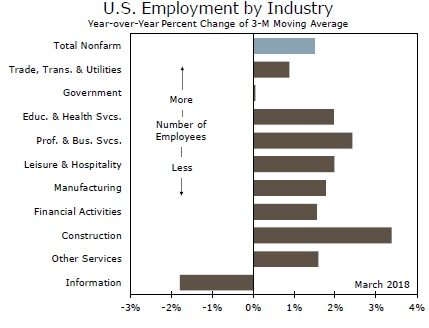
Jobs gains appeared broad-based, with most sectors experiencing gains over the month (top graph). Manufacturing jobs continue to show forward momentum—up 22,000 in March and up an average of 25,000 over the past three months. Construction jobs took a hit, down 15,000, as weather showed its force here. Over the past three months, aggregate hours worked are up 2.0 percent, annualized, which very solid and consistent with continued growth in personal income and consumption.
Wage Growth Awaits Uptick in Inflation
The theory that workers and employers respond to higher inflation is confirmed through Granger causality tests, which reveal that inflation leads wages (middle graph). That is, workers respond to higher inflation by trying to negotiate higher nominal wages to maintain a real wage standard. Similarly, higher inflation fosters more flexibility for employers to raise wages while maintaining profit margins.
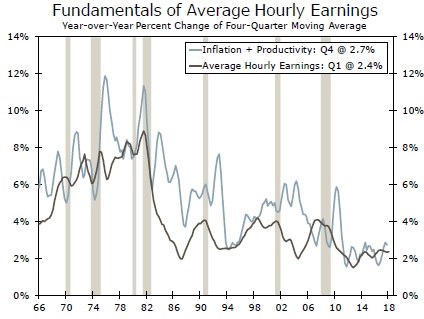
Nominal average hourly earnings rose 0.3 percent in March and are up 2.7 percent over the year—a touch higher than February at 2.6 percent. The gradual rise in earnings over the past six months signals higher incomes, but also greater pressure on profits as firms continue to have modest top-line pricing power. Longer term, subdued inflation readings and weak productivity numbers suggest limited gains in nominal wage growth.
Unemployment Stuck, but Underlying Improvement Continues
The unemployment rate was unchanged in March, sticking at 4.1 percent for a sixth consecutive month. The late winter storms that hit the northeast appear to have had only a small impact on unemployment last month; 159,000 workers reported they were unable to work last month due weather, which is only modestly above the 143,000 average for March over the past 41 years.
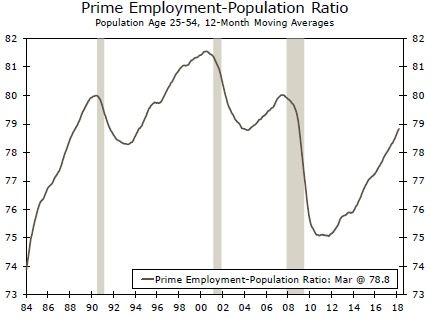
After going on a tear the past two months, labor force participation edged down in March. Beyond the month to month volatility, however, we see encouraging signs from the household survey that point to continued tightening in the labor market. The broadest measure of unemployment, which includes part-time workers who want full time jobs and workers marginally attached to the labor force, is on par with the lows of the previous expansion. Labor force participation among workers ages 25-54 has risen 0.4 points over the past year. Although the prime participation rate has only recovered about half the ground lost since the recession, total employment among this group is closer to making a full recovery (bottom graph).
Author

Wells Fargo Research Team
Wells Fargo