Rupiah at weakest level since 1998 asia financial crisis

Indonesian Rupiah eased to 15,800 per US dollar last Friday after inching closer to break the 1998 Asia crisis peak at Rp 16,850. The high this month at Rp 16,738 came very close to break the previous all-time high. The COVID-19 pandemic prompted investors to dump emerging market currencies. The money flows to safe haven instrument including US Dollar and Gold.
Indonesia has been late in implementing mitigation measure against the spread of COVID-19. As infection and death count soar, the government has belatedly introduce stricter measures in the past two weeks. These include social distancing and closure of non-essential businesses and schools. Government also encourages people to stay and work from home. Economic fundamentals this time around however is better than the 1998 crisis. Indonesia has better management of corporate debts and better credit ratings. In 1998, Indonesia had junk bond status, while the current rating is worthy for investment by the various worldwide credit rating agencies.
Bank Indonesia (BI), the central bank, has stepped up market intervention to stabilize the rupiah exchange rate amid heavy capital outflows. Indonesia’s forex reserves dropped by US $9.4 billion in March to $121 billion. BI data shows foreign investors have sold Rp 148.76 trillion (US $9.04 billion) in Indonesian assets, including Rp 135.08 trillion in government bonds and Rp 9.71 trillion in Indonesian shares. BI has intervened directly in the spot foreign exchange as well as buying bonds dumped by foreign funds. The Finance Minister Sri Mulyani however is on the record saying that the currency may slide as far as 20,000 per dollar if the worst materializes and the economy contracts under the weight of the pandemic. Despite the recent pullback in USDIDR, Rupiah remains one of the worst-performing Asian currencies as it has lost more than 14% against US Dollar so far this year.
USD/IDR (Rupiah) Monthly Elliott Wave Chart
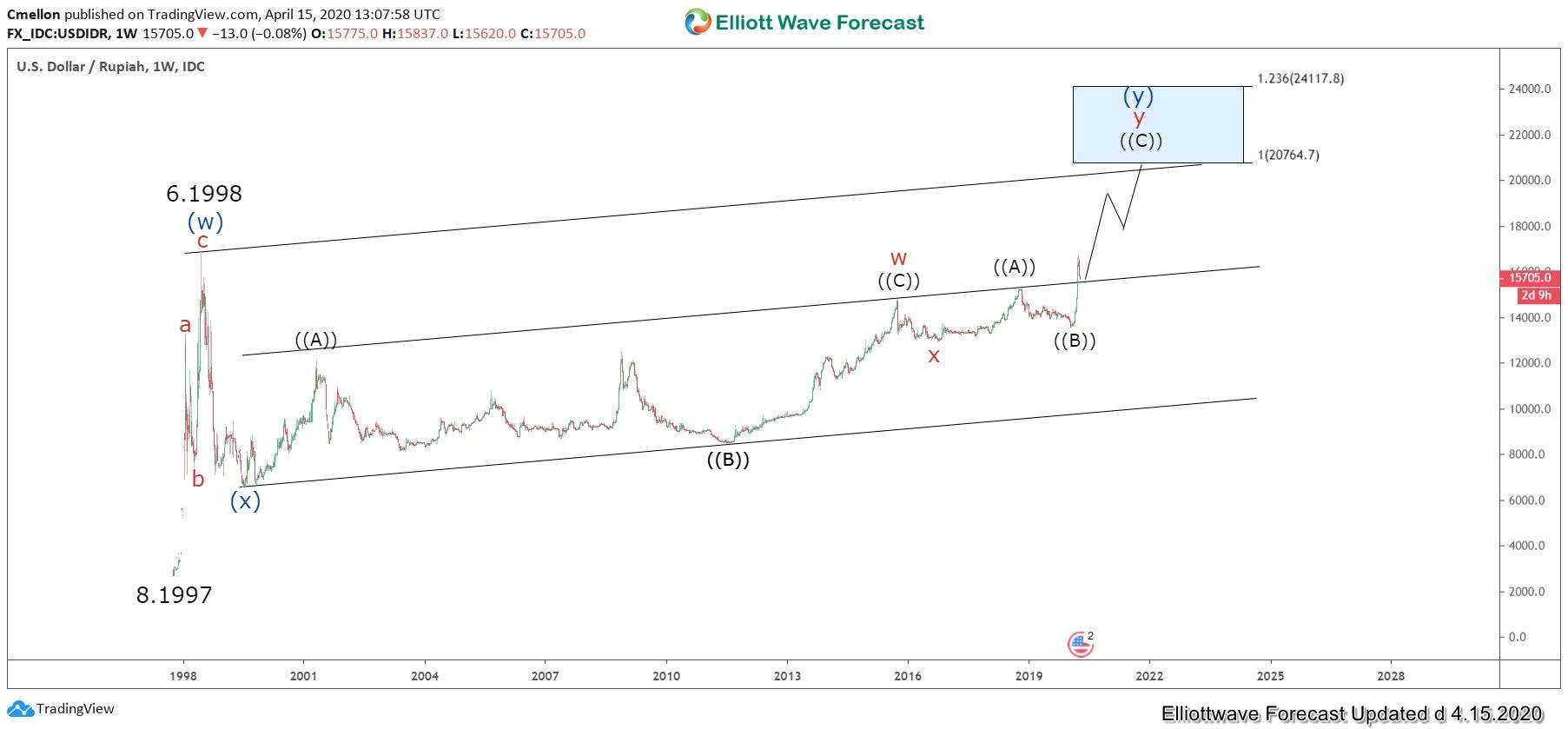
USDIDR Weekly chart above shows the pair is close to breaking above the all-time peak during the Asian financial crisis on 6.1998 (16850). The high registerd on March is 16738, which is close to breaking above the previous all-time high. A break above 16850 suggests the pair is likely to extend higher. Potential target is 100% – 123.6% Fibonacci extension from 8.1997 low towards 20764 – 24117 blue box area. This area is also at the upper portion of the parallel channel.
Author

Elliott Wave Forecast Team
ElliottWave-Forecast.com