Rising interest rates and public debt sustainability

Due to the recent significant increase in interest rates, Eurozone countries now have a borrowing cost on newly issued debt that, for an equivalent maturity, is higher than that of the existing debt. From a debt sustainability perspective, this necessitates a smaller primary deficit or a larger surplus, depending on whether the average interest cost is, respectively, lower or higher than the long-term nominal GDP growth rate. However, this effect will only be fully operational when the entire debt has been refinanced at the higher interest rate. Given the long average maturity of existing debt, the annual adjustment effort is small for the time being but it will grow over time. However, debt sustainability is about more than keeping the debt ratio stable under certain circumstances. It is also about the resilience to interest rate and growth shocks. The higher the debt ratio, the more important it is to do more than simply trying to stabilize it.
An IMF working paper of 2020 asked whether the negative differential between the implicit interest rate on government debt (r) and nominal GDP growth (g), that had become prevalent in many countries since the global financial crisis of 2008, allowed for a better sleep. Considering the recent huge increase in interest rates in many countries, it is tempting to ask whether the quality of our sleep has worsened.
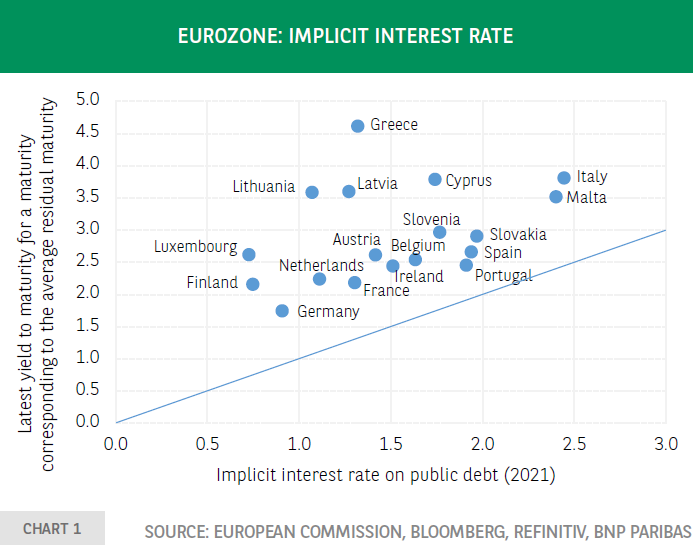
Chart 1 shows for several Eurozone countries the implicit interest rate on the outstanding government debt (horizontal axis) and the current interest rate on newly issued debt with the same maturity as the existing debt (vertical axis). All points are above the diagonal, which shows that the marginal borrowing cost -the interest rate on newly issued debt- is above the average borrowing cost -the rate on the existing debt. It implies that the marginal r-g is higher than the average r-g. Does this create an issue in terms of debt sustainability, thereby influencing how well we sleep at night?
Before focusing on the key factors, let’s recall that the dynamics of the public debt/GDP ratio depend on r-g and the primary balance, which corresponds to the budget balance excluding interest charges. The debt ratio (D/GDP) will be stable over a given period if the primary balance is equal to (r-g)*(D/GDP). When g > r, the government can afford to run a primary deficit and still have a stable debt ratio. When g<r, a primary surplus is required. An increase in the average interest rate (Δr) reduces the ‘affordable’ primary deficit by (Δr)*(D/GDP) or increases the required primary surplus to a similar extent.
The initial debt/GDP ratio thus plays an important role in the assessment of the impact of rising borrowing costs on the debt dynamics. The higher the debt ratio, the more corrective action will be necessary to keep it stable when confronted with higher interest rates. However, the longer the average maturity, the more the fiscal adjustment can be spread out over time. For a country with an initial, stable debt/GDP ratio of 120% and an average maturity of 10 years, a 1 percentage point increase in the average borrowing cost would require a fiscal adjustment effort of 1.2% of GDP over a period of 10 years, which corresponds to a small annual effort.
Author
BNP Paribas Team
BNP Paribas
BNP Paribas Economic Research Department is a worldwide function, part of Corporate and Investment Banking, at the service of both the Bank and its customers.