Riding the wave: Trading AUD, USD, GBP, and JPY in a shifting global landscape

Welcome, this report focuses on the AUD/USD, USD/CAD, and GBP/JPY, exploring the forces driving these pairs. We'll draw insights from recent data, central bank actions, and geopolitical developments. The Fed's surprise rate cut last week sent the USD tumbling and boosted commodity currencies. The BoE, however, took a more cautious path. These diverging monetary policies dominate current market narratives.
AUD/USD
This pair is popular with large institutional investors, commodity traders, hedge funds, and central banks seeking exposure to the Australian economy and commodity prices. Iron ore price swings often drive liquidity, with the AUD/USD showing a strong positive correlation.
RBA's hawkish stance vs China's slowdown
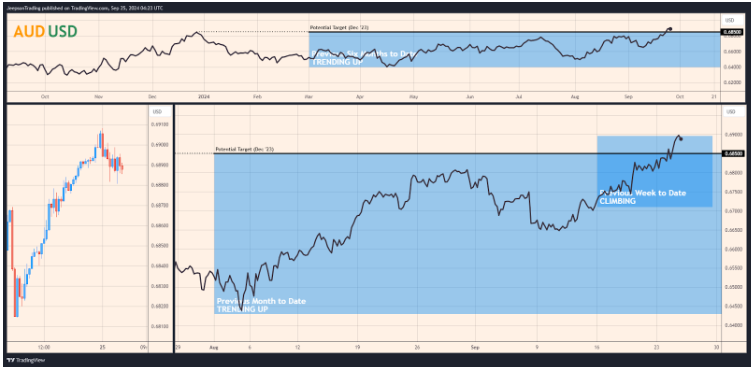
The AUD/USD pair is caught between the RBA's determination to fight inflation and China’s economic slowdown. On Tuesday, September 24th, the RBA held rates at 4.35% for the seventh straight meeting. Governor Bullock’s comments pointed to a data-dependent approach, reaffirming the central bank's hawkish stance. Despite easing to 2.7% in August, the RBA projects inflation to remain above target until 2026.
However, China’s slowdown poses a significant threat. Weakening demand from China, a major importer of Australian commodities, is impacting iron ore prices. China’s new stimulus measures announced Tuesday offered a temporary boost, but their effectiveness remains uncertain.
Climbing this week
The AUD/USD has been climbing this week, hitting a 2024 high of 0.691 on Tuesday.
If the Fed cuts rates again in October, as anticipated, it could further weaken the USD, boosting the AUD. The global risk-on mood and the AUD’s sensitivity to risk favour appreciation. But China's uncertain outlook poses risks.
Key indicators/events to watch
-
Tuesday, October 1st, Week 40: Judo Bank Manufacturing PMI Final (Australia). Forecast: 49.0. A reading below 50 could signal continued contraction in manufacturing, weighing on the AUD.
-
Tuesday, October 1st, Week 40: Retail Sales MoM (Australia). Forecast: 0.3%. Stronger-than-expected retail sales would suggest a pick-up in consumer spending, potentially supporting the AUD.
-
Thursday, 3rd October, Week 40: Balance of Trade (Australia). Forecast: AUD 8.20 billion. A wider-than-expected trade surplus could bolster the AUD.
USD/CAD
This pair is popular with institutional investors, corporations engaged in cross-border trade, and central banks. Oil price fluctuations and interest rate differentials are the main drivers of its liquidity. The USD/CAD typically has an inverse relationship with oil prices.
Oil prices and Fed easing weigh on USD/CAD
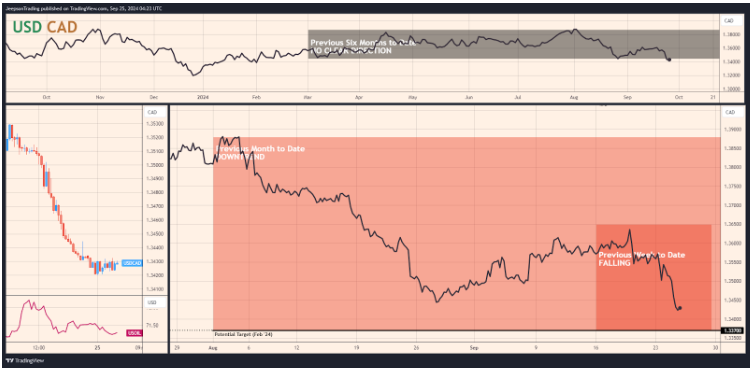
Two key themes have been influencing the USD/CAD pair: the surge in oil prices and the Fed's easing cycle. Escalating tensions in the Middle East and Hurricane Francine’s impact on US oil production have pushed both WTI and Brent crude prices higher. This has benefited the CAD, putting pressure on the USD/CAD.
The Fed's recent rate cut and expectations of more easing have also weighed on the USD/CAD. The initial rate cut sparked a risk-on rally and weakened the USD, but Chair Powell's remarks about future cuts have introduced uncertainty. If the Fed continues to cut aggressively, it could push the USD/CAD lower.
Continuing a monthly downtrend
The USD/CAD has dropped sharply this past week, hitting a four-week low of 1.342 on Tuesday. This continues the monthly downtrend, which began at 1.388 on August 1st.
The USD/CAD could continue to decline if the Fed keeps easing and oil prices remain high. Another Fed rate cut in October could further weaken the USD. Escalating tensions in the Middle East suggest sustained high oil prices, potentially pushing the USD/CAD towards 1.337.
Key indicators/events to watch
-
Friday, 27th September, Week 39: GDP MoM (JUL) - Canada. Forecast: 0.00%. A stronger-than-expected GDP figure could ease BoC rate cut expectations.
-
Friday, 27th September, Week 39: GDP MoM Prel (AUG) - Canada. Forecast: 0.10%. A positive figure could signal continued recovery, potentially supporting the CAD and weighing on the pair.
-
Friday, 4th October, Week 40: Non-Farm Payrolls (United States). Consensus forecast: 130K. A weaker-than-expected jobs report could fuel expectations of further Fed easing, potentially weighing on the USD.
GBP/JPY
This pair attracts carry traders, hedge funds, and institutional investors seeking to capitalise on the interest rate differential between the UK and Japan. Interest rate differentials, global risk sentiment, and economic data releases from both countries drive liquidity. The pair typically correlates positively with the UK's economic performance and inversely with safe-haven flows into the JPY.
Diverging monetary policy drives GBP/JPY uptrend
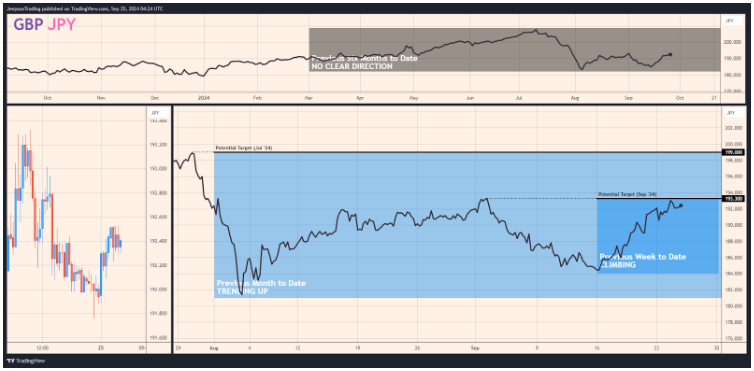
The GBP/JPY pair has been climbing, driven by diverging monetary policies. The BoE has maintained a cautious stance, holding rates at 5% in September, while the BOJ remains ultra-accommodative. This contrast has strengthened the GBP, making it attractive for carry trades.
Price action:Trending up, reaching multi-week highs
The GBP/JPY has been volatile recently but ultimately moved higher, reaching a three-week high of 191.965 on Tuesday. This aligns with the broader uptrend over the past month, with the pair rising from 187.668 on August 2nd.
The GBP/JPY could continue its uptrend due to the GBP's attractiveness as a carry trade currency and the BOE’s stance.
The GBP/JPY is vulnerable to a dovish BoE shift and a surge in risk aversion. Should UK data disappoint, the BoE might reconsider its stance. A sharp rise in global risk aversion, perhaps due to escalation in the Middle East, could drive investors towards the JPY.
If the BoE turns dovish and geopolitical tensions escalate, the GBP/JPY could face a correction, potentially targeting 189.000 in the upcoming month. However, the current monetary policy divergence and the GBP's appeal as a carry trade currency might limit the downside.
Key Indicators/events to watch
-
Thursday, 26th September, Week 39: BOJ Monetary Policy Meeting Minutes (Japan). Hawkish comments from the BOJ could support the JPY and weigh on the GBP/JPY.
-
Monday, 30th September, Week 39: GDP Growth Rate QoQ Final (United Kingdom). Forecast: 0.6%. Weaker-than-expected GDP could increase the likelihood of a BoE rate cut, potentially impacting the GBP/JPY negatively.
-
Tuesday, 1st October, Week 40: Unemployment Rate (AUG) - Japan. A higher unemployment rate could dampen BOJ rate hike expectations, potentially supporting the GBP/JPY.
Concluding remarks
Central bank policies are in the spotlight, shaping the forex market. The Fed's aggressive easing has weakened the USD, creating opportunities for currencies like the AUD and GBP. However, uncertainties surrounding global growth, China's slowdown, and geopolitical risks are contributing to ongoing volatility.
Sources
-
Bank of England.
-
Office for National Statistics.
-
Trading Economics.
-
BRC - British Retail Consortium.
-
Confederation of British Industry.
-
GfK Group.
-
S&P Global.
-
Nationwide Building Society.
-
Office for Budget Responsibility.
-
Eurostat.
-
US Bureau of Labor Statistics.
-
Federal Reserve.
-
Reserve Bank of Australia.
-
Australian Bureau of Statistics.
-
Australian Government.
-
Westpac Banking Corporation.
-
.Melbourne Institute.
-
National Australia Bank.
-
CoreLogic.
-
Bank of Canada.
-
Statistics Canada.
-
Department of Finance Canada.
-
Bloomberg.
-
Reuters.
-
OECD.
-
IMF.
Author

Gavin Pearson
Independent Analyst
Gavin Pearson of Jeepson Trading is a currencies speculator from the UK focused on the G7 economies and is a recognized member of the eToro Popular Investor Program as well as being a funded prop trader with The 5%ers.