Chinese investment demand was resilient in Q2 despite rangebound prices

Despite gold trading sideways in the second quarter after its big price correction in the first, Chinese physical gold investment demand remained robust.
Chinese investors were key drivers of the gold bull market last year, as Western investors generally sat out the rally until the end of the year.
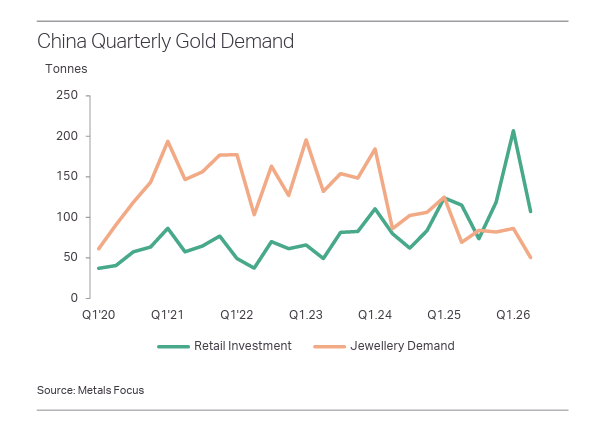
At 107 tonnes, Chinese retail gold investment fell by 48 percent quarter-on-quarter in Q2, and 7 percent year-on-year. However, the data was skewed by an all-time high of 207 tonnes in Q1.
Even with the steep drop in demand from the first quarter, second-quarter Chinese physical investment gold demand was strong from a historical perspective, ranking as the third-highest Q2 since 2010.
When you factor in the 29 percent year-over-year increase in the local gold price, Chinese retail gold investment demand set a second-quarter record.
Through the first half of 2026, retail gold investment demand was up 31 percent.
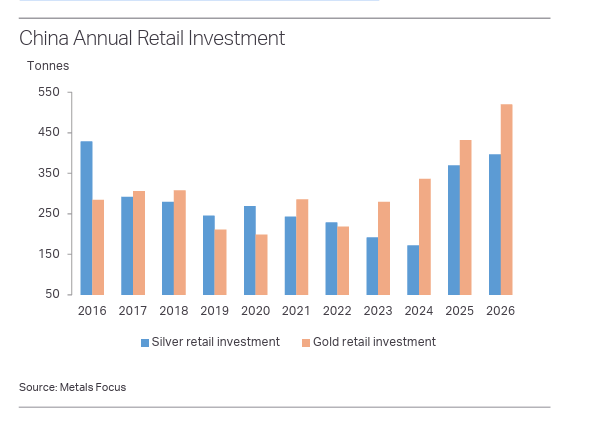
According to Metals Focus, investment gold buying was primarily concentrated in April and the first weeks of May. Despite slowing from the exceptional levels seen in Q1, volumes during this period remained healthy on an annual basis.
Demand slipped in the latter half of May and into June, as a range-bound gold price weakened sentiment. Investors pivoted to riskier domestic AI-related equities.
Metals Focus analysts noted that “given the sharp price declines across the major precious metals during Q2, physical investment generally softened.”
“Nevertheless, gold outperformed both silver and platinum, highlighting its relative resilience.”
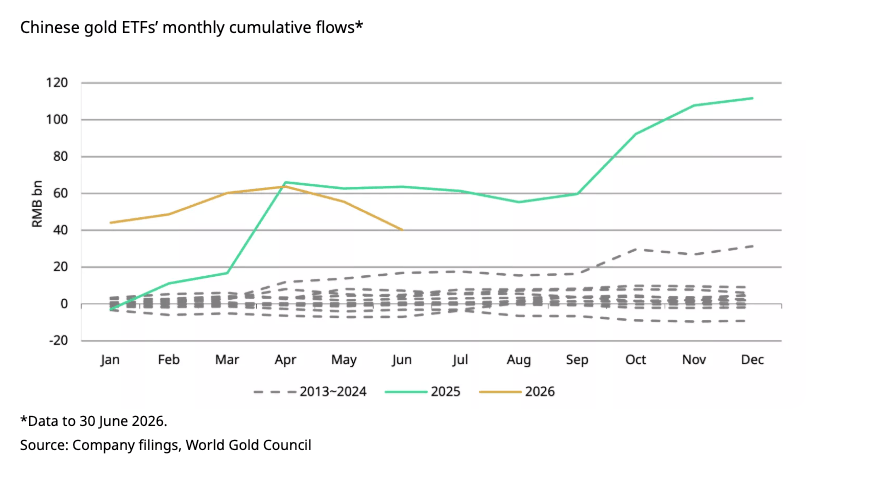
While Chinese investors tend to favor physical metal, ETF flows also reflected strong investment demand.
Despite a large outflow of gold in June, Chinese ETFs added 29 tonnes of metal in H1, the second-strongest start to a year on record. Total assets under management (AUM) rose slightly by 1 percent.
Meanwhile, interest in Gold Accumulation Plans (GAPs) offered by local commercial banks remained solid in Q2 despite a moderate slowdown.
Tax incentives and disincentives driving Chinese precious metals markets
New Value Added Tax (VAT) rules imposed last November helped boost gold investment relative to other metals. Under the rules, gold bars and coins sold by Shanghai Gold Exchange (SGE) member companies remained exempt from VAT. However, silver and platinum bars and coins, along with gold investment products sold by non-SGE members, are subject to 13 percent VAT on their full value.
According to Metals Focus, the new policy left non-SGE members at a price disadvantage, incentivizing them to switch their focus from gold to silver bars.
“Silver’s rally to a series of record highs, marketing campaigns highlighting its favorable fundamentals, and its lower unit value for investors priced out of gold all contributed to a dramatic surge in silver bar sales during late 2025. This momentum extended into Q1.26, resulting in widespread product shortages, longer delivery times and higher premiums.”
However, silver demand slipped as the price fell earlier this year. That incentivized many Johnny-come-lately silver bar suppliers to flip back to gold.
“Online stores and retailers now serve as sales agents for SGE-member companies, earning commissions on gold bar sales, while manufacturers produce gold bars for SGE members under a processing model whereby only labor costs are charged.”
VAT rules have also shifted Chinese demand from investment jewelry to gold bars.
“While gold retail investment remains VAT-free, consumers now effectively pay an additional VAT charge of around 7 percent on gold jewelry. Historically, a relatively large proportion of Chinese gold jewelry purchases have been driven by quasi-investment motives. The policy change has been particularly detrimental to heavy, plain 24K gold jewelry, which is typically sold by weight and carries relatively low labor charges. As a result, Q2.26 marked the third consecutive quarter in which retail investment exceeded jewelry consumption.”
Looking ahead
As we move through the final half of 2026, Metals Focus expects Chinese gold demand growth to continue at a moderately slower pace. The forecast is for a 20 percent year-on-year increase to around 500 tonnes.
“The slower pace of growth in H2.26 partly reflects the already elevated base established last year. Gold’s growing appeal as a store of value and safe-haven asset, our constructive price outlook, the sentiment boost from the PBoC’s gold reserve accumulation program, the ongoing shift from quasi-investment jewelry to gold bars, and aggressive supply chain marketing of investment products are expected to remain the key demand drivers.”
Chinese investors were a key pillar of support during last year's gold bull market.
Gold coin and bar demand hit a 12-year high of 1,374.1 tonnes in 2025 with a record-breaking value of $154 billion. More than half of that global coin and bar demand came from two countries – China and India.
Chinese investment demand has continued to provide support even after the gold price corrected and struggled against headwinds caused by the U.S.-Iran war and worries about rising interest rates.
To receive free commentary and analysis on the gold and silver markets, click here to be added to the Money Metals news service.
Author

Mike Maharrey
Money Metals Exchange
Mike Maharrey is a journalist and market analyst for MoneyMetals.com with over a decade of experience in precious metals. He holds a BS in accounting from the University of Kentucky and a BA in journalism from the University of South Florida.

















