Reserve Bank of Australia Preview: The waiting game could hit the aussie hard
- The Reserve Bank of Australia is likely to keep the key rate on hold at 0.10%.
- Australia’s wage price growth not enough to endorse a near-term rate hike.
- RBA’s cautious stance could hit AUD/USD hard but reaction to be limited.

An interest rate hike in Australia this year is “plausible,” Reserve Bank of Australia (RBA) Governor Philip Lowe said last month. But not so fast, as the central bank is likely to play the waiting game when it meets to decide on its monetary policy on Tuesday, April 5, at 0430 GMT. Uncertainty around the Ukraine crisis, minor signs of wage inflation and the May Federal election are some of the key factors that could lead the RBA to maintain its cautious stance.
Growth in wage inflation not enough
The Australian central bank is likely to keep the Official Cash Rate (OCR) on hold at a record low of 0.10% during its April meeting.
Having gradually walked back on its pledge of no rate rise before 2024, the RBA still remains in a patient mode after highlighting that the war in Ukraine is a major new source of uncertainty in its March policy announcements.
The central bank’s stance is unlikely to change this time around, as it may continue to remain data-dependent, waiting for signs of wage inflation before responding to broad inflationary pressures.
Australian wages inflation accelerated to 2.3% YoY in the fourth quarter of 2021 amid a tightening labor market. The annual wage price growth, however, was much below the 3% target that policymakers set before pulling the rate hike plug.
It’s worth noting, the RBA’s preferred core inflation surged by 1.0% in the last quarter, registering the largest increase since 2008. Meanwhile, Australia’s Unemployment Rate hit the lowest in 13 years in February, arriving at 4.0%.
Even though the economy remains on a solid footing, the central bank Chief Lowe was clear enough, during his speech at an event honoring journalists on March 22, that the RBA “will not respond until there is evidence of pervasive price pressures.”
Adding to it, Lowe and Co. would want to wait to see the inflationary impact of the latest federal budget announced by Treasurer Josh Frydenberg on March 29. The Australian government pledged billions in fuel tax cuts, cash giveaways and public works spending on Tuesday as it sought voter support ahead of the May election. The RBA would also think it’s appropriate to refrain from pulling the trigger before the polls, which is seen as ‘quite tough’ for the current government.
Money market traders are pricing in a rate rise to 0.25% as early as June, with the rates seen climbing to 1.50% by year-end.
Ahead of the policy meeting, the Australian government appointed Michele Bullock as the new deputy governor of the central bank, replacing Guy Debelle, who resigned from the central bank early in March. The RBA’s policy-setting board is now filled.
AUD/USD technical outlook
The Australian dollar has stood quite resilient to the central banks’ divergence theme when compared to its G10 peers, in the face of the Russia-Ukraine war-driven surge in commodities prices.
With China’s economic slowdown concerns back to the fore, however, aussie bulls are losing the upside conviction. AUD/USD is struggling to resist above the 0.7500 level heading towards the RBA showdown next Tuesday.
Only a strong hawkish pivot from the RBA could lead the pair to break through the critical horizontal trendline resistance on the daily chart at 0.7557, which is the level last seen in late October 2021. Dovish forward guidance will knock down AUD/USD towards the bullish 21-Daily Moving Average (DMA) at 0.7395.
The reaction in the AUD/USD pair could be also influenced by the risk tone prevalent at the time of the central bank decision.
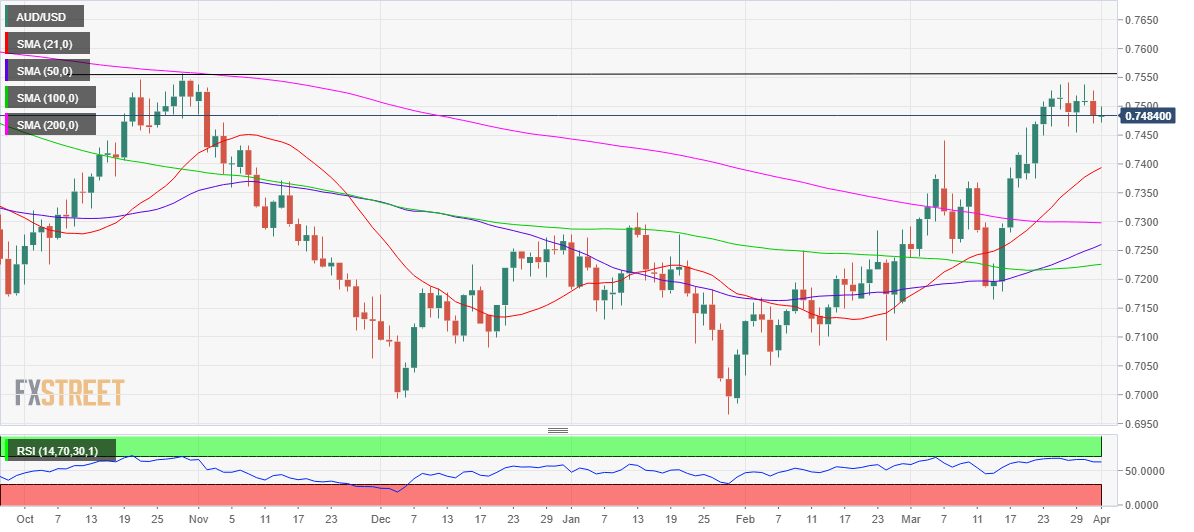
AUD/USD: Daily chart
Author

Dhwani Mehta
FXStreet
Residing in Mumbai (India), Dhwani is a Senior Analyst and Manager of the Asian session at FXStreet. She has over 10 years of experience in analyzing and covering the global financial markets, with specialization in Forex and commodities markets.