|

Reserve Bank of Australia Preview: How aggressive can it be?

  • The RBA will likely increase the cash rate by 50 basis points.
  • Australian inflation continues to rise in the second quarter of the year.
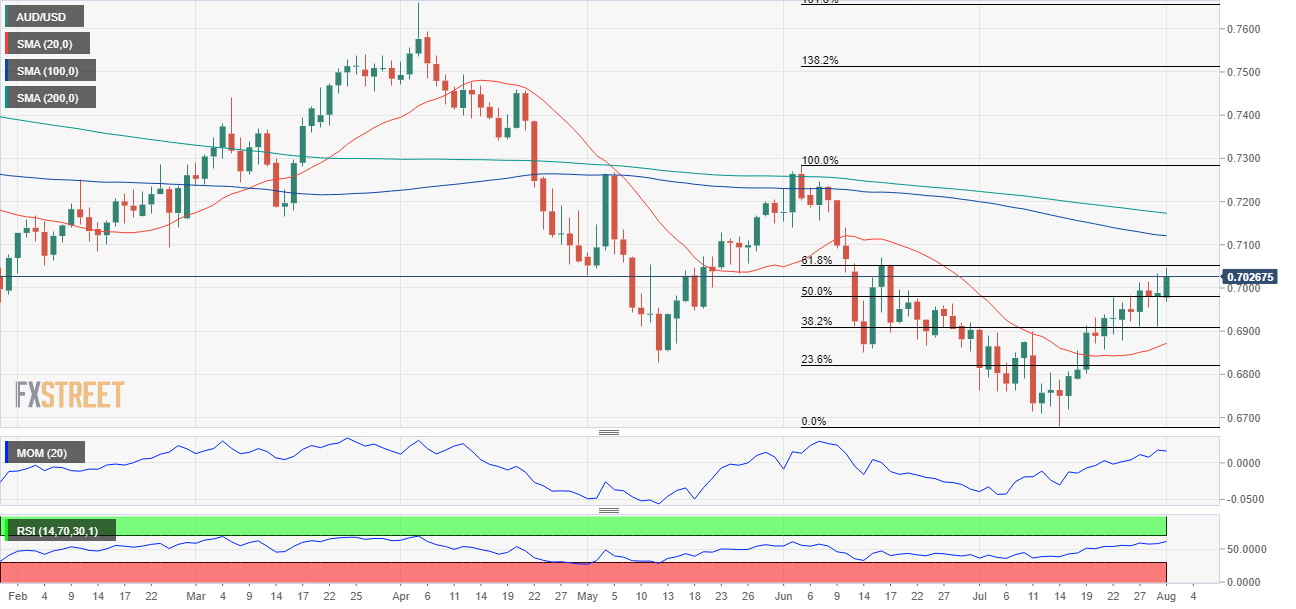
  • AUD/USD is technically bullish and near a critical Fibonacci resistance level.

The Reserve Bank of Australia will announce its monetary policy decision on Tuesday, August 2. Market participants anticipate another 50 bps cash rate hike. The central bank has accelerated the pace of tightening in June and has already hiked 125 bps this year, bringing the key rate to the current 1.35%.

Australian policymakers noted in their July statement that the cash rate’s current level is “well below” what they consider a neutral one, which should be “at least” 2.5%. Nevertheless – and along with many other central banks – the RBA is juggling to contain inflation without restricting economic growth. The annual inflation rate rose by 6.1% in the second quarter of the year from 5.1% in Q1. It was slightly below-expected but still on the rise.

It seems unlikely that the central bank will hike by 75 bps, but there are some chances of a 25 bps movement. Policymakers could turn cautious considering the impact higher rates may have on household spending, slowing further economic activity.

AUD/USD possible scenarios

A smaller-than-anticipated hike should have a negative impact on the Australian dollar, sending AUD/USD sharply lower, particularly if the market sentiment deteriorates ahead of the announcement. A 75 bps hike, on the other hand, could fuel gains towards the 0.7100 figure. Whether gains will be sustainable or if the rally will be seen as a selling opportunity will depend on investors’ perception of risk.

From a technical perspective, AUD/USD heads into the release with a bullish bias. The pair has neared the 61.8% retracement of its latest daily slide between 0.7282 and 0.6680 at 0.7050, the immediate resistance level ahead of the 0.7100 figure. A break through the latter will require a quite hawkish RBA hinting at an aggressive path ahead.

A move below 0.6990, on the other hand, will open the door for a slide towards 0.6910, the 38.2% retracement of the aforementioned decline.
Author

Valeria Bednarik

Valeria Bednarik was born and lives in Buenos Aires, Argentina. Her passion for math and numbers pushed her into studying economics in her younger years.


More from Valeria Bednarik
Share:

Editor's Picks

AUD/USD defies Iran war jitters as RBA hike bets double

The Australian Dollar rallies for the fourth straight day against the US Dollar as market mood remains positive amid high tensions in the Middle East, pointing to a resumption of hostilities, as reported by recent news. Despite this, the AUD/USD trades at 0.7027, up 0.44%.

USD/JPY remains confined in a familiar range below 158.50

USD/JPY sees some dip-buying in the Asian session on Wednesday, though it remains confined within a multi-week range near 158.50 as the uncertainty over the timing of the next BoJ rate hike keeps Japanese Yen bulls on the defensive. Meanwhile, hawkish Fed expectations, bolstered by inflation risks stemming from volatile oil prices, underpin the US Dollar. However, looming intervention fears could limit JPY losses and cap the currency pair.

Gold advances modestly; targets $4,150

Gold prices manage to reverse three consecutive daily declines, trading just below the $4,150 mark per troy ounce on Wednesday. The precious metal’s recovery comes amid a slight drop in the US Dollar, mixed US Treasury yields across the board and a widespread cautious tone from the US-Iran front.

Dogecoin Labs launches, resistance looms
Dogecoin (DOGE) Labs launched Wednesday in partnership with the Dogecoin Foundation, bringing together several product teams and technologies to expand the use of the memecoin (DOGE) across payments, decentralized finance (DeFi) and consumer applications. The launch will consolidate MyDoge, DogeOS and Such App under one business, led by Jordan Jefferson, founder of MyDoge and DogeOS.
What the midterm elections mean for Treasury yields, the Dollar and Gold
Democrats are priced to take the House, so November 3 comes down to the Senate and how much Washington can borrow without the other party. Treasury yields will show the answer first, then the Dollar and Gold. On November 3, Americans vote for all 435 House seats and 35 Senate seats. For bond prices, the result comes down to one thing: how much the government will borrow over the next two years.
The US Dollar fell. Gold didn't rally. That tells you everything
Gold (XAU/USD) is struggling to capitalize on a weaker US Dollar (USD), after repeatedly failing to establish itself above the $4,200 level. The precious metal remains confined to a relatively narrow trading range despite a combination of developments that would normally support higher prices.