Reserve Bank of Australia Preview: Hinting toward an end to its rate hike cycle?
- Reserve Bank of Australia is set to hike OCR by another 25 bps to 3.1% in December.
- The central bank will be on a natural pause until the February meeting.
- AUD/USD could test 200-DMA resistance should RBA disappoint the doves.

The Reserve Bank of Australia (RBA) is on course to hike rates for the eighth consecutive month when the board members meet on December 5. The central bank will announce the interest rate decision at 03:30 GMT, with markets predicting that the RBA could be close to the end of its rate hike cycle.
All eyes on RBA’s future path
A majority of the economists foresee the RBA raising the Official Cash Rate (OCR) by 25 bps from 2.85% to 3.10% at its December policy meeting, summing up to a total of 300 bps in rate increases in eight months.
However, RBAWatch shows about a 30% probability of the central bank not announcing any change to its OCR this month. According to the Reuters poll, the median expectation is for a 3.60% terminal rate, although some industry experts suggest that Tuesday’s hike will be the last in the RBA’s tightening cycle.
Participating in a panel discussion titled "Growth and Inflation Dynamics" at the Bank of Thailand 80th Anniversary Conference last Friday, the RBA Governor Philip Lowe said that the central bank’s decision to downshift reflects monetary policy lags.
That said, there will be a natural pause until the RBA’s meeting in February, as the bank does not hold the policy meeting in January. This break will allow them to assess the impact of the policy tightening, thus far.
Therefore, Tuesday’s policy statement will be closely scrutinized for hints on whether the RBA will continue its rate-hike track early next year. Even though the Australian Consumer Price Index (CPI) hit 7.3% in the July-September period, the highest since 1990, the slowdown in the October CPI rate to 6.9%, hinted at possible peak inflation. Markets are expecting the RBA to take note of easing inflationary pressures, with all eyes now focused on any changes to this statement - “the Board expects to increase interest rates further over the period ahead.”
China’s shift toward Covid reopening could also ease concerns over the supply bottlenecks, alleviating further pressure on the RBA from the inflation perspective.
Trading AUD/USD with the RBA
AUD/USD is sitting at the best levels seen since September near 0.6850 as we head toward Tuesday’s RBA policy announcements. Dovish Fed outlook and China’s reopening optimism have fuelled the latest uptrend in the Aussie pair.
If the central bank surprises with a less than 25 bps rate increase or delivers a 25 bps hike with cues on an end to its tightening cycle, it would be an outright dovish move, taking the wind out of AUD/USD’s ongoing bullish momentum. In such a case, the currency pair could fall back toward the December 2 low at 0.6742.
Further south, the confluence of the 21- and 100-Daily Moving Averages (DMA) at 0.6685 will come to buyers’ rescue. The 14-day Relative Strength Index (RSI) holds firmer above the midline, providing credence to the bullish potential.
Should the RBA’s policy guidance hint at future rate increases, it will be seen as a hawkish rate hike and would offer additional legs to the northward journey in AUD/USD. Bulls could drive the pair toward the 200-DMA at 0.6921 on a sustained move above the 0.6900 barrier.
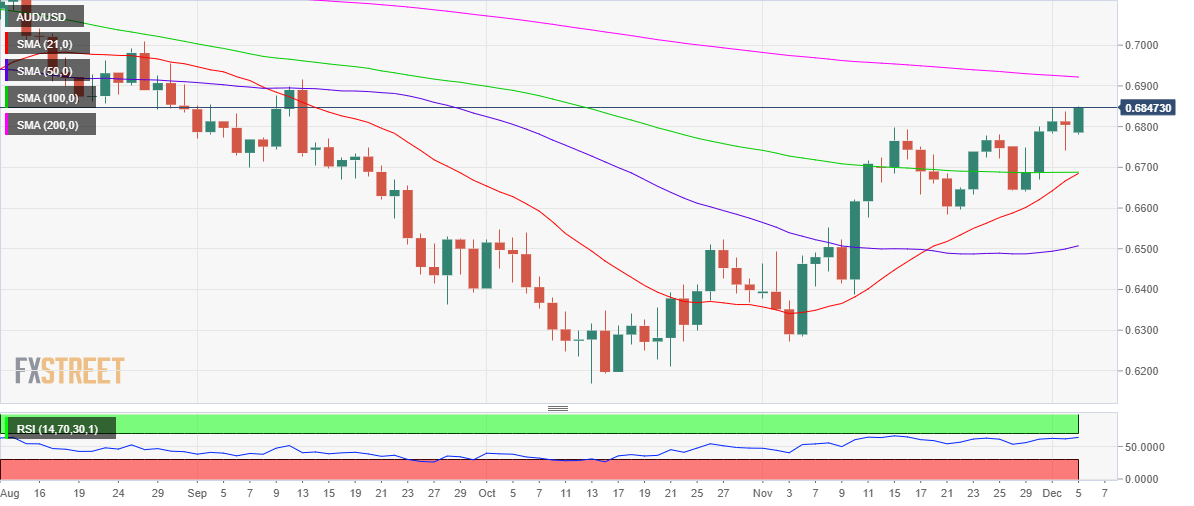
AUD/USD: Daily chart
Author

Dhwani Mehta
FXStreet
Residing in Mumbai (India), Dhwani is a Senior Analyst and Manager of the Asian session at FXStreet. She has over 10 years of experience in analyzing and covering the global financial markets, with specialization in Forex and commodities markets.