Q1 productivity: Ignore the quarterly chop – Trend favorable for inflation

Summary
The latest productivity report is not as discouraging as viewing the quarterly prints in isolation would suggest. Slower growth in Q1 paired with a pickup in hiring and hours worked led productivity growth to nearly stall in Q1 (+0.3% annualized), while unit labor costs (ULCs) strengthened to a 4.7% annualized rate. However, the unfavorable outturns for both productivity and ULCs are reminiscent of the first quarter of 2022 and 2023, hinting at some difficulty in fully accounting for seasonality in the data.
When measured over the past year, nonfarm productivity growth is up 2.9%, the strongest gain in three years. Unit labor cost growth, which can be viewed as the productivity-adjusted cost of labor, increased just 1.8% over the past year. The downward trend in ULCs points to inflationary pressure from the jobs market continuing to subside and is supportive of inflation resuming its downward trend later this year.
Taking a breather
Nonfarm labor productivity growth nearly stalled out in the first quarter. Output per hour worked increased at an annualized rate of 0.3%, a sharp slowdown from the prior quarter's 3.5% rise (chart). Robust hiring and soft real GDP growth over Q1 presaged the outturn.
This is not the first time productivity growth has eased considerably in Q1 and undershot expectations. The pattern follows weaker-than-expected output and stronger-than-expected job growth in the first three months of the year. These seasonal dynamics have obscured the view of productivity's sequential growth rates at the turn of the calendar, thus we often look to annual comparisons to gauge the underlying trend. Relative to Q1-2023, labor productivity is up 2.9%, or the strongest annual gain in three years. The year-ago change has steadily ticked higher over the past four quarters, indicating a solid pace of expansion. For context, labor productivity expanded at a 1.5% average annual rate during the 2007-2019 business cycle.
Amid the softer gain in productivity and another strong quarter for hourly compensation growth (+5.0% annualized), unit labor costs (ULCs) picked up to a 4.7% annualized rate in the first quarter. Unit labor costs can be viewed as the productivity-adjusted cost of labor, making it a useful gauge of the extent to which the nominal pace of compensation growth is problematic (or not) for the Fed's 2% inflation objective. While today's reading is on its own yet another unfriendly print for the Fed's efforts to corral inflation, the jump is reminiscent of the first quarters of 2022 and 2023 when ULCs also leapt, hinting at the possibility of residual seasonality in both productivity and compensation data (chart).

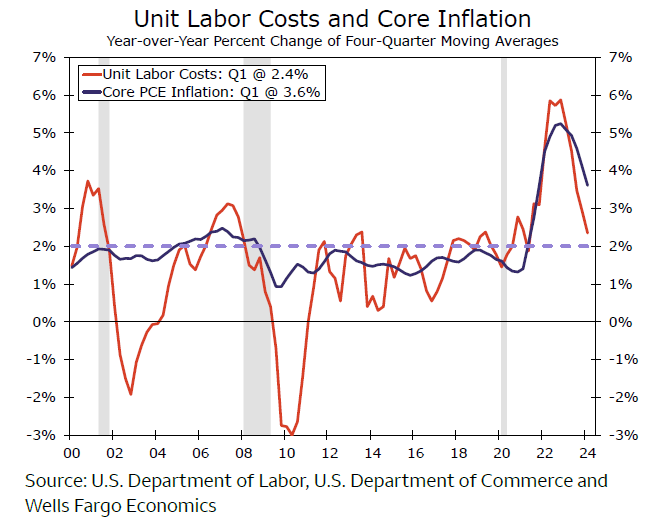
Taking a slightly longer view shows a less worrying picture. Over the past year, unit labor costs are up 1.8%. Smoothing out the inherent choppiness of this report's data a little more and looking at the year-ago change in the four-quarter average of ULCs also shows the inflationary pressure coming from labor costs continues to subside (chart). While, overall, labor costs are still making it difficult for inflation to return to 2% on a sustained basis, the improving trend in productivity is supportive of inflation resuming its downward path ahead.
Author
Wells Fargo Research Team
Wells Fargo