Price inflation heating up based on June CPI

Based on the latest Consumer Price Index (CPI) data, prices showed signs of creeping higher in June. However, there were enough dovish points in the data to support those pushing for looser monetary policy.
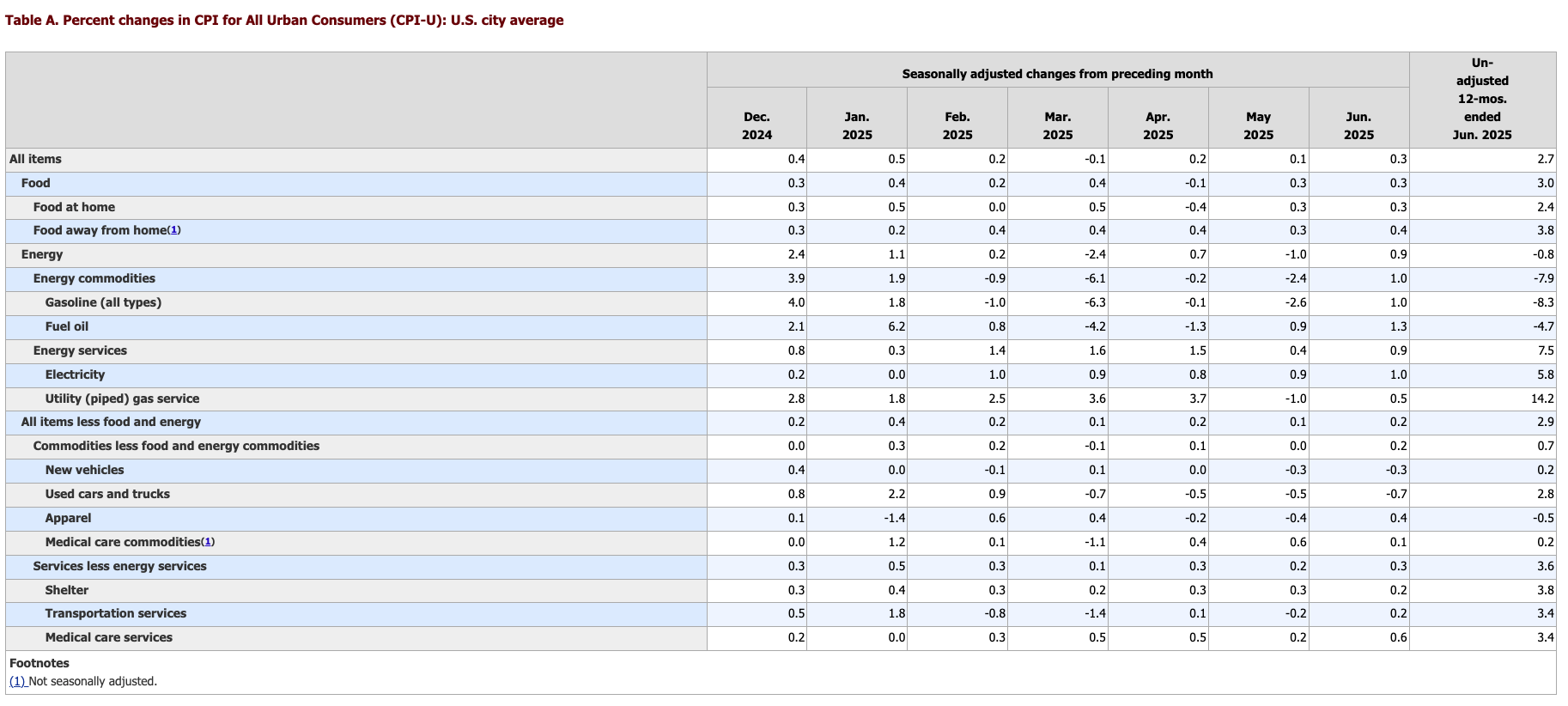
The headline annual CPI spiked from 2.4 percent in May to 2.7 percent in June, according to the latest data from the BLS. That was slightly above the 2.6 percent expectation.
On a monthly basis, prices rose 0.3 percent in June, in line with projections. That follows a 0.1 percent rise in prices in May. That monthly CPI number annualizes to 3.6 percent.
Stripping out more volatile food and energy prices, core CPI came in better than expected, rising 0.2 percent month-on-month. The projection was for a 0.3 percent rise. On an annual basis, core CPI was 2.9 percent, in line with expectations and the same as the May number.
As you parse the data, keep in mind that the CPI doesn’t tell the entire story of inflation. The government revised the CPI formula in the 1990s so that it understated the actual rise in prices. Based on the formula used in the 1970s, CPI is closer to double the official numbers. So, if the BLS used the old formula, we’d be looking at CPI closer to 6 percent. And using an honest formula, it would probably be worse than that.
However, this is the formula the government uses, and it drives decision-making.
It is also important to note that a federal government hiring freeze has reportedly stretched the BLS thin, and the agency recently reduced data collection and expanded a process known as “imputation,” which uses modeling to fill in incomplete data. In April, the BLS announced it was “reducing sample in areas across the country” and suspended data collection in Lincoln, Nebraska; Provo, Utah; and Buffalo, New York.
Looking deeper into the May BLS data, food prices rose 0.3 percent in June. On an annual basis, food prices are up 3 percent for the year.
Tariff-sensitive apparel prices spiked by 0.4 percent, indicating some price pressure from the trade war. Household furnishing prices also surged, rising by 1 percent month-on-month. However, new vehicle prices fell by -0.3 percent.
Service prices, which are less impacted by tariffs, were also up, rising 0.3 percent month-on-month. Service prices have risen by 3.6 percent in the past year.
Energy prices rose 0.9 percent month-on-month, driven by a 1 percent hike in gasoline prices, driven at least in part by a surge in oil prices during the brief hostilities between Israel and Iran.
Shelter costs continued to moderate as the weak housing market drove down home prices. However, shelter costs still rose 0.2 percent month-on-month in June.
How do they spin this?
How you interpret the data will likely depend on your political bent.
The financial media called it a “mixed” report. CNBC led its report writing, “Consumer prices rose in June as President Donald Trump’s tariffs began to slowly work their way through the U.S. economy." Most mainstream headlines emphasized tariffs and their impact on prices.
However, while tariffs can raise a lot of prices, and that will show up in CPI, customs duties do not cause “inflation” properly defined. Only one thing raises the general price level (all prices) in an economy – that is, an expansion of money and credit.
Henry Hazlitt is best known for his brilliant book Economics in One Lesson. In another essay titled “Inflation in One Page,” he explained why using a more precise definition of inflation is crucial.
“Inflation is an increase in the quantity of money and credit. Its chief consequence is soaring prices.
“Therefore inflation—if we misuse the term to mean the rising prices themselves—is caused solely by printing more money. For this, the government’s monetary policies are entirely responsible.” (Emphasis added)
While the Federal Reserve tightened monetary policy enough to rein in rising prices, it never did enough to slay the inflation dragon. In fact, inflation (properly defined as an increase in the money supply) has been going up for over a year.
On the other side of the coin, President Trump and those pushing for rate cuts can point to the core CPI data and plausibly argue that price inflation remains muted. While there are signs that price inflation is heating up, it remains cool compared to the numbers were were seeing a year ago.
Even if one can make a plausible argument for rate cuts based on the CPI, it's important to remember that it is actually a push to increase inflation.
Given the fact that the money supply is expanding, and financial conditions are loose from a historical standpoint, caution in cutting is warranted. Just taking the CPI at face value should signal caution. After all, none of the metrics are at the mythical 2 percent target.
However, President Trump and others pushing for rate cuts aren’t wrong either.
A higher interest rate environment will eventually crack the debt-riddled economy and pop the bubbles. The economy needs its easy money drug. However, a few good CPI reports notwithstanding, inflation is far from dead.
So, the central bank needs to simultaneously keep rates higher for longer and cut rates. That’s quite a Catch-22, and this CPI report won’t make the decision-making any easier.
To receive free commentary and analysis on the gold and silver markets, click here to be added to the Money Metals news service.
To receive free commentary and analysis on the gold and silver markets, click here to be added to the Money Metals news service.
Author
Mike Maharrey
Money Metals Exchange
Mike Maharrey is a journalist and market analyst for MoneyMetals.com with over a decade of experience in precious metals. He holds a BS in accounting from the University of Kentucky and a BA in journalism from the University of South Florida.