Price inflation accounts for entire increase in Retail Sales since pandemic

Do you feel like you spend more and more money every month but get less and less for it?
That’s because you are.
As talking heads on mainstream financial networks point to ever-increasing retail sales (May data notwithstanding) and gush about the “health of the American consumer,” Joe Main Street is spending hand over fist to keep up with rising prices.
In fact, we can account for virtually the entire increase in retail sales in the United States since April 2021 by price inflation.
Retail sales increased rapidly as the country emerged from the government-imposed pandemic lockdowns. By mid-2020, they had climbed from a pandemic low of under $400 trillion to pre-pandemic levels around $500 trillion. Retail sales rapidly surged from there. By the spring of 2021, retail sales were up to $575 trillion. Media reports touted the surge in consumer spending, lauding it as a sign of a recovering economy.
It was also the foreshadowing of something much more sinister.
Inflation.
As Federal Reserve Chairman Jerome Powell insisted inflation was “transitory,” retail sales continued to march higher. But in July 2021, they were over $600 trillion, and they continued to climb steadily higher in the subsequent months.
In May, retail sales were $715.4 billion. Since July 2021, retail sales have increased by a healthy 15.9 percent.
But when you adjust retail sales for price inflation, an entirely different picture emerges. In real terms, sales flatlined in April 2021 and have remained rangebound between $550 trillion and $575 trillion ever since.
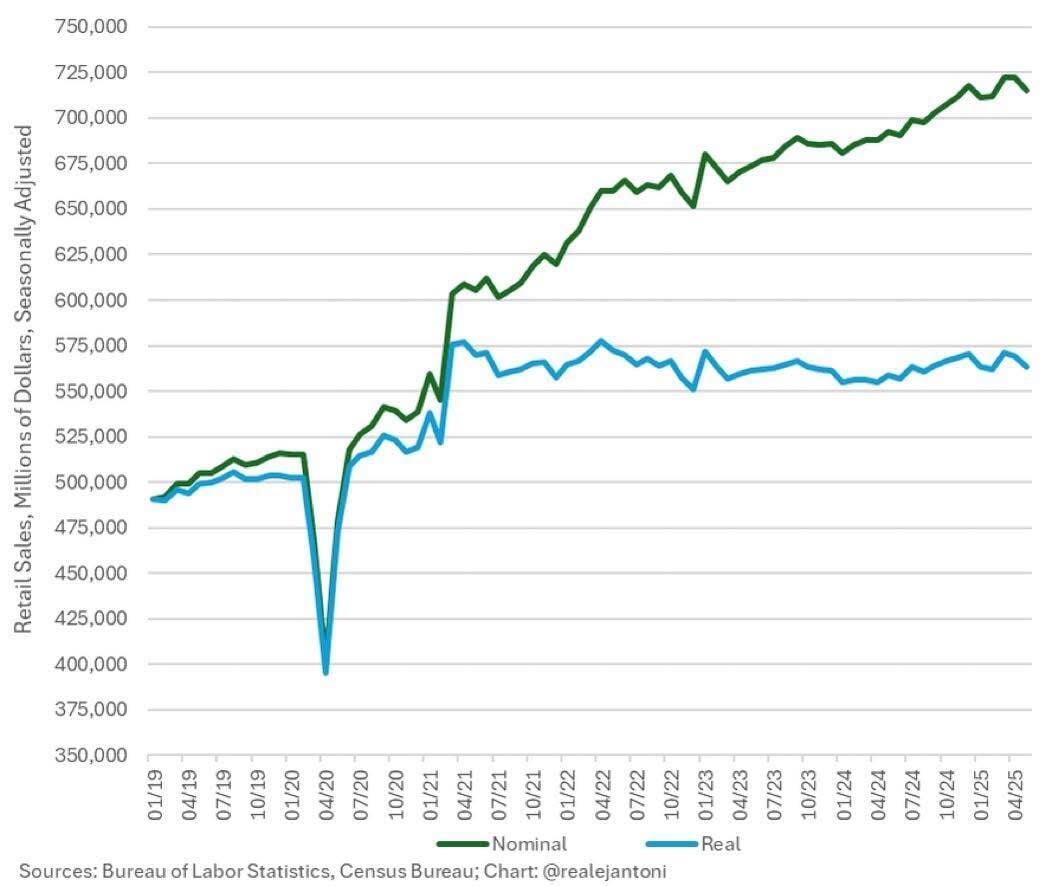
So, while American consumers have spent more month after month for the last four years, they have been purchasing roughly the same amount of stuff. That big 15 percent-plus increase in retail sales is nothing more than a reflection of rising prices.
The reality of Retail Sales
Most people reflexively assume an increase in retail sales means consumers bought more goods and services. But that’s just one side of the coin. Retail sales data not only reflect the amount of goods and services sold; they also capture changes in prices.
Retail sales are calculated by multiplying the price of goods by the quantity sold (Sales = P × Q). These figures are not adjusted for inflation. As a result, if prices rise while the volume of goods and services remains constant, retail sales data will still show an increase. In fact, retail sales can rise even when fewer goods are sold – if prices increase enough.
For instance, let's say a widget costs $1. If consumers purchased 100 widgets last month, retail sales were $100 (1x100=100). Now let's say the price increases to $2 this month. Due to the higher price, consumers only purchased 60 widgets. Retail sales would increase to $120 (2x60=120). The news would report that retail sales rose by 20 percent. Talking heads on CNBC would gush about how well consumers are doing.
But in reality, consumers did a lot worse.
They paid more and bought less.
American consumers have faced this ugly reality for nearly four years now.
And keep in mind, the situation is worse than the data indicates because the government revised the CPI formula in the 1990s so that it understates the actual rise in prices. Based on the formula used in the 1970s, CPI is closer to double the official numbers.
All of this underscores the pain of price inflation. It steals your purchasing power. Thanks to the ever-devaluing dollar, you have to work harder and harder just to maintain your standard of living. This is precisely why so many people find it impossible to get ahead.
To receive free commentary and analysis on the gold and silver markets, click here to be added to the Money Metals news service.
To receive free commentary and analysis on the gold and silver markets, click here to be added to the Money Metals news service.
Author
Mike Maharrey
Money Metals Exchange
Mike Maharrey is a journalist and market analyst for MoneyMetals.com with over a decade of experience in precious metals. He holds a BS in accounting from the University of Kentucky and a BA in journalism from the University of South Florida.