Pound rally at risk as US inflation could restore the Dollar’s advantage
The pound is being supported by a weaker US dollar and expectations of tighter Bank of England policy.
The Bank of England remains cautiously hawkish. Markets continue to see scope for further rate hikes to curb inflation, although BoE Chief Economist Huw Pill has questioned the need for tightening on the scale expected by some market participants.
The IMF expects UK GDP to grow by 1.3% in 2026 but warns that high energy prices and borrowing costs could hold back the economy.
The budget announcement on 28 October could cause additional volatility for the pound, particularly if the government’s plans add to concerns over government borrowing.
The short-term backdrop is moderately favourable for the pound as the US dollar weakens. At the same time, if US inflation comes in above both forecasts and previous readings, this could shift the advantage back towards the dollar, while UK budget risks are limiting sterling’s upside potential.
Technical analysis
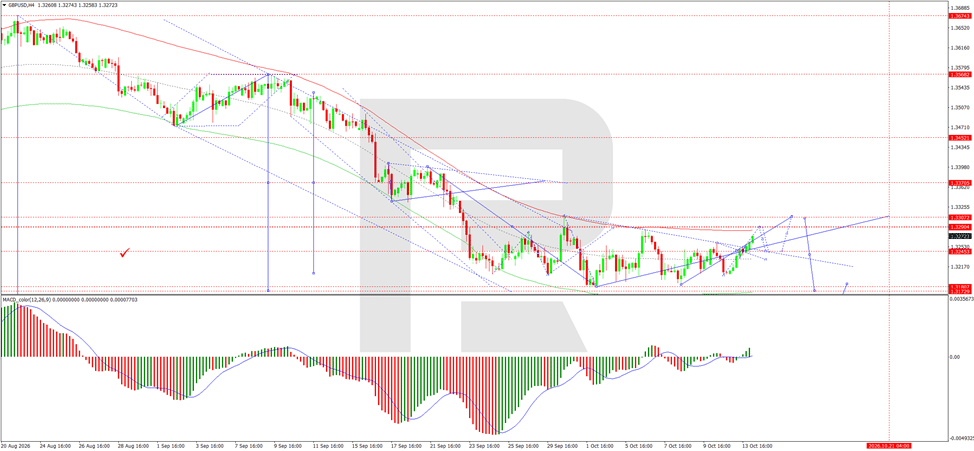
On the H4 chart, GBP/USD continues to develop a corrective upward wave within the main downtrend. During today’s trading session, the pair is expected to reach 1.3290, followed by a decline towards support at 1.3242. A subsequent rise back towards resistance at 1.3307 is possible, where the corrective structure is expected to be completed. A rejection from this level would create the conditions for another downward wave towards 1.3232. A break below this level would open the way for the third wave within the main downtrend to continue towards 1.3181 and 1.3173. The MACD indicator confirms the current upward move, with the signal line near zero and pointing upwards, indicating that short-term upward momentum remains intact. However, the overall market structure remains bearish for now.
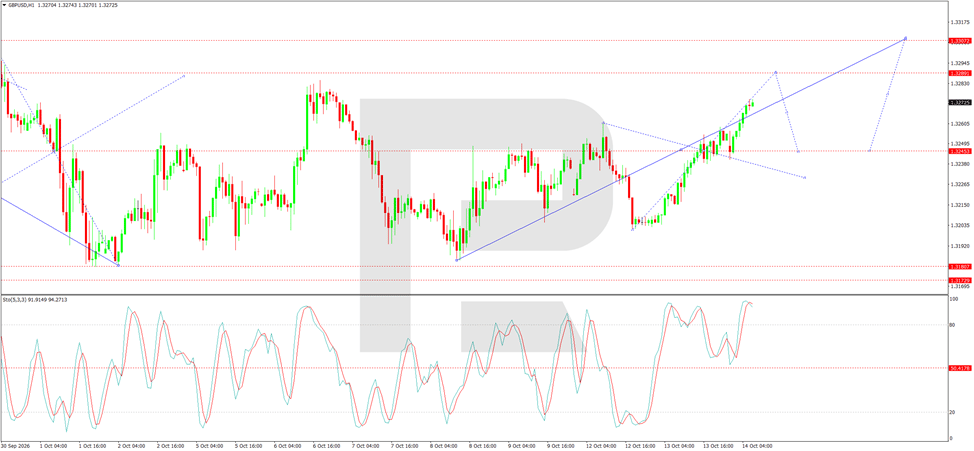
On the H1 chart, GBP/USD has completed a local consolidation range around 1.3242 and continues to develop an upward wave. During today’s trading session, the pair is expected to rise towards resistance at 1.3290, followed by a pullback towards 1.3242. Once the correction is complete, a second rise towards 1.3307 is possible. Subsequently, if a reversal structure forms, the pair is expected to decline towards 1.3232. The Stochastic oscillator supports this view, with its signal lines above 80 in overbought territory, suggesting that the upward move may be nearing its end. In the short term, a downward turn in the indicator would provide further confirmation that a corrective decline is beginning. The main condition for the bearish scenario remains a close below support at 1.3242, followed by a downward move.
Conclusion
The pound’s rally is at risk as US dollar weakness and expectations of further BoE tightening only provide temporary support. While the Bank of England remains cautiously hawkish, Chief Economist Huw Pill’s scepticism about large-scale tightening introduces uncertainty. The IMF’s warning about high energy prices and borrowing costs, together with the upcoming budget on 28 October, adds further risk. The key event will be the US inflation data: a stronger-than-expected reading could shift the advantage back towards the dollar, while UK budget concerns limit sterling’s upside. Technically, the pair remains in a corrective phase within a broader downtrend, with resistance at 1.3290–1.3307 and support at 1.3242. A break below support would confirm the bearish scenario, targeting 1.3232, 1.3181 and 1.3173. The overbought Stochastic suggests that the corrective rebound may be nearing its end.
Author

RoboForex Analysis Department
RoboForex
RoboForex Analysis Department provides timely market insights, expert technical analysis, and actionable forecasts across forex, commodities, indices, and equities.

















