|

Pound falls to nine-week low, UK food inflation jumps

The British pound is down for a fourth straight day, as the US dollar is showing strength against most of the majors. The pound has declined 1.5% in the current slide.

In the European session, GBP/USD is trading at 1.3338, down 0.10% on the day. The pound fell as low as 1.3315 earlier, its lowest level since May 19.

UK food inflation rises

UK inflation has been going up, so it was no surprise that the British Retail Consortium (BRC) Shop Price Index jumped 0.7% in July, up sharply from 0.4% in June and above the forecast of 0.2%.

Food inflation rose for a six consecutive month, rising 4.0% y/y in July, up from 3.7% in June. The driver of the increase was a rise in the cost of meat and tea. The increase in food prices helped boost UK inflation, which climbed to 3.6% y/y in June from 3.4% in May.

Consumers are being squeezed by rising inflation and high interest rates and are responding by holding tighter on the purse strings. The Confederation of British Industry (CBI) reported today that retail sales volumes continue to fall sharply, with a reading of -34 in July. This was an improvement from -46 in June but missed the forecast of -28.

Despite the fact that inflation is moving the wrong way, the markets expect that the Bank of England will lower interest rates next month. The central bank wants to trim the current cash rate of 4.25% and boost the economy, but the upward risk of inflation remains a headache for BoE policymakers who don't want to see inflation continue to move away from the Bank's 2% target.

GBP/USD technical

  • GBP/USD is putting pressure on support at 1.3337. This is followed by support at 1.3321.

  • There is resistance at 1.3359 and 1.3375.
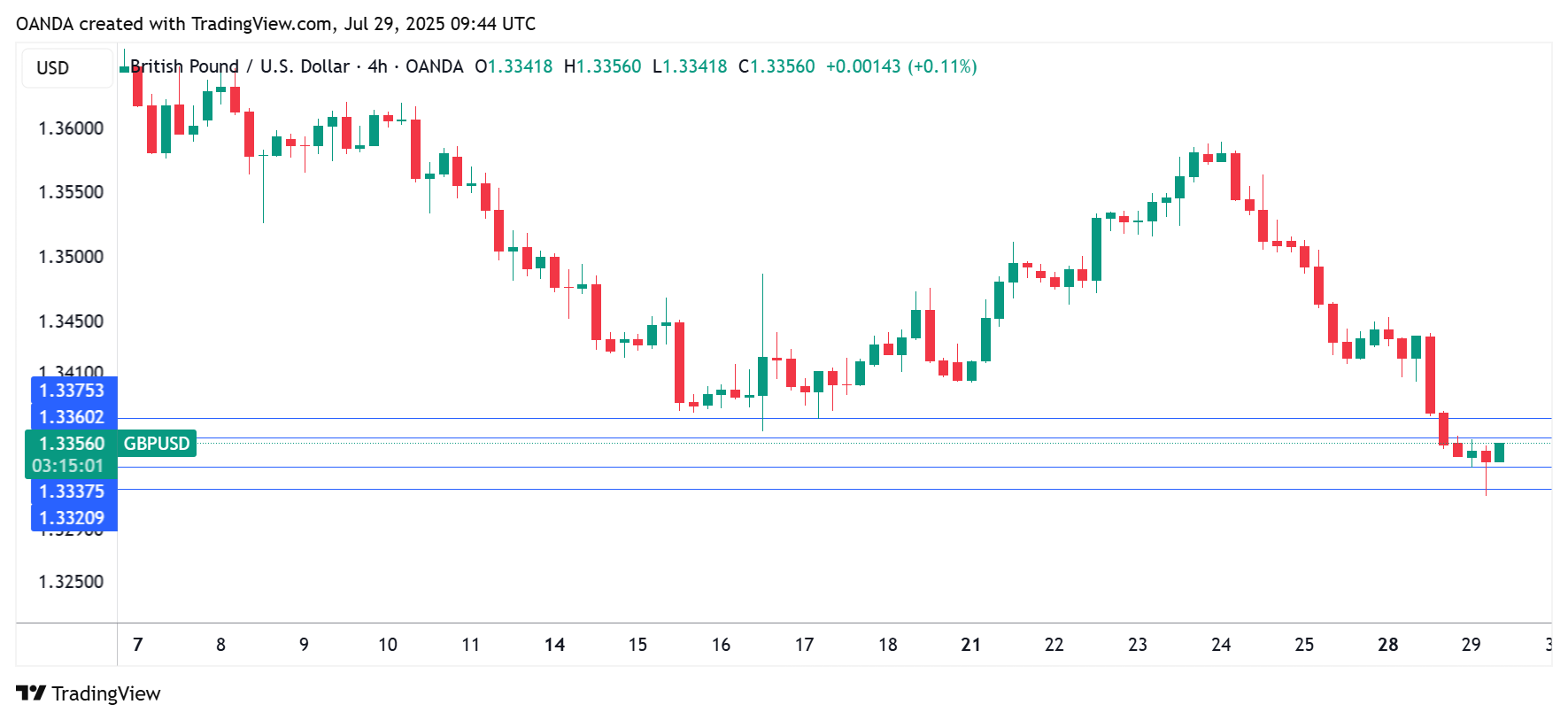
Chart

GBPUSD 4-Hour Chart, July 29, 2025

Author

Kenny Fisher

Kenny Fisher

MarketPulse

A highly experienced financial market analyst with a focus on fundamental analysis, Kenneth Fisher’s daily commentary covers a broad range of markets including forex, equities and commodities.


More from Kenny Fisher
Share:

Editor's Picks

GBP/USD rebounds above 1.3300 ahead of UK Retail Sales data

The GBP/USD pair recovers some lost ground to near 1.3325, snapping the five-day losing streak during the Asian trading hours on Friday. However, the potential upside might be limited amid heightened military tensions in the Middle East. Traders brace for the release of the UK Retail Sales data, which will be published later on Friday. 


EUR/USD rises as US Dollar weakens despite rising Middle East tensions

EUR/USD gains ground after posting modest losses in the previous day, trading around 1.1380 during the Asian hours on Friday. However, the potential upside for the pair could be limited as the US Dollar may regain strength, largely driven by escalating conflicts in the Middle East that threaten to push crude oil prices higher. 

Gold retains bearish bias heading into the Fed week

Gold is nursing heavy losses incurred on Thursday, keeping its range near $4,050 early Friday. Despite the recent retracement, Gold remains on track to register its first weekly gain in three.   


Ethereum: Derivatives interest in ETH improves, but signs of caution remain

Ethereum is hovering slightly below the $1,900 level, down 3% on Thursday following a slight expansion in derivatives interest. The top altcoin's open interest has increased to 14.60 million ETH, marking a 600K ETH increase over the past two days and its highest level since June 7.

Silver's missing crisis trade: Why a war keeps pushing it down
The Strait of Hormuz has closed twice this year, and both times silver fell instead of rallying, because the crisis bid went into the US dollar rather than into metals. Silver trades near $58.77 an ounce as I write this, with the gold-silver ratio around 69.5.
US Dollar mid-year outlook: Exceptional currency, exceptional risks?
The US Dollar enters the second half of 2026 in a markedly different position from a year ago. The King currency has recovered, reflecting persistent US inflation, changing expectations for Fed policy, geopolitical tensions and renewed demand for defensive assets.















