Poland just bought time not to hike

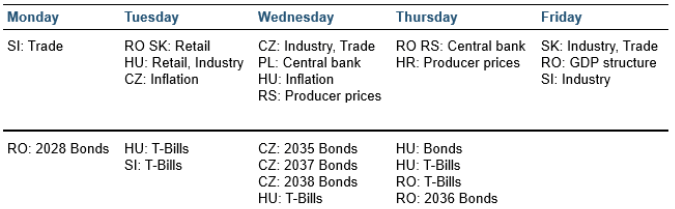
Inflation will remain in focus across the CEE region this week. We expect September inflation to increase by 0.4-0.5pp in both Czechia and Hungary, broadly in line with the rise already observed in several countries that reported their figures last week. While higher fuel prices remain the main driver of inflation, September inflation in Czechia could also be partially affected by increases in household energy prices introduced by the country's largest energy supplier. Furthermore, three central bank meetings are scheduled for this week, in Poland, Romania and Serbia, and we expect policy rates to remain unchanged in all three countries. However, with inflation in Poland approaching 4% in September, it will be interesting to see how the central bank interprets this inflation spike. After the president signed legislation allowing temporary tax cuts on fuel, policymakers gained some additional time. The central bank does not need to react immediately, as inflation should remain below 4% in the coming months thanks to the tax cuts, which are expected to shave 0.7-0.8pp off headline inflation. Without these measures, inflation would likely rise above 4.5%. However, since such measures just delay inflation in time, we expect a rate hike to become a realistic possibility after the release of January or February inflation data. On the political front, Romania's president is expected to hold another round of consultations with political parties, after which he is likely to nominate a new candidate to form the next government, this time with the backing of the PSD party.
FX market developments
CEE currencies were under depreciation pressure, with the Romanian leu clearly underperforming. Another failed attempt to resolve the political deadlock, combined with the approaching S&P rating review of Romania and the risk of a downgrade to speculative grade, weighed on the currency. Implied yields edged higher over the past week, while changes in FX reserves and trade and price patterns suggest that the central bank intervened to support the currency at some point. We believe the central bank is allowing some degree of FX flexibility, as it needs to balance interest rate and financing stability against exchange rate stability.
Bond market developments
The widening of the spread between French 10-year government bonds and German 10-year Bunds to around 150bp, the highest level since 2011, supported CEE issuers outside the Euro Area. Local currency yield curves shifted 10-15bp w/w lower in Czechia, Hungary and Poland. The long end of the curve also moved lower in Romania, while the short end was influenced by changes in RON liquidity following FX operations. Last week, Croatia submitted its final request for EUR 2.7bn, Hungary for EUR 9bn, Poland for EUR 12.7bn, Romania for EUR 4.3bn and Slovenia for EUR 0.3bn from the RRF program, while the Czech and Slovak requests had been submitted earlier. The European Commission is expected to decide on the release of the final payments in the coming months. We expect to see more T-bill issuance across the CEE region this week, as investors continue to favor short-term debt instruments.
Author

Erste Bank Research Team
Erste Bank
At Erste Group we greatly value transparency. Our Investor Relations team strives to provide comprehensive information with frequent updates to ensure that the details on these pages are always current.