OPEC production cut very likely after US election outcome

Oil prices could be heading for a crunch time in what could be a make or break deal as OPEC countries converge in Vienna on November 30th.
While until now, there was a lot of room for doubt on whether OPEC would manage to reach an agreement to cut production levels as informally agreed in Algiers a few months ago, the stakes are high especially after the US presidential election outcome last week.
Trump on Oil & Energy
Trump's policies on oil and energy have already rattled nerves among OPEC, especially Saudi Arabia. During his campaign trail, Trump stayed consistent on his views on energy independence.
"Among all the gifts that God gave to America was an abundant supply of natural energy. According to the Department of Energy, the natural gas reserves we have in the ground could supply our energy needs for centuries." Trump said even going further, saying "I've never understood why, with all of our own reserves, we've allowed this country to be held hostage by OPEC, the cartel of oil- producing countries, some of which are hostile to America."
It wasn't surprising that soon after the election victory; Saudi Arabia released a statement, subtly telling the President-Elect not to stop oil imports from Saudi Arabia.
"At his heart, President-elect Trump will see the benefits and I think the oil industry will also be advising him accordingly that blocking trade in any product is not healthy," Aramco's oil minister, Khalid Al-Falih reportedly told the Financial Times last week on the sidelines of another informal gathering in Marrakesh.
"The U.S. is sort of the flag-bearer for capitalism and free markets," Al-Falih said, noting that "The U.S. continues to be a very important part of a global industry that is interconnected, that is dealing with a fungible commodity which is crude oil. So having equalization through free trade is very healthy for oil."
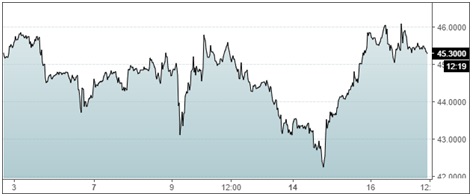
Crude Oil Futures, December 2016 Contracts
Harold Hamm tipped to be the new US energy minister
Last week, US Representative, Kevin Cramer a top energy adviser to Trump said that Harold Hamm, the Chief Executive of Continental Resources was tipped for the job of US energy secretary.
Hamm's Continental Resources is a big player in the US shale oil industry. The very industry Saudi Arabia has been trying to push out of the market since 2014 but with little success to show.
While there is still speculation that Hamm could reject the job, the Trump administration, at least as far as the energy sector is concerned could mean another big blow for Saudi.
Iran: Production ahoy!
Meanwhile, Iran continues to pump oil at a record pace. According to a Bloomberg report, Iranian President Hassan Rouhani announced last Sunday that his nation increased oil production by 250k barrels per day.
The announcement was highly unexpected, especially for its OPEC neighbors. However, it is likely that the surge in production could start to slow down. Iran maintained a consistent view that it would not slowdown production until it reached 12% of OPEC production levels. As of October, it is estimated that Iran produced 3,920,000 barrels per day, nearing 11% of OPEC production.
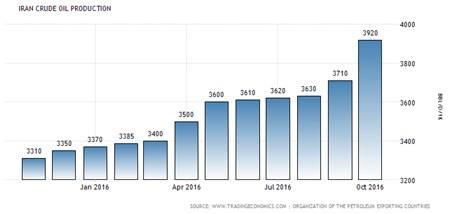
Iran Crude Oil Production rises to 3920k bbl/day
Does this mean higher or lower oil prices?
If the above variables do not change, there is a high chance that oil prices could start to stabilize. Although it is hard to expect crude oil prices back in the triple digits, the days of $30 oil per barrel is very likely to be history.
Starting with the November 30th OPEC meeting, Saudi Arabia is likely to swallow the bitter pill and cut production, regardless of whether Iran is on board with the deal or not. For its part, Iran’s production could start to stabilize once it nears the 12% of OPEC production level which should also help oil prices.
In Algeria, the OPEC nations and Russia initially inked a deal to keep production ceiling capped at 32.5 million - 33 million barrels per day. Oil experts believe that a reduction of 700k - 1 million barrels per day is required to see any meaningful impact on global supply and prices.
However, this could mean that US shale oil producers will be back to ramping up production and could potentially derail the OPEC’s plan, which only heightens the fact that OPEC could start looking into slowly scaling back oil production, whether it likes it or not.
Author

John Benjamin
Orbex
John is a market analyst for Orbex Ltd. and is a forex and equities trader having been involved in trading since late 2009. John makes use of a mix of technical and fundamental analysis and inter-market relationships.