Oil prices falter amid diverging economic signals from China and US


Oil prices have been experiencing a modest decline with West Texas Intermediate (WTI) Crude Oil briefly inching below $76.50, as developments in the global oil market indicate diverging economic signals from China and the United States. This has left crude oil prices caught in a tug-of-war between bearish and bullish factors.
Data from China, the world's second-largest economy and a major oil consumer, dashed hopes of a robust rebound in demand following the easing of pandemic restrictions, after registering a slower-than-expected GDP growth rate of 4.7% in the second quarter. This has raised concerns that the anticipated surge in Chinese crude oil consumption may not materialise, putting downward pressure on crude prices.
The lacklustre performance of China's real estate sector, a significant driver of economic growth, further exacerbated concerns. Housing-related wealth experienced a sharp decline in 2023, and real estate investment continued to contract in the first half of the year. This weakness in the property market has contributed to the overall economic slowdown and dampened consumer sentiment, potentially impacting oil demand.
Muted domestic demand, as evidenced by weak retail sales coupled with subdued credit growth, have further solidified concerns about China's economic outlook. Despite government efforts to stimulate consumption and investment, the data suggests that the recovery remains fragile and uneven.
Meanwhile, in the United States, expectations of monetary easing by the U.S. Federal Reserve have counterbalanced the bearish sentiment emanating from China. Market participants are increasingly betting that the Fed will begin cutting interest rates as soon as September, a move that could stimulate economic activity and boost oil demand.
Lower interest rates tend to weaken the U.S. dollar, making dollar-denominated commodities like oil more affordable for buyers using other currencies. This could potentially spur demand from other major oil-consuming nations, offsetting the weakness in Chinese consumption.
The contrasting economic narratives from China and the U.S. have created a complex and uncertain outlook for WTI and Brent crude oil prices. While the prospect of Fed rate cuts offers some support, the looming threat of a prolonged slowdown in Chinese demand continues to weigh heavily on market sentiment. A bullish argument can be made about China’s exports holding up better than expected at 8.6% from a year earlier according to customs data, but those gains could be erased if anti-China trade tensions resume.
The impending end of production cuts by OPEC+ adds another layer of complexity to the equation. As the group of oil-producing nations prepares to ramp up output, the delicate balance between supply and demand could be further disrupted, potentially leading to increased price volatility.
WTI technical outlook
On the daily chart, the price is currently sitting around $76.50, a level where it has previously found support. Another support level to watch is around $75, which could provide a further cushion if the price dips lower. On the upside, resistance is identified at two key levels: $78.50 and $79.70.
The Relative Strength Index (RSI) is currently at 35, indicating that the asset is in oversold territory. This suggests that there may be a potential for a rebound if buying interest picks up.
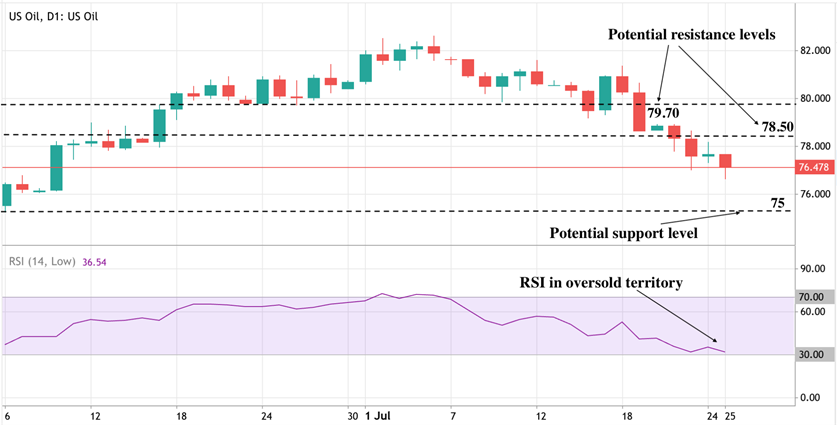
Source: Deriv MT5
Author
Prakash Bhudia
Deriv
Prakash Bhudia, HOD – Product & Growth at Deriv, provides strategic leadership across crucial trading functions, including operations, risk management, and main marketing channels.