WTI outlook: Oil prices stabilise implying a wait and see stance


Oil prices seem to have halted their freefall mentioned in last week’s report and stabilised for the time being, yet the stabilisation is still being characterised by a relative uneasiness. In todays’ report we are to have a look at fundamental issues guiding oil prices, such as the state of the US oil market, OPEC+’s meeting and oil demand. For a rounder view we are to provide also a technical analysis of WTI’s daily chart.
US Oil market tightens supporting Oil prices
Starting with the state of the US oil market we note that last Friday, Baker Hughes reported unexpectedly a drop in the number of active oil rigs in the US. The drop tends to imply that oil demand in the US may have been reduced forcing producers to shut down some rigs, which is interpreted as a bearish signal for oil prices. On Tuesday though we got a different picture as API reported another drawdown in US oil inventories, narrower than the prior week, but still, the reduction of US oil inventories by almost four and a half million barrels, highlights how oil production levels failed to catch up with aggregated oil demand in the US, which in turn implies a relative tightness of the US oil market which is supportive for oil prices. The tightness of the US oil market was also implied by EIA’s report which also showed a reduction of US oil inventories, albeit to a lesser extend than what was reported by EIA. Should we see signals about a tightening of the US oil market intensifying, we may see oil prices getting some support.
OPEC+’s stunts markets with Oil production hike
OPEC+’s meeting stunned the markets over the last weekend as OPEC+ agreed to an oil production surge in June. The oil production cartel agreed to boost production by 411k barrels per day, in the coming month, June. The oil production hike is concentrating with Saudi Arabia expected to reach a production of 9,367kbd, Russia to 9,161kbd, Iraq to 4,086kbd, UAE to 3,092kbd, Kuwait to 2,466kbd, Kazakhstan to 1,500kbd, Algeria to 928kbd and Oman to 775kbd. Gradual increases as per OPEC’s announcement may be paused or reversed depending on the evolving market conditions. The news dealt a hit on oil prices as Brent dropped temporarily below $60 per barrel and WTI neared $55 per barrel. Overall the prospect of a substantial increase of oil supply, continues to constitute a bearish factor for oil prices. Should we see such signals intensifying in the coming week, we may see oil prices retreating further.
Oil demand outlook may improve supporting Oil prices
In an examination of the demand sign of the international oil market, we note that analysts are highlighting signs of increased demand from Europe and China. Overall a potential improvement of economic activity in the two areas, especially in the manufacturing sector could be considered as a forerunner for a rise of oil prices. Also we note the possibility of an easing of the trading tensions, given Trump’s tariffs. The US President has stated that he is to announce a major trade deal in the coming days. Such news could ease market worries and improve the outlook of oil demand. It’s characteristic that market expectations for a possible US-Sino trade deal intensified. As Per Reuters, U.S. Treasury Secretary Scott Bessent and chief trade negotiator Jamieson Greer will meet top Chinese economic official He Lifeng in Switzerland this weekend for talks. Should the market’s hopes for a possible trade deal between China and the US intensify further we may see them having a bullish effect on oil prices.
Technical analysis
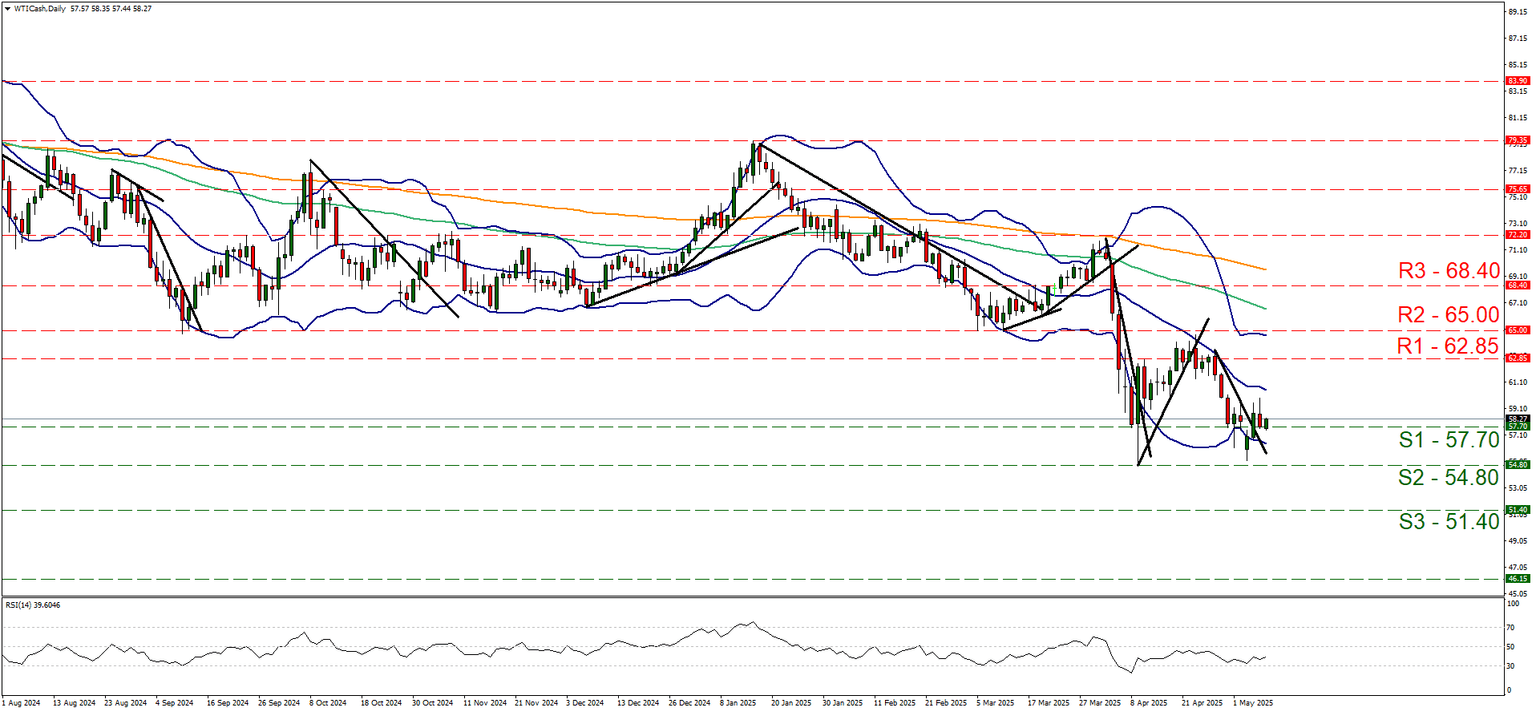
WTI Cash daily chart
- Support: 57.70 (S1), 54.80 (S2), 51.40 (S3).
- Resistance: 62.85 (R1), 65.00 (R2), 68.40 (R3).
WTI’s price action continued to test 57.70 (S1) support line yesterday and during today’s Asian session. Given the temporary breaking of the S1 line on Monday, we see the case for the commodity’s price to maintain a sideways motion around the 57.70 (S1) support line. We should note though that the RSI indicator remained between the readings of 30 and 50 implying a bearish predisposition of the market for the commodity’s price. Should the bears take over, we may see WTI’s price breaking the 57.70 (S1) support line and continue to also break the 54.80 (S2) support level with the next possible target being the 51.40 (S3) support barrier. Should the bulls take over, we may see the WTI’s price action rising and breaking the 62.85 (R1) resistance line and start aiming for the 65.00 (R2) resistance level.
Author
Peter Iosif, ACA, MBA
IronFX
Mr. Iosif joined IronFX in 2017 as part of the sales force. His high level of competence and expertise enabled him to climb up the company ladder quickly and move to the IronFX Strategy team as a Research Analyst. Mr.

















