Oil back to $100? The Hormuz disruption holds the key
Oil’s market reaction has been immediate and sharp. The market is no longer pricing in a simple rise in tensions, but the de facto paralysis of the world’s most strategic energy corridor: the Strait of Hormuz. The degree of disruption in this critical waterway will determine the future of Oil prices: stabilization or spike toward $100 and beyond.
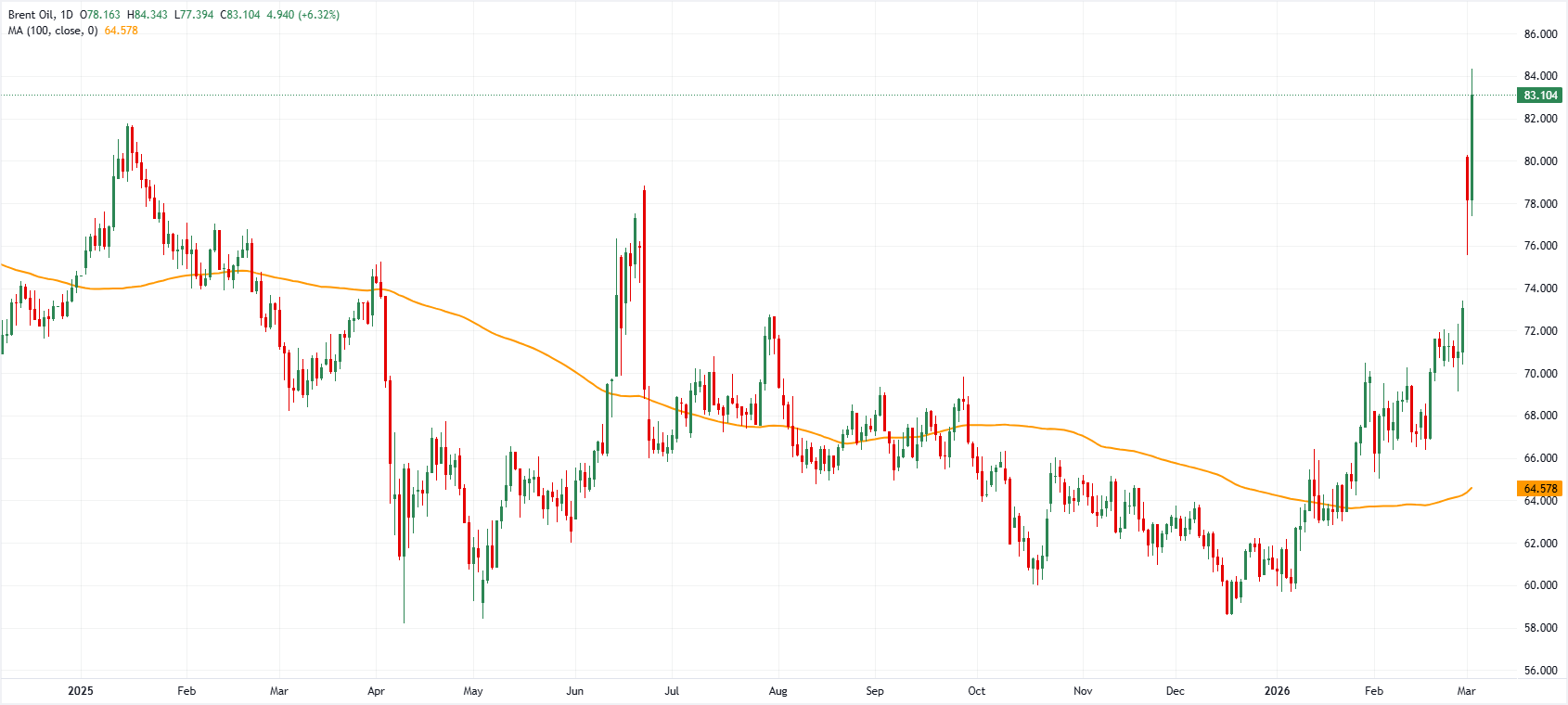
West Texas Intermediate (WTI) US Oil jumps to $75.50 on Tuesday, up 12.65% since Friday’s close, while Brent Oil climbs to $82.70, posting a gain of 13.27% over the same period. The global Oil benchmark reached its highest level since July 2024.
Why the Strait of Hormuz sits at the core of the global energy system
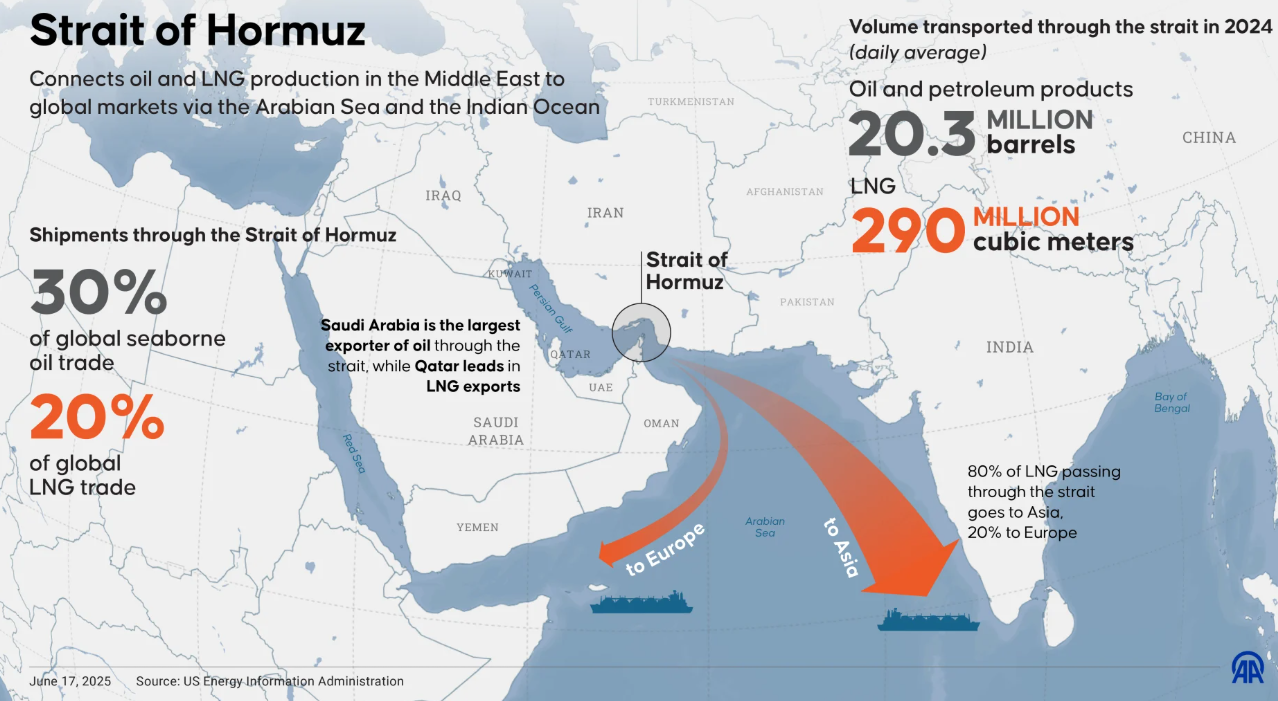
The Strait of Hormuz connects the Persian Gulf to the Gulf of Oman and the Arabian Sea. At its narrowest point, it measures just over 30 kilometers. Yet roughly 20% of the Oil consumed worldwide transits through it every day, or close to 20 million barrels.
This passage concentrates on exports from Saudi Arabia, Iraq, the United Arab Emirates, Kuwait, Qatar and Iran. It is also a major artery for Liquefied Natural Gas (LNG), particularly from Qatar, a key player in global Gas markets.
"The majority of the world's spare production capacity is located in the Gulf. A closure of the Strait would make these volumes inaccessible", notes the IEA, according to a EuroNews report.
Adding that the US Energy Information Administration (EIA) calls it the "world's most important Oil chokepoint," underlining the strategic importance of the passage that links the Persian Gulf with the Gulf of Oman and the Arabian Sea.
There are a few credible alternatives. Some infrastructure allows partial bypassing of the strait, but capacities remain limited compared to the volumes typically transported by sea. This geographic concentration is what turns Hormuz into a critical chokepoint.
A de facto blockade as powerful as a formal closure
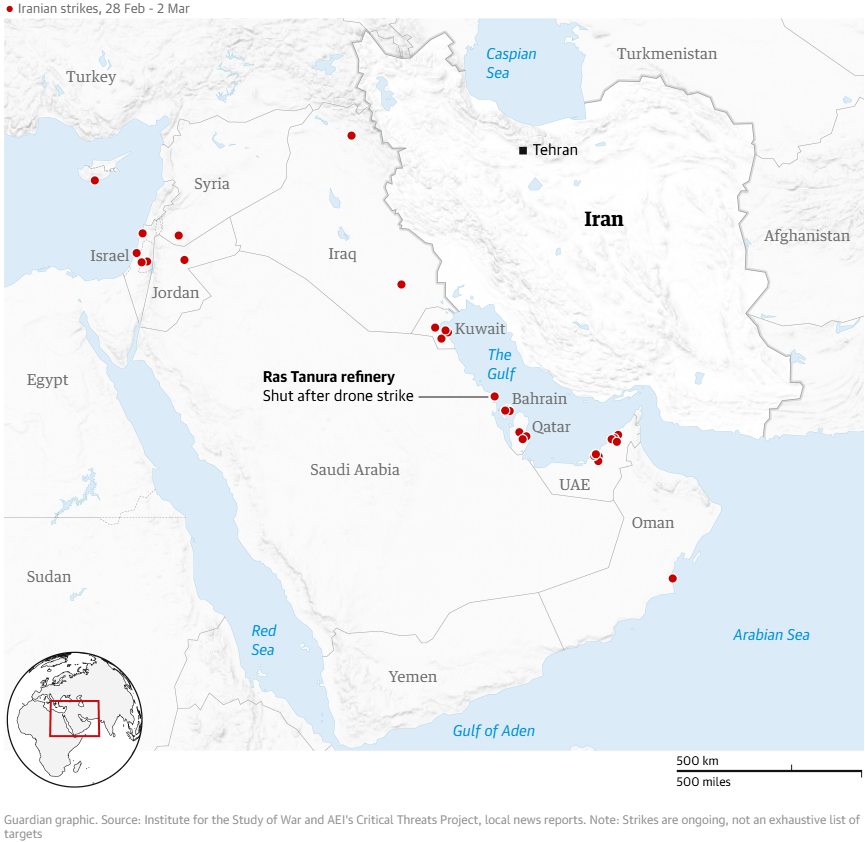
Even without a formally recognized international decree, the current situation amounts to a closure. Statements from Iran’s Revolutionary Guards, attacks on several tankers and regional strikes have fundamentally altered the behavior of private actors.
Major shipping companies are suspending crossings. Insurers are withdrawing or sharply increasing war-risk coverage. Dozens of vessels remain anchored in the Gulf, waiting for military clarity.
In this context, the issue is no longer legal but operational. If ships are no longer moving, the economic effect is the same as a blockade.
“Whether the strait is closed by force or rendered inaccessible by risk avoidance, the impact on flows is largely the same”, notes Jorge León, Head of Geopolitical Analysis at Rystad Energy, according to The Guardian.
Hiring a supertanker to move Oil from the Middle East to China reached an all-time high on Monday of more than $400,000 per day, almost double the cost last week, according to data from the London Stock Exchange Group, notes the BBC. War-risk insurance premiums have multiplied within days, with some providers refusing any exposure in the area.
This double impact of higher Crude Oil prices and soaring logistics costs is tightening physical markets. Asian refiners, the main destination for Gulf exports, must contend with delays, potential rerouting around the Cape of Good Hope and extreme uncertainty over supply timelines.
Markets are therefore pricing not only a supply shortage risk, but also prolonged disruption across global energy supply chains.
Limited role for alternative capacities
The Organization of the Petroleum Exporting Countries and its allies (OPEC+) have mentioned a modest increase in output. However, the central issue is not just production, but the ability to move barrels.
Even if Saudi Arabia or the United Arab Emirates can partially bypass the strait through pipelines, these infrastructures cannot absorb the full volumes normally transported by sea. In the event of a prolonged disruption, several million barrels per day could be temporarily stranded.
“Markets are more concerned with whether barrels can move than with spare capacity on paper”, noted Jorge León, mentioned by The Washington Post.
An uncertain but highly volatile scenario
Historically, the Strait of Hormuz has been threatened multiple times without ever being durably closed. However, the scale of the current attacks and the direct military involvement of the United States (US) mark a structural shift.
If the disruption proves temporary, prices could stabilize after a period of heightened volatility. However, a prolonged blockage or targeted strikes on major infrastructure could push Brent above $100, or even higher under extreme conditions.
“We could be looking at a material disruption, potentially of a greater magnitude than the recent loss of Russian supply in 2022, which sent spot prices to over $120 per barrel”, noted UBS analysts, mentioned by The Guardian.
Iran itself depends on the strait for a large share of its exports, particularly to China. Yet in a context of strategic confrontation, the ability to disrupt 20% of global energy flows represents a powerful geopolitical lever.
A structural geopolitical premium on Oil
The Oil market is now operating under a regime of elevated geopolitical risk premium. As long as navigation does not fully resume under secure conditions, every military or diplomatic development will have an immediate impact on prices.
WTI at $75.50 and Brent at $82.70 do not merely reflect a temporary imbalance between supply and demand. They embody the materialization of a structural risk that is the persistent vulnerability of the global energy system to a single transit chokepoint.
In this environment, the Strait of Hormuz once again becomes what it has always been beneath the surface of markets. Not just a maritime corridor, but the aorta of the global energy economy.
Brent Crude Oil FAQs
Brent Crude Oil is a type of Crude Oil found in the North Sea that is used as a benchmark for international Oil prices. It is considered ‘light’ and ‘sweet’ because of its high gravity and low sulfur content, making it easier to refine into gasoline and other high-value products. Brent Crude Oil serves as a reference price for approximately two-thirds of the world's internationally traded Oil supplies. Its popularity rests on its availability and stability: the North Sea region has well-established infrastructure for Oil production and transportation, ensuring a reliable and consistent supply.
Like all assets supply and demand are the key drivers of Brent Crude Oil price. As such, global growth can be a driver of increased demand and vice versa for weak global growth. Political instability, wars, and sanctions can disrupt supply and impact prices. The decisions of OPEC, a group of major Oil-producing countries, is another key driver of price. The value of the US Dollar influences the price of Brent Crude Oil, since Oil is predominantly traded in US Dollars, thus a weaker US Dollar can make Oil more affordable and vice versa.
The weekly Oil inventory reports published by the American Petroleum Institute (API) and the Energy Information Agency (EIA) impact the price of Brent Crude Oil. Changes in inventories reflect fluctuating supply and demand. If the data shows a drop in inventories it can indicate increased demand, pushing up Oil price. Higher inventories can reflect increased supply, pushing down prices. API’s report is published every Tuesday and EIA’s the day after. Their results are usually similar, falling within 1% of each other 75% of the time. The EIA data is considered more reliable, since it is a government agency.
OPEC (Organization of the Petroleum Exporting Countries) is a group of 12 Oil producing nations who collectively decide production quotas for member countries at twice-yearly meetings. Their decisions often impact Brent Crude Oil prices. When OPEC decides to lower quotas, it can tighten supply, pushing up Oil prices. When OPEC increases production, it has the opposite effect. OPEC+ refers to an expanded group that includes ten extra non-OPEC members, the most notable of which is Russia.
(This story was corrected on March 4 at 09:30 GMT to say that the global Oil benchmark reached its highest level since July 2024, not July.)
Author

Ghiles Guezout
FXStreet
Ghiles Guezout is a Market Analyst with a strong background in stock market investments, trading, and cryptocurrencies. He combines fundamental and technical analysis skills to identify market opportunities.

















