Oil and Gold: Price review for the week ahead

This preview of weekly data examines USOIL and XAUUSD, with economic data expected later this week as the primary market drivers of the near-term outlook.
Highlights of the week: RBA, BoJ, BoE & Fed rate decisions, UK inflation & unemployment.
Tuesday
- The Bank of Japan's Interest rate decision at 03:00 AM GMT is expected to raise the rate from 0.75% to 1%. Market participants are expecting the BoJ to hike interest rates, which could further support the Yen against its currency pairs, especially against the US Dollar.
- Reserve Bank of Australia’s interest rate decision at 04:30 AM GMT, where the market is expecting that the interest rates will remain stable at 4.35%. In the event, however, that we have a surprise cut by the Reserve Bank, then it might create minor losses for the Aussie Dollar in the short term.
Wednesday
- British Inflation rate at 06:00 AM GMT, where the figure for May is expected to increase from 2.8% to 3%. If it's confirmed, then the pound might witness some short-term gains against other currencies because it could influence the future path of the Bank of England towards hiking rates if inflation continues to move up.
- The Fed interest rate decision at 18:00 GMT is broadly expected to keep steady at 3.75%, with the probabilities of a cut being less than 4%. Participants are focusing closely on what the comments of the central bankers in the subsequent press conference will be in an effort to get some hints as to the future direction of monetary policy.
Thursday
- British unemployment at 06:00 AM GMT for April is expected to hold steady at 5%, while the claimants are expected to decrease to 25,800 for May compared to the previous recording of 26,500.
- The Bank of England decides on its interest rate at 11:00 AM GMT. The general expectation is that the central bank will hold its rate stable at 3.75%, but if we witness a hike in the rate, it could give some support to the pound in many of its pairs, especially against the US dollar, whereas in the unlikely event of a cut, it might hurt the British pound in the aftermath of the release.
- Japanese inflation rate at 23:30 GMT. The expectations for May is that the rate could go up to 1.6% from the previous 1.4%. This might be somewhat bullish news to the market participants trading the yen.
USOil, daily
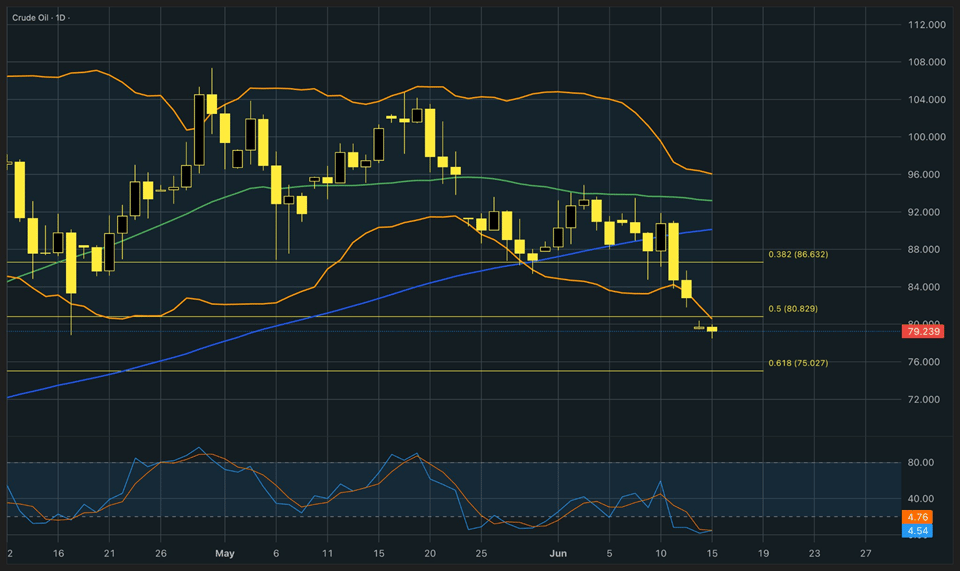
Oil prices fell after the US and Iran agreed to an interim deal that could reopen the Strait of Hormuz and ease supply concerns. While the agreement has improved market sentiment, traders remain cautious due to uncertainty around the deal's details, shipping risks, mine clearance, and the time needed to restore disrupted production. The deal also begins a 60-day negotiation period over Iran's nuclear program, with President Trump warning that military action could resume if no broader agreement is reached.
From the technical analysis perspective, crude oil has been declining through most of last week and has even traded below the lower band of the Bollinger Bands. This has shown a strong push by the bears, and news about the deal about the US-Iran conflict has pushed the price even lower at the opening of this week. The result of this push was for the Stochastic oscillator to decline to extreme oversold territory, but given the increased volatility, it's possible to see the oscillator remaining in this area for some time. The moving averages are still validating an overall bullish trend; however, this might change in the upcoming sessions if the bearish trend extends. The level of $75 seems to be the next strong support area on the chart, consisting of the 61.8% weekly Fibonacci retracement level and an area of price reaction in June of last year.
Gold-Dollar, daily
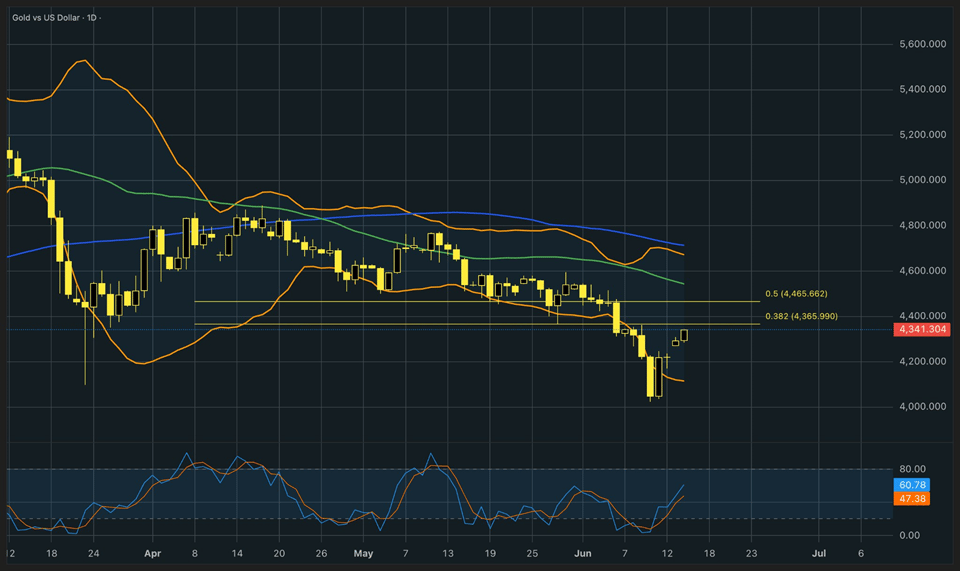
Gold climbed as the US and Iran reached a temporary deal, easing geopolitical tensions and reducing concerns over inflation. Bullion gained as markets expected the reopening of the Strait of Hormuz and lower energy pressures, which could reduce the need for higher interest rates. However, traders remain cautious until the agreement is formally signed and negotiations progress. The deal includes a 60-day period of talks over Iran’s nuclear program, while markets now focus on upcoming central bank decisions and rate expectations.
From a technical point of view, gold has started rebounding late last week just above the psychological support of $4,000 and is currently pushing upwards. The next major resistance could be found around $4,400 which consists of the 38.2% daily Fibonacci retracement level as well as a price reaction area tested throughout May. The Stochastic oscillator is in neutral levels, hinting that there is potential for the price to move to either side while the Bollinger Bands have expanded showing that volatility is increasing and that the upward momentum could extend in the short-term. On the other hand, the moving averages are still validating an overall bearish trend, but this could shift if the recent bullish correction becomes a complete trend reversal.
Author

Antreas Themistokleous
Exness
Antreas has been trading CFDs since 2018 using a combination of fundamental and technical analysis.