Oil and Gold: Price review for the week ahead

This preview of weekly data examines USOIL and XAUUSD, with economic data expected later this week as the primary market drivers of the near-term outlook.
Highlights of the week: RBA rate decision, US inflation and PPI, British GDP
Tuesday
- Reserve Bank of Australia’s Interest Rate Decision: Scheduled for release at 04:30 AM GMT, consensus forecasts indicate that the interest rate will remain unchanged at 4.35%. Conversely, an unexpected rate reduction by the Reserve Bank could induce short-term depreciation of the Australian Dollar.
Wednesday
- United States Inflation Rate: Anticipated at 12:30 PM GMT, projections suggest a deceleration to 3.4% from the preceding 3.5%, alongside an expected 0.1% decline in core inflation for July. Given that expectations for a Federal Reserve rate hike are consistently deferred, inflation data remains paramount. A higher-than-anticipated reading would likely reinforce rate hike expectations, whereas a lower figure could diminish the probability of an imminent rate increase by the Federal Reserve.
Thursday
- British GDP Growth: To be published at 06:00 AM GMT, market consensus points toward a month-over-month decrease from 0.1% to -0.1%. While this June data may not significantly impact the Sterling, it will offer insights into the broader economic performance of the United Kingdom.
- United States Producer Price Index (PPI): Scheduled for 12:30 PM GMT, market participants forecast a reading of 0.1%, up from the previous -0.3%. Confirmation of this figure could signal upward pressure on inflation in subsequent months, as elevated producer costs typically transmit to consumers.
USOIL, daily
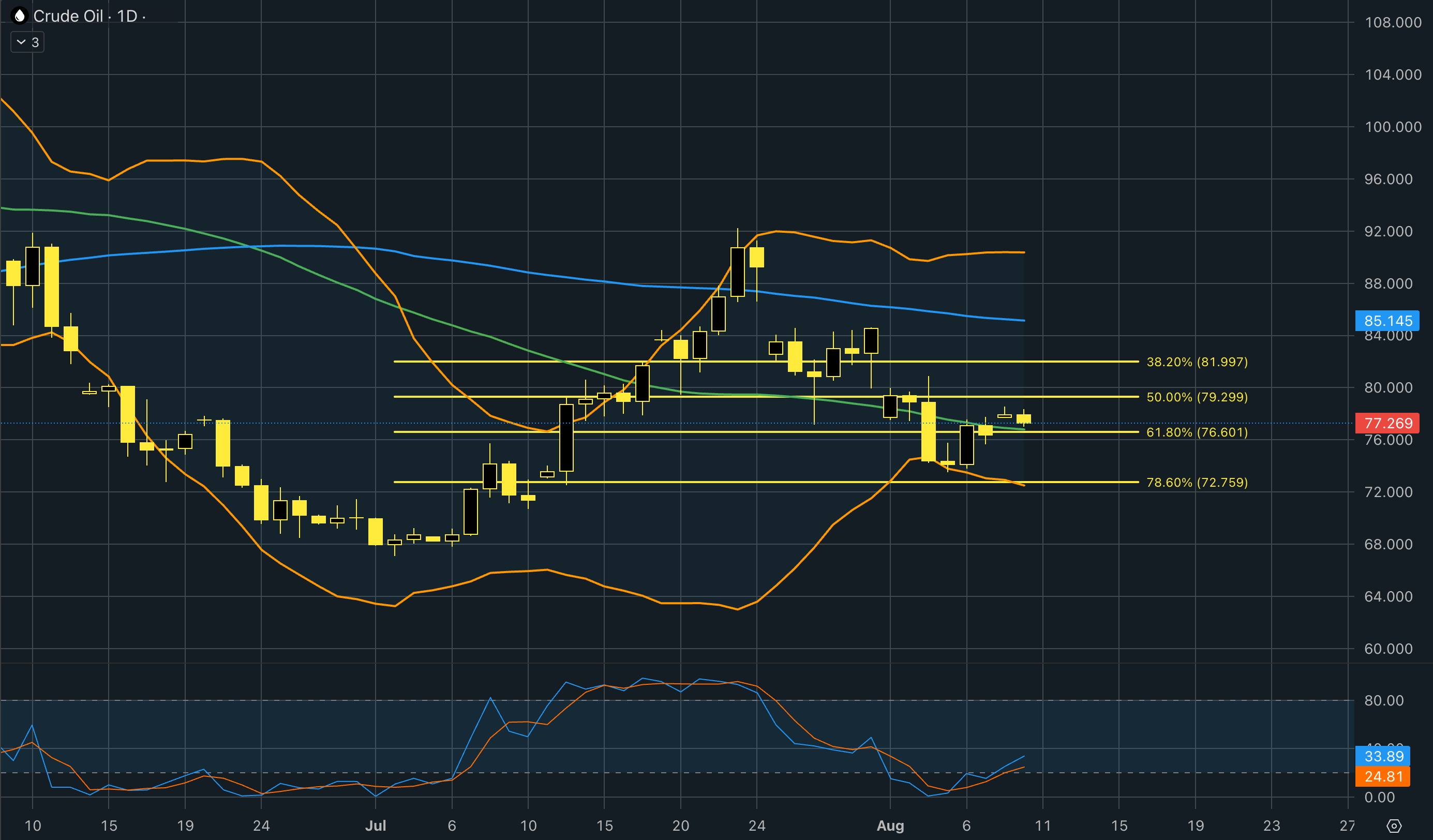
Oil prices extended gains as uncertainty over the reopening of the Strait of Hormuz kept geopolitical risks elevated. West Texas Intermediate traded near $78 a barrel after gaining more than 5% over three sessions. Iran said a deal with Oman to establish a shipping route through Hormuz was close, but warned that the waterway would not reopen immediately. Meanwhile, renewed attacks on a tanker and Saudi Arabia’s Jazan refinery added to supply concerns. With around a fifth of global oil and gas supplies normally passing through Hormuz, continued disruption could keep upward pressure on oil prices.
From a technical perspective, crude oil remains under pressure, with price trading below the 100-day SMA, keeping the broader trend bearish. However, price has stabilised around the 61.8% Fibonacci retracement at $76.60 after bouncing from the 78.6% level near $72.76, while the Stochastic oscillator is turning higher from oversold territory, suggesting that short-term momentum is improving. The Bollinger Bands remain relatively wide, indicating elevated volatility, although the recent price action points to consolidation. A sustained break above $79.30 could open the way toward the 38.2% Fibonacci level at $82, while a move below $76.60 would expose the $72.76 support area. Overall, the broader outlook remains bearish, but the oversold conditions leave room for a short-term recovery.
Gold-Dollar, daily
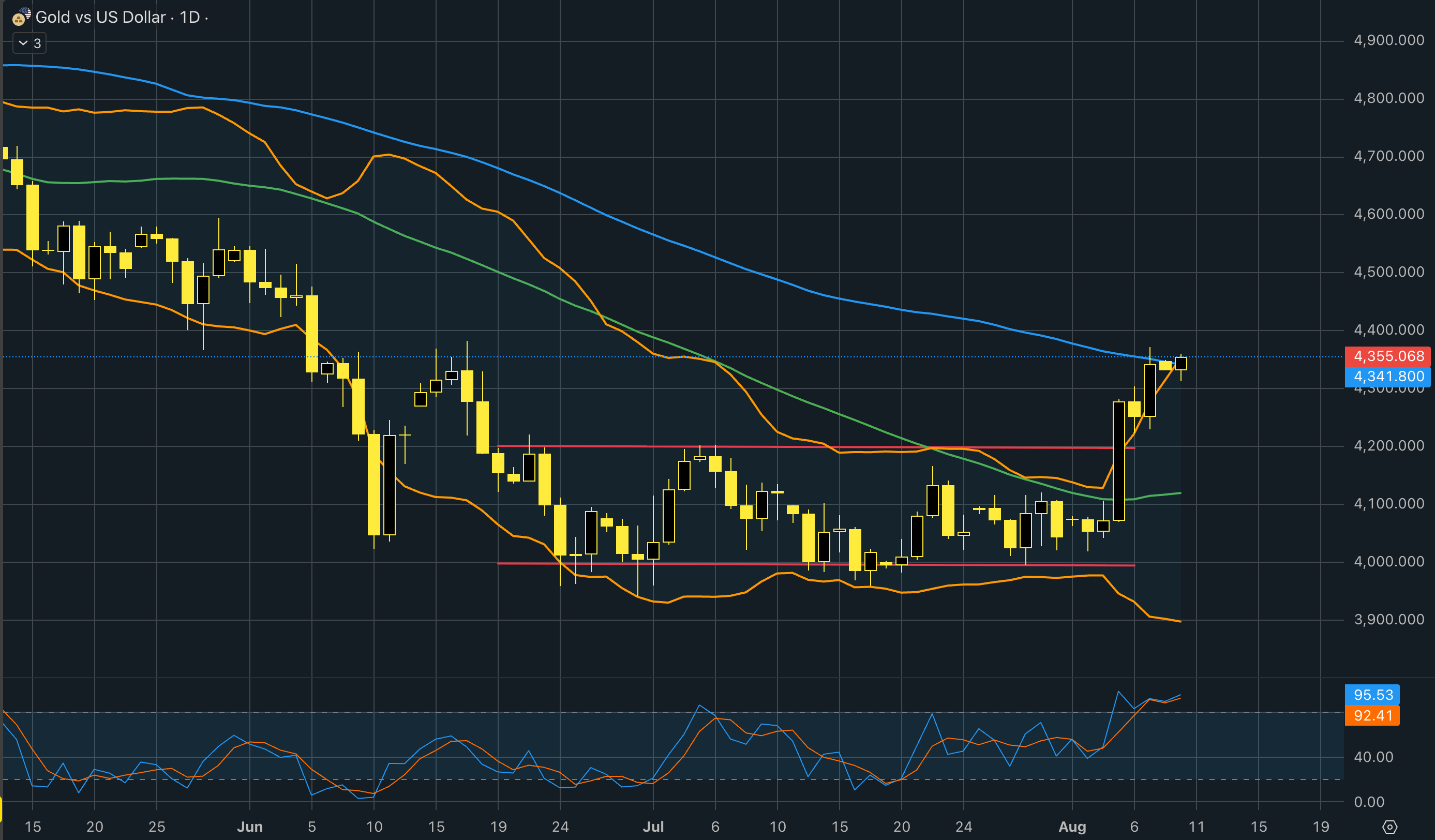
Gold held above $4,300 an ounce after surging more than 7% last week, supported by weaker-than-expected US jobs data that reduced expectations of near-term interest-rate hikes. The softer data also weakened the dollar, further supporting gold. Investors now await US inflation data for further clues on the Fed’s rate path. Gold is also benefiting from strong buying, with hedge funds increasing bullish positions, Chinese gold ETFs seeing continued inflows and China’s central bank extending its gold-buying streak. Geopolitical tensions remain an additional support for the metal, while markets now focus on upcoming US inflation and PPI data for the next major catalyst.
From a technical point of view, gold has entered a stronger short-term bullish phase after breaking above the sideways channel boundary at $4,200 and reclaiming both the 50- and 100-day SMAs. Price is now trading around $4,355, slightly above the 100-day SMA near $4,342, a key technical development. However, the Stochastic oscillator is deeply overbought, suggesting the recent rally may be stretched and vulnerable to a short-term pullback. Price is also pressing against the upper Bollinger Band, reinforcing the possibility of consolidation. If the breakout holds, the next key upside target is around $4,400, with $4,200 as the first major support. Overall, the short-term outlook has turned bullish, although the overbought conditions increase the risk of a temporary correction.
Author

Antreas Themistokleous
Exness
Antreas has been trading CFDs since 2018 using a combination of fundamental and technical analysis.