Coffee retreats from November peak as weather and supply risks rise


Coffee markets have shifted tone sharply as the rally that dominated the first half of the fourth quarter begins to lose momentum. After reaching a high near 41.480 dollars in late November, Coffee has slipped toward the 36.570 zone, marking the first meaningful retracement since the autumn breakout. The move does not contradict the broader strength of soft commodities, but it signals that the market is entering a more delicate phase in which weather patterns, supply tightness and structural imbalances will shape the early 2026 trajectory.
Soft commodities have repeatedly shown that they are the earliest responders to climate volatility, and Coffee is no exception. The recent weakness reflects a combination of profit taking, seasonal adjustments and renewed uncertainty over the upcoming harvest cycle in key producing regions. Yet the pullback remains contained, suggesting a market that is recalibrating rather than reversing.
Coffee’s role in global inflation dynamics is far from marginal. Food components of the CPI basket continue to show stickiness, and any pressure on agricultural commodities tends to spill into broader price expectations. With energy markets stabilizing and metals rotating in and out of leadership, soft commodities have reemerged as a crucial link between climate risk and macroeconomic volatility.
Weather remains the dominant source of uncertainty
The foundation of Coffee’s long term narrative rests on weather conditions across Brazil, Colombia and Central America. The tail effects of El Niño and the transition toward a neutral or La Niña leaning cycle make the upcoming months highly unpredictable. Rainfall distribution remains uneven, soil moisture levels are still recovering from previous stress events and flowering patterns across several producing regions show early signs of inconsistency.
Such weather irregularities do not always translate into immediate supply cuts, but they increase the probability that forward production estimates will need adjustments. Markets respond early to these signals, and this anticipatory behavior explains why Coffee can experience significant moves well before harvest data fully materialize.
At the same time, logistical challenges continue to affect exporters. Shipping routes remain congested, insurance costs have increased in several maritime corridors and port side operations have not fully normalized after the disruptions of recent years. This combination of climate uncertainty and logistical friction represents a structural source of volatility that will accompany the market into 2026.
Demand remains resilient despite price sensitivity
On the demand side, consumption in North America, Europe and Asia shows remarkable stability. Even with rising costs in the retail segment, demand for roasted and soluble coffee has not weakened. Emerging markets are expanding consumption, driven by demographic growth and shifts in consumer patterns. The hospitality sector continues to normalize after the pandemic era, which provides a steady demand floor for physical beans.
This resilience helps explain why sell-offs in Coffee tend to be moderate and short lived. Unlike cyclical metals, Coffee demand does not contract rapidly with economic slowdowns, and unlike energy markets, it is not directly tied to industrial production. This unique profile creates a market that often outperforms during periods of macro uncertainty.
The Renko structure reveals a controlled retracement
The Renko chart brings clarity to the recent correction. The structure shows a clean rejection near 41.480 dollars followed by a progressive sequence of bearish bricks that has guided price toward the 36.570 area. The retracement is orderly and lacks signs of panic or exhaustion. Momentum indicators highlight a bearish divergence, confirming that the late November rally had begun to lose strength even before the price rollover.
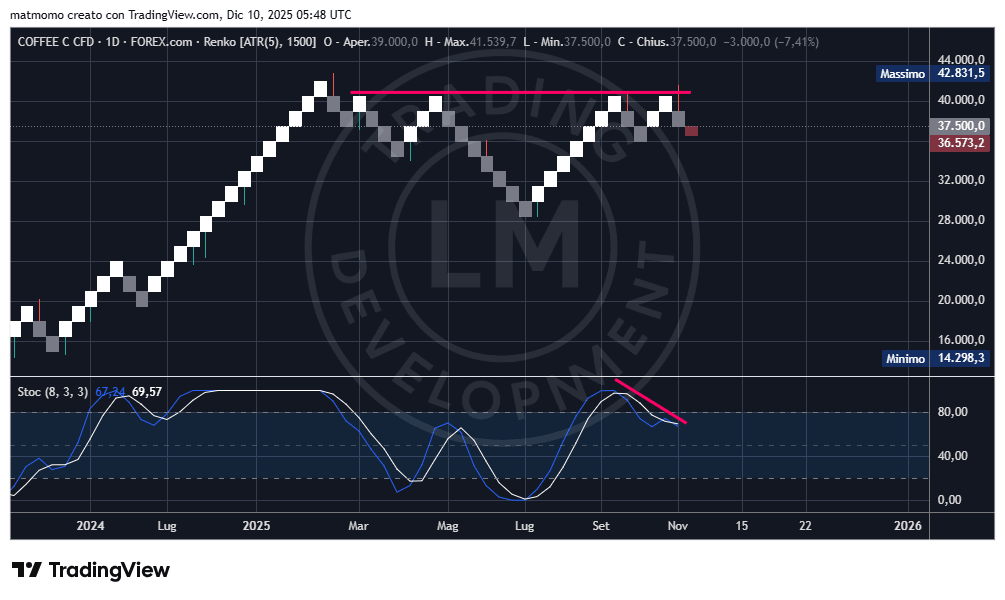
The 36.000 to 36.500 dollars region now emerges as a tactical zone where buyers may attempt to stabilize the sequence. A sustained break below this area would suggest that the market is pricing more severe weather or supply headwinds. Conversely, a reaction above 38.000 dollars would indicate that the retracement has served its purpose in resetting positioning.
For traders, the current pattern offers a clean setup. The pullback provides an opportunity to reassess risk reward conditions without the noise often associated with time based charts. Renko highlights structure rather than speed, and the current structure is signaling recalibration rather than trend reversal.
EcoModities perspective: Softs as early indicators of structural stress
In the EcoModities perspective, Coffee and Cocoa sit at the intersection of climate volatility, land productivity and global trade flows. They offer some of the earliest signals of how weather anomalies translate into price instability, long before the broader CPI indexes capture the shift. This makes soft commodities essential forward looking indicators for 2026 inflation risks.
Coffee’s current behavior fits this framework with precision. The rally into November reflected tightening supply expectations, while the current retracement reflects the market’s sensitivity to weather noise and harvest uncertainty. This interplay between climate, logistics and macro expectations is exactly what EcoModities research identifies as a structural driver of commodity markets in the coming cycle.
Why 2026 may be shaped by soft commodities more than energy
Energy markets have stabilized after the volatility of 2022 and 2023. Metals continue to respond to monetary policy shifts and industrial rotations. In this environment, soft commodities stand out as the most direct expression of climate risk and supply chain fragility.
Coffee, Cocoa and Sugar have all shown the capacity to influence food inflation, reshape CPI expectations and alter central bank communication indirectly.
If weather conditions fail to normalize in the first quarter of 2026, soft commodities may become a leading force in the global inflation narrative. This would elevate their relevance for macro traders, institutional allocators and policymakers.
Outlook: Recalibration now, directional risk ahead
The coming weeks will determine whether Coffee can stabilize above the mid 36 dollars zone or whether forward supply expectations deteriorate. Weather will remain the primary driver, but harvest reports, export flows and shipping conditions may add further noise.
A break above 38.500 dollars would signal renewed accumulation ahead of the 2026 cycle. A break below 35.000 dollars would suggest a more structural shift in market expectations.
For now, the message is clear. Coffee is retreating from its November peak, not collapsing. The market is adjusting to weather uncertainty while maintaining the possibility of renewed strength as 2026 approaches.
Author
Luca Mattei
LM Trading & Development
Luca Mattei is a market analyst focusing on FX, metals, and macroeconomic trends. He develops trading tools for retail and professional traders, coding indicators and EAs for MT4/MT5 and strategies in Pine Script for TradingView.