NZD/USD: Buyers and sellers battle for control at 0.5660
- NZD has lost almost 3% in September, making it the weakest major currency this month.
- NZD/USD is down over 4% as a hawkish Fed, higher yields and geopolitical uncertainty weigh.
- Sellers’ resolve is being tested around the key 0.5660 support.

The New Zealand dollar has been the weakest major currency in September, losing almost 3%. The currency has been weighed down by the Reserve Bank of New Zealand’s dovish rate hike and heightened geopolitical uncertainty as the US-Iran conflict continues to linger.
Although the RBNZ raised its Official Cash Rate by 25 basis points to 2.75%, it projected a more gradual path for further tightening than markets had expected. This reduced some of the support the rate increase might ordinarily have provided for the New Zealand dollar.
NZD/USD is down more than 4% this month, with the US dollar side of the equation providing additional reasons for the pair to move lower. A hawkish Federal Reserve and rising Treasury yields have supported the dollar broadly, placing further pressure on NZD/USD.
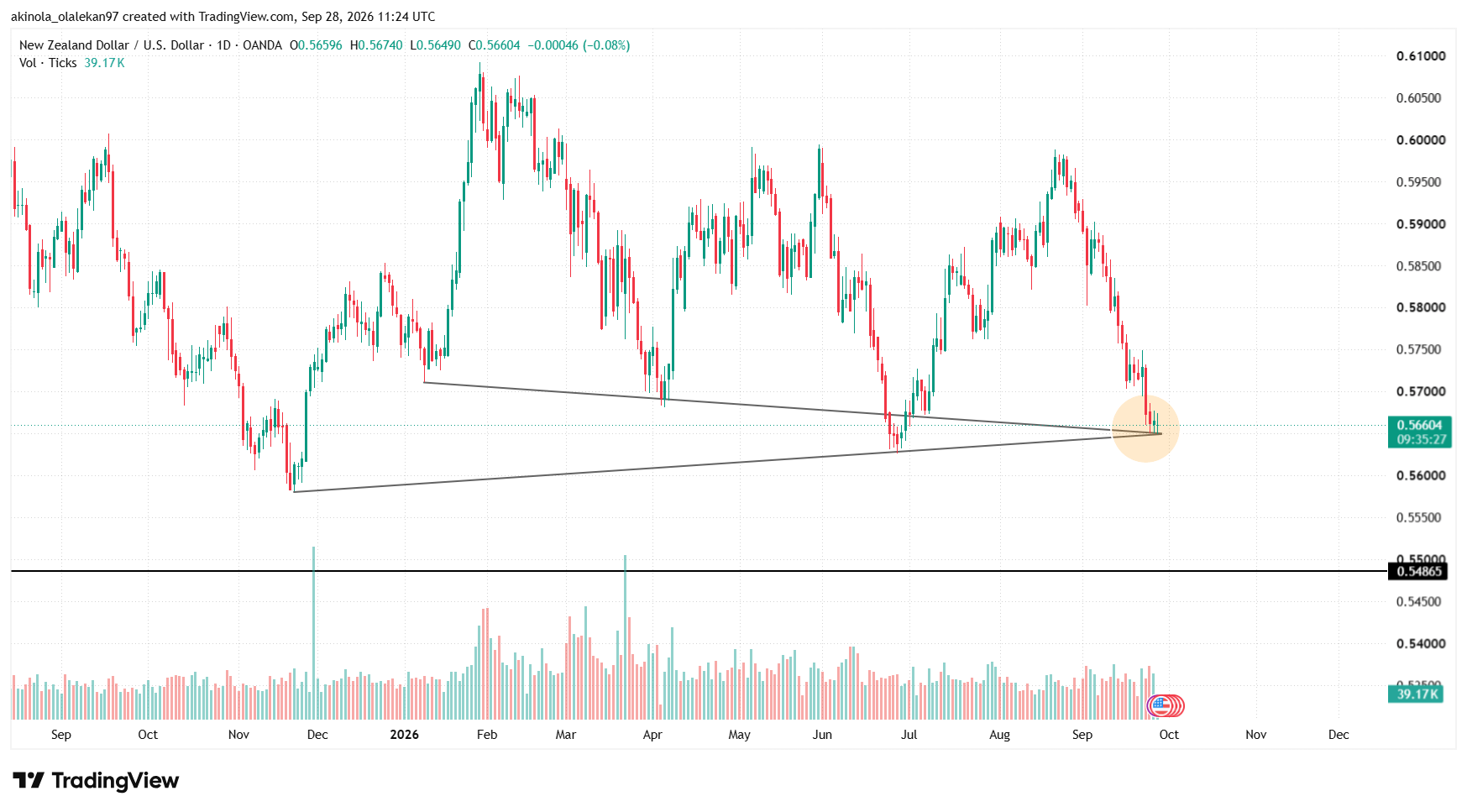
The decline has stalled in recent sessions after price encountered support around 0.5660. Sellers have struggled to secure a sustained break below this level, while buyers remain determined to defend it—but how long can they hold on?
Can sellers break below 0.5660?
There is little doubt that 0.5660 is an important support level. Recent reactions on the daily timeframe suggest that buyers are keeping the level alive, despite the broader bearish pressure.
The key question is whether sellers can extend the decline, secure a sustained break below 0.5660 and launch another charge towards the previous low around 0.5485.
The macroeconomic backdrop still leaves sellers in constructive control of NZD/USD. US Treasury yields remain elevated, markets are pricing a strong probability of another Federal Reserve rate hike in October, and geopolitical uncertainty continues to support demand for the US dollar.
However, the additional premium these factors have provided to the dollar appears to be losing some momentum. With NZD/USD already stretched to the downside, even a modest change in the macroeconomic environment could offer buyers a stronger opportunity to recover.
Profit-taking as month-end trading approaches could improve buyers’ chances of defending 0.5660. This week’s US Nonfarm Payrolls report could also support a recovery if employment growth disappoints, Treasury yields retreat and expectations of an October Fed rate hike weaken.
Nevertheless, the longer-term directional bias remains tilted to the downside. Support around 0.5660 may trigger a recovery, but it is unlikely to produce a complete change in direction on its own.
A meaningful shift in the NZD/USD outlook would likely require markets to reprice the probability of an October Fed rate hike, a sustained retreat in US bond yields, an improvement in global risk sentiment and a more hawkish RBNZ. Until then, any recovery may remain corrective, with sellers retaining the broader advantage.
Author

Olalekan Akinola
Independent Analyst
Olalekan Akinola is a financial-markets analyst and writer with five years of experience covering forex, commodities, and global macroeconomic developments.