|

Normalisation of monetary policy in the United Kingdom: The impact on mortgages

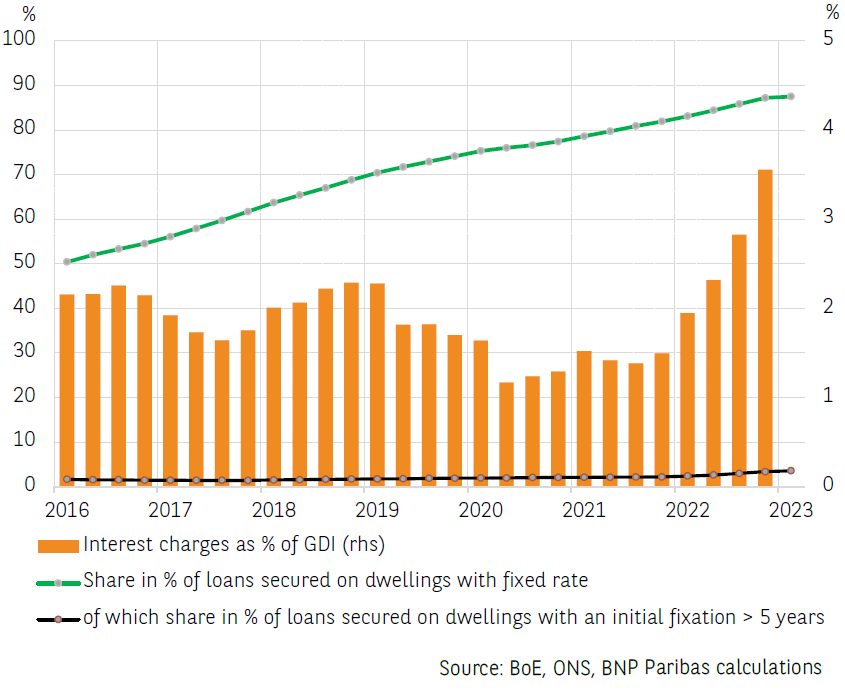
The normalisation of the Bank of England’s (BoE) monetary policy, which began in December 2021, helped increase the cost of mortgages to households: it rose from an average of 1.5% in November 2021 to 4.4% in March 2023.

The share of households’ gross disposable income devoted to interest payments more than doubled between the first quarter 2021 (1.5%) and the fourth quarter 2022 (3.6%), reaching a level not observed since the first quarter 2009.

According to BoE statistics, only 12.5% of outstanding household mortgages were floating rate in the first quarter of 2023, suggesting that the proportion of borrowers affected by an immediate rate revision remains modest. Nevertheless, a large proportion of those mortgages classified as "fixed rate” by the BoE have a relatively short initial rate fixation period. In the first quarter of 2023, 84% of outstanding mortgages to households were granted with an initial fixation of up to five years, 3.5% with an initial fixation of just over five years and less than 0.1% with an initial fixation of just over ten years. This implies that the bulk of “fixed-rate” mortgages will be subject to a rate revision in the coming years, and will therefore also be affected by monetary tightening.

However, to the extent that the BoE’s bank rate and the Gilt’s yield could start easing as early as 2024, and that the revision of loan rates would occur only after this easing of market rates had begun, a large proportion of borrowers could escape the effects of the BoE’s and market rates peak on their interest charges.

United Kingdom: household loans secured on dwellings with fixed rate and interest charges as % of gross disposable income
Download The Full Eco Flash

Author

BNP Paribas Team

BNP Paribas Team

BNP Paribas

BNP Paribas Economic Research Department is a worldwide function, part of Corporate and Investment Banking, at the service of both the Bank and its customers.


More from BNP Paribas Team
Share:

Markets move fast. We move first.

Orange Juice Newsletter brings you expert driven insights - not headlines. Every day on your inbox.

By subscribing you agree to our Terms and conditions.

Editor's Picks

EUR/USD edges above 1.1750 due to ECB-Fed policy divergence

EUR/USD has recovered its recent losses registered in the previous session, trading around 1.1760 during the Asian hours on Friday. Traders will likely observe Germany’s Manufacturing Purchasing Managers’ Index data later in the day.

GBP/USD stays weak near 1.3450 on modest USD recovery

GBP/USD remains under modest beairsh pressure and fluctuates at around 1.3450 on Wednesday. The US Dollar finds fresh demand due to the end-of-the-year position adjustments, weighing on the pair amid the pre-New Year trading lull. 

Gold climbs to near $4,350 on Fed rate cut bets, geopolitical risks

Gold price rises to near $4,345 during the early Asian session on Friday. Gold finished 2025 with a significant rally, achieving an annual gain of around 65%, its biggest annual gain since 1979. The rally of the precious metal is bolstered by the prospect of further US interest rate cuts in 2026 and safe-haven flows.

Bitcoin trades in compression as 2026 begins with structure still unresolved

BTC/USD remains locked in a two-way structure, with micro supply-and-demand levels guiding early-year price behaviour.

Economic outlook 2026-2027 in advanced countries: Solidity test

After a year marked by global economic resilience and ending on a note of optimism, 2026 looks promising and could be a year of solid economic performance. In our baseline scenario, we expect most of the supportive factors at work in 2025 to continue to play a role in 2026.

Crypto market outlook for 2026

Year 2025 was volatile, as crypto often is.  Among positive catalysts were favourable regulatory changes in the U.S., rise of Digital Asset Treasuries (DAT), adoption of AI and tokenization of Real-World-Assets (RWA).