“No one can make sense of it anymore”: Trump tariffs to hurt the US Dollar
Market players learned Friday that the US Supreme Court ruled against President Donald Trump’s use of the International Emergency Economic Powers Act to justify a big chunk of country-specific tariffs announced since his return to the White House.
But what does that mean for the US Dollar and the American economy?
A tale full of tariffs
A bit of context could help understand what is going on.
President Trump expressed concerns about the US trade deficit, noting that other countries were taking advantage of the US economy. To counteract such “abuse,” Trump announced a myriad of tariffs on almost all trading partners. Some of these levies were applied to specific goods and services, such as steel, aluminum, lumber, and furniture. Those tariffs are not in doubt, and the Supreme Court decision has no impact on those.
But Trump also applied what he called “reciprocal tariffs,” meant to match other countries' levies and make international trade more “fair.” President Trump used the IEEPA to apply them, an extraordinary power of the White House. The Supreme Court ruled that Trump improperly invoked the law and, therefore, reciprocal tariffs are no longer valid.
As soon as the ruling came out, Trump claimed the US would “take in more money” through other tariffs and appealed to a different law to impose tariffs up to 15%. What Trump did not say is that these particular taxes can only last for 150 days, after which Congress must approve their renewal.
But tariffs are beyond being a US trade problem: Trump's announcement disrupted international trade. Indeed, the highest levies were applied to trade competitors, such as China, Japan, or the European Union.
Throughout the last year, most major economies have sat on the table with White House representatives to find some common ground and more balanced levies. Trump claimed success on trade deals, but honestly, deals were mostly achieved with smaller economies and little with major counterparts.
Even further, US President Trump used tariffs to achieve other goals. Just recently, he threatened to take possession of Greenland, a Danish territory.
At this point, and beyond reciprocal tariffs and some specific taxes, most threats have fallen into oblivion, resulting in financial markets coining the term TACO (Trump Always Chickens Out).
Onto the issue: What the court ruling means
Say goodbye to trade deals. The European Commission released a statement after Trump’s latest 15% tariffs announcement, demanding “full clarity on the steps the United States intends to take following the recent Supreme Court ruling on the International Emergency Economic Powers Act,” adding that the current situation “is not conducive to delivering 'fair, balanced, and mutually beneficial' transatlantic trade and investment.”
“No one can make sense of it anymore – only open questions and growing uncertainty for the EU and other US trading partners,” said Bernd Lange, chair of the European Parliament trade committee.

In Japan, Itsunori Onodera, an executive of Prime Minister Sanae Takaichi's Liberal Democratic Party and a former defense minister, called Trump's new tariffs "outrageous,” while a government spokesman announced they would examine the new ruling “and respond appropriately."
Trump is missing a couple of points here: the most relevant one is that his indiscriminate threats intensified efforts by many countries to seek alternative trade relationships.
Tariff rate expected to fall despite Trump announcements
Despite Trump’s latest announcement of a global 15% tariff rate, economists at Deutsche Bank expect the effective tariff rate to fall in 2026. “The only thing that’s certain is that we are certain that we don’t quite know how this is going to pan out, but net net we still believe the effective tariff rate is coming down in 2026,” they said on Monday, highlighting the uncertainty markets have to navigate with the tariff mess.
Lower tariffs have two major implications:
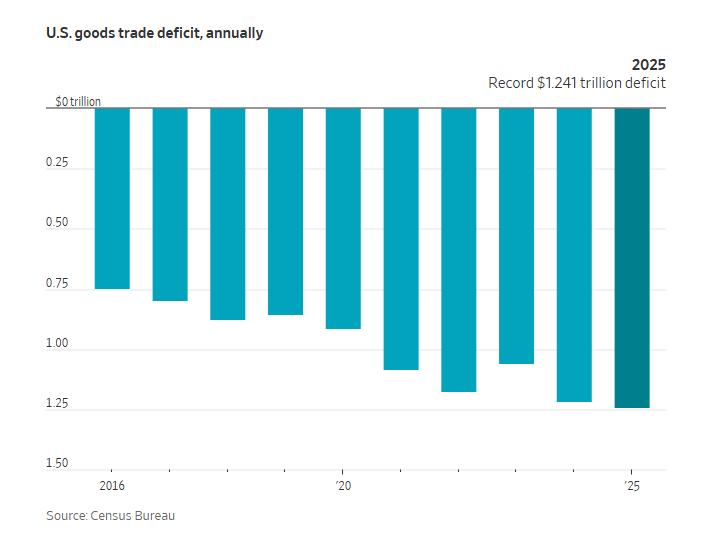
1. Inflation should come down. Regardless of Trump’s denial on the impact on inflation, a recent study from the New York Federal Reserve showed that over the course of 2025, the average tariff rate on US imports increased from 2.6% to 13%. “We find that nearly 90 percent of the tariffs’ economic burden fell on US firms and consumers,” the report said. The recent inflation figures have been worrisome: 3% in December, according to the PCE Price Index. Indeed, lower tariffs should help diminish the pressure. But it would take some time, and that, as long as the freshly announced 15% tariffs do not come into effect. If that were the case, then inflation is likely to remain around 3%, or worse, continue rising.
2. Budget deficit set to skyrocket. The US economy has run out of budget twice in the last six months, and multiple times in the last few decades, with the first shutdown taking place in the eighties under President Ronald Reagan. Tariffs had been a major source of government funding through 2025, and USAFacts.org reported that revenue from tariffs and other import-related fees was up to $194.9 billion in the fiscal year of 2025. If the court ruling goes through, it would have quite a negative impact on the expected revenues for 2026.
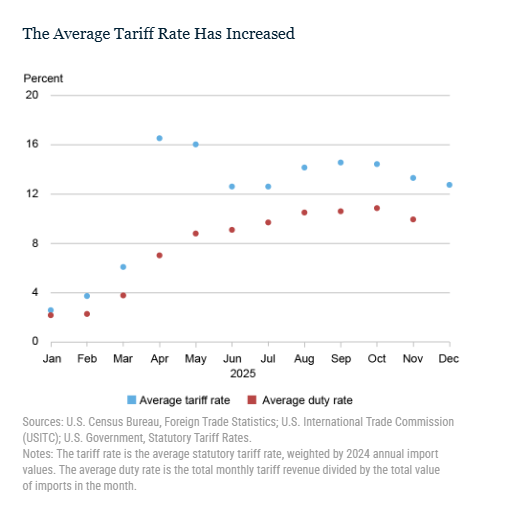
Finally, it's worth adding that the US trade deficit has been growing exponentially since 2012, hitting a seasonally adjusted annual rate of $1.37 trillion in Q1 2025, according to the US Bureau of Economic Analysis, right before Trump’s tariffs came into effect. The deficit improved afterwards, but suffered a major setback in early 2026, with Trump blaming it on the October shutdown.
A lose-lose outcome
Let’s assume Trump abides by the ruling and takes reciprocal tariffs off the table. The deficit will skyrocket, and trade rivals will take real advantage of the US in times of need. Worse, Trump gets his way and the Congress approves his new 15% tariffs every other four months: that would mean higher inflation, to the detriment of households and consumption.
Under no case is the news positive for the US Dollar. Neither is Trump’s stubborn determination to announce higher tariffs while dealing with major counterparts.
Author

Valeria Bednarik
FXStreet
Valeria Bednarik was born and lives in Buenos Aires, Argentina. Her passion for math and numbers pushed her into studying economics in her younger years.