Yen under double pressure: High Energy prices and a tight Fed complicate matters

The Bank of Japan acknowledges the possibility of another rate hike and may raise its inflation forecast for the next financial year because of persistently high energy prices. At the same time, the policy rate is likely to remain at 1.25% at the 30 October meeting, although a further increase in December cannot be ruled out. This could provide support for the yen.
Fed Chair Kevin Warsh continues to point to insufficient monetary policy restraint in the fight against inflation. Markets are assessing the prospect of further rate hikes, which could support the US dollar and limit any strengthening of the yen.
A weak yen increases the cost of imported goods and energy for Japan. Therefore, a sharp depreciation of the Japanese currency could increase the likelihood of action by the Japanese authorities that could lead to a rapid strengthening of the yen.
The fundamental backdrop for USD/JPY remains moderately positive for the US dollar, as expectations of tight Fed policy contrast with the Bank of Japan’s cautious stance. At the same time, the possibility of a Japanese rate hike this year and the risk of intervention limit the pair’s further upside potential. The focus is on the Bank of Japan’s 30 October meeting and signals from the Fed.
Technical analysis
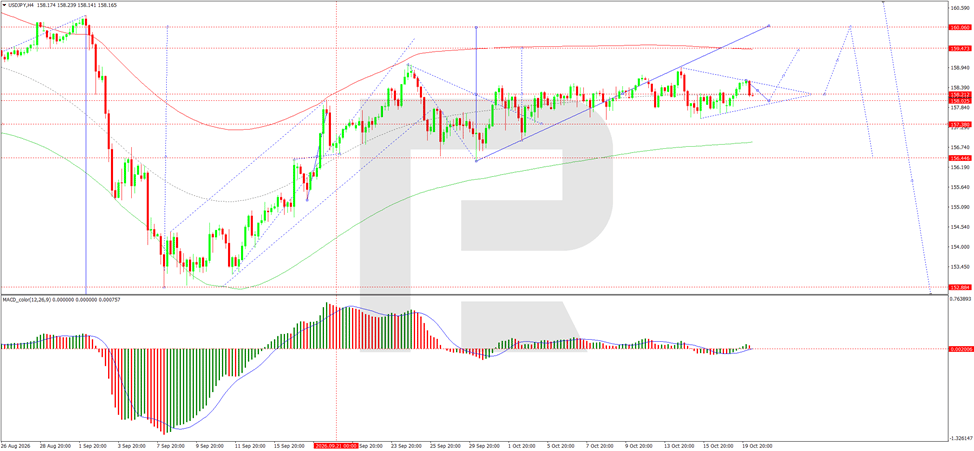
On the H4 chart, USD/JPY maintains an upward structure after recovering from a local low around 153.00. The price subsequently entered consolidation, forming an equilibrium area around 158.22. Consolidation above this resistance led to an upward move towards 158.58, but further gains slowed. The market still has the potential for a corrective decline towards 158.00, followed by a new upward wave. If this support holds, the main target is 159.47; if upward momentum develops, the next target is 160.06. The MACD indicator is near zero, suggesting weakening directional momentum and the need to confirm that buying is resuming.
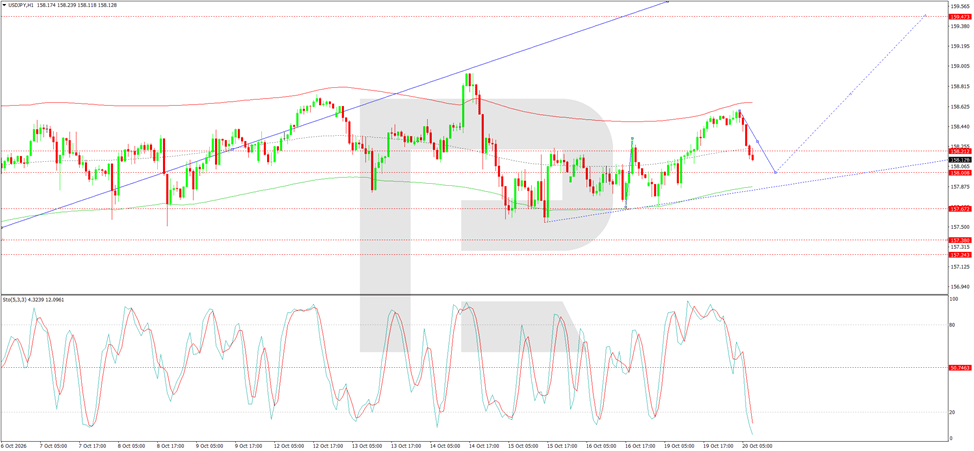
On the H1 chart, a downward correction formed following a test of the 158.58 area. The price is approaching support at 158.00, which coincides with the expected end of the short-term pullback. The Stochastic oscillator has fallen below 20, reflecting increased short-term selling pressure and allowing for a further decline before a possible recovery. If the price stabilises above 158.00, the priority scenario will be a rise towards 159.47. A break above this resistance would open the way towards 160.06. If the price closes below 158.00, the upward scenario will require revision, and the market may continue to decline towards the nearest technical support levels. For the coming day, the baseline scenario therefore remains a correction towards 158.00, followed by an assessment of whether the upward move can resume.
Conclusion
USD/JPY remains caught between two competing forces: the Bank of Japan’s cautious stance and the possibility of a December rate hike, which could provide some support for the yen, and expectations of tight Fed policy, which support the US dollar. Rising energy prices continue to weigh on Japan’s import-dependent economy and could increase the likelihood of action by the Japanese authorities if the yen weakens sharply. Technically, the pair retains an upward bias after recovering from 153.00, with support at 158.00 and targets at 159.47 and 160.06 if the corrective pullback ends. A close below 158.00 would require reassessing the upward scenario and could open the way for further declines. The BoJ’s 30 October meeting and signals from the Fed will be the key catalysts for the pair’s next move.
Author

RoboForex Analysis Department
RoboForex
RoboForex Analysis Department provides timely market insights, expert technical analysis, and actionable forecasts across forex, commodities, indices, and equities.