Finally, the UK jobs market is levelling out

After a torrid couple of years for UK employment, there are growing signs that the worst is behind us and that hiring is starting to stabilise. But that is not the same thing as a jobs market that is heating up. Wage growth is cool and there's scant evidence of second-round effects from the energy shock so far.
Finally, it looks like the UK jobs market might be levelling out.
After a long period of attrition, there are tentative signs that employment is stabilising. Private sector payrolls grew in September for the first time since January, albeit by a modest 8,000. Hospitality – a key area of weakness – also recorded a small increase for the first time in months, having been hammered by last year's combination of a big minimum wage hike and tax increases (retail is still shedding jobs, though).
These figures are prone to a fair bit of revision, but it does tally with signals from some hiring surveys that employment is starting to turn a corner. At face value, it also mirrors the drop in the unemployment rate – 4.9% down to 4.7% – though a fair chunk of that can be explained away by a rise in inactivity. And in any case, these figures are still shrouded in scepticism given long-running sampling problems.
Consumer-facing employment is falling less rapidly
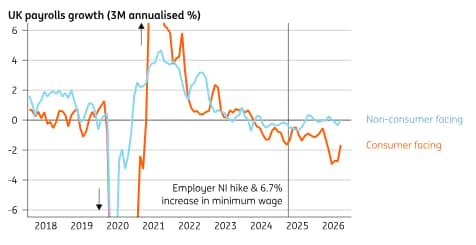
Crucially, though, a jobs market that is stabilising is not the same as a jobs market that’s heating up. And that matters for wage growth. At 3.4% in the private sector, adjusting for so-called compositional effects, pay growth is still consistent with a 2% inflation target over the medium term, by the Bank of England’s own reckoning. And though the data has been quite volatile over the past few months, the one-month annualised increase in private sector regular pay growth was down at 1.7% on the latest reading. BoE surveys on wage growth have been pretty much unchanged all year, around 3.5%.
So when the Bank of England hikes rates in November, as looks increasingly likely, it won’t be because of anything in the economic data. We still have inflation data tomorrow, but so far, there’s scant evidence that the energy shock is broadening out via second-round effects. Instead, a November hike – together with the follow-up move we tentatively expect in February – will be entirely an insurance move. That means that, assuming we don’t get big second-round effects emerging over the winter, the Bank should be in a position to start cutting rates again from late 2027, when the storm has passed.
Author

James Smith
ING Economic and Financial Analysis
James is a Developed Market economist, with primary responsibility for coverage of the UK economy and the Bank of England. As part of the wider team in London, he also spends time looking at the US economy, the Fed, Brexit and Trump's policies.