NFP preview: No signs that AI is destroying jobs so far
- Mixed jobs picture leading up to payrolls.
- No sign of AI jobs cull yet.
- NFP could determine if Fed hikes rates this year.
- If Warsh scraps forward guidance, then jobs report could trigger market volatility.

The US labour market report for May is expected to show that US payrolls grew by 85,000, while the unemployment rate is expected to remain steady at 4.3%; average hourly earnings growth is expected to rise by 0.3% on the month.
Mixed jobs picture leading up to payrolls
The lead indicators for the US jobs report, paint a mixed picture for last month. The ADP jobs data was stronger than expected for May, coming in at 122k, initial jobless claims data has been stable in recent weeks between 210k and 215k, however, the JOLTS job openings data showed a large increase in job openings last month, which rose to their highest level for nearly 2 years. Overall, there does not appear to be a consensus view about the strength of the US labour market going into today’s report, and there is a wide range of analyst estimates, between 45k and 125k, as measured by Bloomberg.
We are going through an unusual period for the US economy. Although growth is holding up, anxiety about the state of the economy is rising, and there are increasing concerns about the impact of AI on the jobs market. However, it is not clear that AI is destroying jobs, yet. The latest Challenger, Gray and Christmas report, that tracks corporate layoffs and hiring trends, showed that there had been over 97,00 job cuts in May, the highest monthly figure since 2020. AI was the most cited reason for layoffs for the third consecutive month.
According to the same report, the tech sector had its worst monthly performance for job losses since August 2024, however, tech stocks having been leading the stock market higher this year. Overall, the US tech sector is higher by more than 30% YTD, and tech stocks have not reflected the increase in layoffs in this sector; instead it has focused on the massive capex spending pledges from the AI hyperscalers.
No sign of AI jobs cull yet
However, the increase in US jobs openings last month came almost entirely from the professional and business services sector, which is considered most at risk from AI. This sector saw job postings rise to its highest level for 3 years, which may ease fears about an AI cull, for now, even if there are pockets of weakness caused by AI, such as graduate recruitment.
The backdrop to this report has been one of a strong stock market rally in the US, which persisted for 9 weeks. Semiconductors are dominating the US trading theme right now, especially memory stocks, and there have been several key performers in recent weeks including SanDisk, AMD and Micron, which reached a trillion-dollar valuation. Although there have bene pockets of weakness, for example Broadcom fell 12% on Thursday and lost $285bn of market capitalization, overall, momentum in US stock indices has been strong leading up to this report, even if price action in the last 24 hours suggest that the AI trade may be pulling back. This is triggering some rotation into other sectors of the US market, and the Dow Jones Industrial Average reached a record high on Thursday as investors turned their backs on tech.
NFP could determine if Fed hikes rates this year
Leading up to this meeting, the Fed Fund Futures market has priced out the chance of a rate cut from the Fed this year. There is now a near 40% chance of a rate hike by year end. We expect financial markets to be extremely sensitive to today’s data. This will be the first NFP report where Kevin Warsh is chair of the Federal Reserve. Ahead of this report, financial markets are already reading US economic data through a hawkish lens: the economy is growing and jobs are plentiful. Due to this, the bigger risk to upside stock market momentum is a stronger than expected reading, rather than a weaker one.
If Warsh scraps forward guidance, then jobs report could trigger market volatility
The new Fed chair is significant for financial markets in many ways, including the changes he plans to implement. Warsh has already explicitly said that he would like to move away from forward guidance. His rationale is that the Fed is not good at forward guidance, and it can cause market volatility. Going forward, there may be less handholding from the Fed, which means that inflation and jobs data like NFP, will become the primary signal for markets.
Due to this, a strong print could harden expectations that the Fed will hike interest rates at some stage later this year. It could also weigh on tech stocks and other growth areas of the market, and dent overall stock market momentum. If today’s NFP report is weaker than expected, then we would expect the dollar to sell off, stocks to continue to trend higher led by tech stocks, and for rate hike expectations to get scaled back.
Overall, with a key change at the Fed, today’s jobs report may determine whether Warsh talks dovish or hawkish at his first FOMC press conference on 17th June.
S&P 500 and the Nasdaq 100
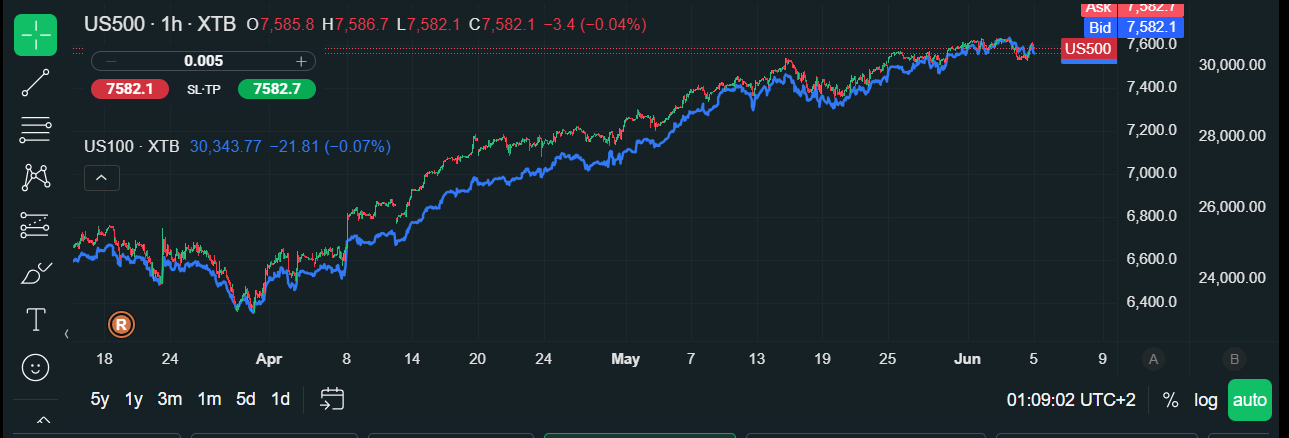
Source: XTB
Author

Kathleen Brooks
XTB UK
Kathleen has nearly 15 years’ experience working with some of the leading retail trading and investment companies in the City of London.