Hawkish Bank of England hikes rates, and there’s more to come
The Bank of England has raised interest rates to 4%, and we expect one further rate hike by February. A renewed spike in energy prices could bring that forward to December. However, we're still sceptical that the Bank will need to hike more than once more.
Every bit of the latest Bank of England decision to raise rates from 3.75% to 4% is more hawkish than expected.
First, even the two arch-doves voted for a hike, meaning every committee member opted for higher rates. Second, the Bank now sees inflation peaking at 4.9%, above our own, and indeed most other economists’, predictions. And third, some – though not all – officials are more forthright than we’d expected about a probable need to tighten policy further.
This reinforces our view that the Bank of England will hike rates again by February, potentially as early as December.
But as things stand right now, the consensus behind the next hike is likely to be much weaker. The two doves – Dhingra and Taylor – are clear that they think this is a one-off insurance hike. Breeden and Ramsden appear to make further tightening at least partly contingent on second-round effects emerging in the data. And Governor Bailey, though pretty clear that he thinks the Bank will need to hike again, remains sceptical about the need for much more tightening beyond that.
This all comes back to the awkward position the Bank finds itself in. It now sees inflation well above 4%, but its latest forecasts reveal this is almost entirely energy-driven – with a gradual pick-up in food inflation baked in too. At least until March next year, it expects services inflation to stay broadly flat, and this remains the key barometer of domestically-driven price pressures.
No data received so far – be it hard data on prices/wages, or surveys – points to signs that the energy shock is broadening across the inflation basket. Remember too that today’s forecasts were made before the latest downward move in energy prices.
Instead, this is a hike solely about the risks. Bailey explicitly says that companies have been shielded by longer energy price fixes and hedging more generally – resilience that won’t last indefinitely. In other words, the Bank will need several more months of data to be sure that the upside risks to inflation aren’t materialising. Implicit in today’s decision is previous BoE research, showing that second-round effects become more likely when inflation exceeds 4%.
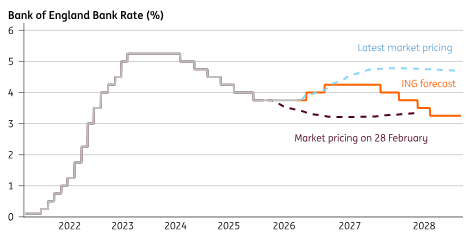
How our BoE forecast compares to markets
Our view is that, against a backdrop of a cooling jobs market, tight fiscal policy and already-restrictive interest rates, the risk of second-round effects is considerably lower than it was in 2022. But we doubt the Bank will feel confident enough to sound the all-clear until the second quarter at the earliest. The April CPI report, released in May, will be particularly important, as many service sector prices are adjusted only once a year, at the start of the financial year.
So what next? If energy prices continue to drift lower – and oil stays below $100/bbl – we think the Bank will feel comfortable holding rates in December, teeing up the next rate hike in February. If the Middle East crisis re-escalates into year-end – as it may well do – then a December hike clearly can’t be ruled out. Markets are now pricing that as a 50:50 call.
We’re still comfortable calling for 50bp worth of tightening in total. That seems consistent with the views of the committee at this meeting. Markets are still pricing roughly four hikes over the next year, but more controversially still, aren’t really pricing in any cuts thereafter.
We think there’s still a good chance rate cuts begin towards the end of 2027 or early 2028, eventually taking rates back down towards 3.25%.
Author

ING Global Economics Team
ING Economic and Financial Analysis
From Trump to trade, FX to Brexit, ING’s global economists have it covered. Go to ING.com/THINK to stay a step ahead.