NATO Summit: Aiming for 5% military spending, but can Europe keep up?

The NATO Summit held this week in The Hague produced an agreement as historic as it was ambitious. Alliance members are now aiming to spend 5% of their GDP on defense by 2035, including 3.5% on "pure" military spending.
A strategic leap forward to reinforce collective security in the face of growing threats, notably from Russia. But can European countries really keep this promise?
Increased military spending to reassure...Trump
Behind this decision lies as much a diplomatic imperative as a military one: to satisfy the demands of US President Donald Trump. The President has reiterated that the United States will remain "friendly" and "committed" to NATO on condition that its European allies assume greater budgetary responsibility. The target was then more than doubled from the 2% threshold adopted in 2014.
"The U.S. has recognized that Europe is back again," the German Foreign Minister was pleased to say, according to CNBC, underlining the renewed unity around a fundamental pillar of NATO: collective deterrence.
Is the new goal set by the NATO Summit realistic?
In reality, the 5% mark seems out of reach for most European countries. Only Germany has a clear plan to reach 3.5% military spending by 2029. The other countries, notably France, Italy, Spain and Belgium, are already struggling to reach the former 2% target.
Spain has even obtained an exception clause from the NATO Summit: it will not go beyond 2.1%. As for Italy, its Defense Minister has publicly acknowledged that 3.5% would be very difficult in the absence of a concrete budget plan.
Misleading figures thanks to creative accounting
However, the NATO Summit has left many doors open. The new threshold includes 1.5% for "defense-related expenditure": infrastructure, cybersecurity, military roads, even some paramilitary forces. This allows countries like France and Spain to recycle some existing spending and show progress without significantly increasing their actual effort.
As a NATO expert summarizes, according to Euractiv, this could bring strict defence spending of some allies down to 1.2% or 1.3% when they need to meet 3.5%, he estimates.
A slow but real rise in military spending
Despite doubts about whether the 5% mark will be reached, one thing is certain: European defense spending is set to grow. By 2024, the Eurozone was devoting an average of 1.8% of GDP to defense, a figure that ABN AMRO forecasts will rise to 2.5% by 2026. Historically lagging countries such as Spain, Italy and Belgium are catching up.
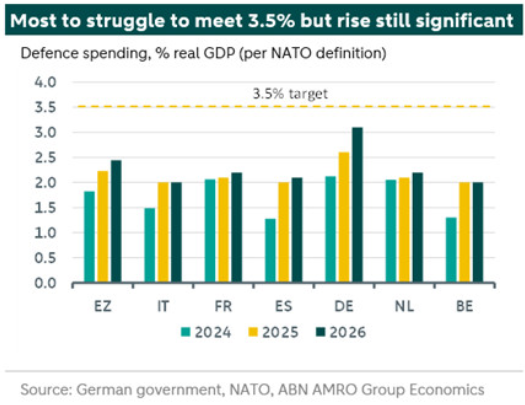
Germany is already planning debt-financed increases in military spending. This has led to a significant increase in public debt issuance, with already visible effects on German long-term interest rates.
A major fiscal and political cost
But this increase in military budgets agreed on at the NATO Summit could be costly, both financially and politically. According to Capital Economics, a rise to 3.5% of GDP financed solely by debt could increase the debt/GDP ratio by more than 10 points in several countries, notably France, Belgium and Italy. These are already fiscally fragile countries, where fiscal margins are virtually non-existent.
Increasing military spending without touching other items would imply cuts in social welfare, pensions and public services — an explosive scenario in electoral terms.
A stronger alliance, provided it remains realistic
For countries close to Russia, such as Poland and the Baltic States, the debate is less sensitive, as their public opinion supports budget increases. But for Western Europe, the real question remains the "how": how to rearm without further weakening public finances under strain. And how to do so without stirring up the populism already lurking in ambush.
By focusing on flexible objectives, the NATO Summit has found a political compromise that is effective in the short term. In the long term, however, military effectiveness will depend less on the magic of numbers than on the coordination of resources: pooling purchases, supporting the European defense industry, and above all defining common priorities.
Political turning point at the NATO Summit
The NATO Summit in The Hague marked a political turning point. The 5% target is, above all, a signal to Washington and Moscow that Europe is taking its security seriously.
But to avoid this commitment becoming a mirage, governments will have to combine strategic ambition with budgetary rigor. Beyond the symbolism, Europe's military credibility is at stake.
Author

Ghiles Guezout
FXStreet
Ghiles Guezout is a Market Analyst with a strong background in stock market investments, trading, and cryptocurrencies. He combines fundamental and technical analysis skills to identify market opportunities.
















