National bank of Poland to keep key rate flat

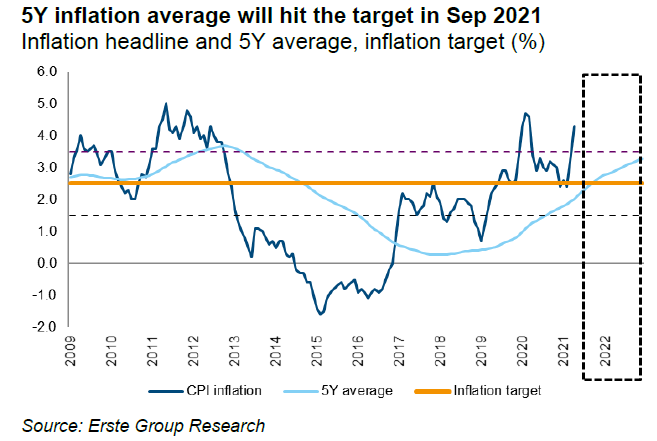
The central bank to stay on hold but any change in the monetary policy setup cannot be ruled out. Friday’s conference of the Governor could bring more clarity about the interest rate outlook. 5Y inflation average to hit the target in September, justifying policy normalization in 4Q21.
Watch this week
June 9 – Central bank to remain on hold
We expect the National Bank of Poland to keep the key rate unchanged at 0.1% at this week’s meeting. Despite surging inflation and strong economic rebound, we believe the NBP will most likely wait until November inflation and growth projections are out and would react only afterward. However, any change in the monetary policy setup already in June cannot be ruled out. As inflation is expected to stay above the upper bound of the central bank’s target until the yearend and likely at the beginning of next year, NBP could deliver a 15bp hike to anchor inflation expectations. Whereas such a marginal increase of the key rate would signal the central bank’s readiness to react, it would likely not negatively affect the economic rebound. Furthermore, this month’s central bank meetings in Czechia and Hungary could be decisive for the future monetary decisions in Poland. If regional central banks begin policy normalization as early as June, it would be difficult for the NBP to defend its loose policy setup. All in all, if inflation stays elevated around the current level the 5Y inflation average will hit the central bank’s target at 2.5% in September 2021, while the 5Y core inflation average will reach that level in April 2022, justifying policy normalization at any time between 4Q21 and 1Q22.
It will be interesting to observe Friday’s press conference of Governor Glapinski, who will likely address the recent surge in inflation and better than expected economic growth in 1Q21. Moreover, we could get more insights on the possible tapering of the asset purchase program given the recent lower activity of the NBP on the bond market and the rejection of most of the bids at the latest tender. As the NBP announced that it will hold only one QE auction in June after holding two in April-May, we expect the central bank to end its QE program after the July projection is out.
Last week’s highlights
-
1Q21 GDP growth has been revised up to -0.9% y/y (+1.1% q/q s.a.). Household consumption stood at 0.2% y/y, while investment growth surprised to the upside and arrived at 1.3% y/y. Domestic demand added 1.0pp to the headline figure, while net export shaved off 1.9pp. We revised our FY21 GDP growth forecast up to 4.8% with risks to the upside.
-
Flash inflation jumped to 4.8% y/y in May on the back of rising food and energy prices.
-
According to preliminary data unemployment rate dropped by 0.2pp to 6.1% in May.
Market developments
Bond market drivers | 10Y yield stabilized around 1.85%
Last week, there were hardly any movements in CEE sovereign bond yields. The long end of the Polish yield curve moved close to 1.85%, while the spread against the 10Y German Bund stayed close to 205bp. While the long end of the curve remained broadly unchanged, market expectations for monetary tightening are pushing the short end further up. The 2Y Polish yield went up by almost 30bp since mid-May and moved toward 0.4% resulting in a visible flattening of the Polish LCY curve. Markets’ expectations for policy normalization are broadly in line with our forecasts as a 10-15bp hike is priced-in by the end of the year, while key rate could increase by a total of 60-65bp within a year. State-development bank BGK sold papers worth PLN 2.3bn at the first auction this month. So far BGK sold bonds worth around PLN 23bn since the beginning of the year. The second BGK auction is planned for June, 30. This week, the central bank meeting and Governor Glapinski’s press conference will be the key events. We expect the MPC to remain on hold but any adjustment to the monetary policy setup cannot be ruled out. Separately, Polish MinFin will hold the first out of two planned for this month switch auctions at the end of the week.
FX market drivers – Zloty awaits the MPC meeting
Over the course of the week, zloty followed other CEE currencies and continued to appreciate, fueled by bets of an earlier start of monetary tightening. EURPLN moved toward 4.46, which is the strongest level since mid-December when the central bank intervened on the FX market in order to tame the zloty’s appreciation. Given that markets have already priced in some tightening, any moderation of the central bank’s rhetoric could result in currency weakening. On the other hand, US CPI data for May and the ECB’s Governing Council meeting could both bring a surprise and thus affect the US dollar and the zloty. US consumer prices jumped surprisingly strongly in April on the back of price increases triggered by the ramp-up of the economy. Markets will be closely watching the pace of inflation and the sectors from which the increases are coming. The ECB Council will decide on the pace of its asset purchases under PEPP in the third quarter, also on Thursday. We expect the elevated level of purchases to be extended from the second to the third quarter. But the outcome bears some uncertainty due to the ECB’s very vague guidelines and contradicting statements by ECB officials recently. Should the ECB lower asset purchases, the EURUSD is likely to rise, which would be positive for the zloty.
Author

Erste Bank Research Team
Erste Bank
At Erste Group we greatly value transparency. Our Investor Relations team strives to provide comprehensive information with frequent updates to ensure that the details on these pages are always current.
















