More fiscal woe for the UK, as OBR highlights risks to public finances
- UK bond yields jump on latest OBR report.
- The UK is in one of the worst fiscal positions in the world.
- Successive governments have skirted the issue and failed to reign in public sector spending.
- Pensions are a major risk for the public finances, in direct and indirect ways.
- Bond market volatility could be a feature of the future.

After last week’s spike in UK borrowing costs on the back of the fallout of the welfare reform rebellion and rumors that the Chancellor was about to be replaced, the UK government was hoping for a quiet period in UK bond markets. However, the OBR report on Fiscal Risks and Sustainability, has spooked markets once again.
UK long term bond yields have risen sharply on Tuesday, the 10-year yield is rising at a faster pace than its European counterparts and is up more than 5bps, the 30-year yield is higher by 7bps. This is not a major move compared to other wobbles, but it adds to the pressure on the UK bond market. At the same time as bond yields are rising in the UK, the pound is falling. GBP is the second worst performer in the G10 FX space on Tuesday, behind the Japanese yen, which is also suffering from a slump in bond prices and a jump in bond yields.
UK bonds follow Japan
Japan’s long-term bonds sold off earlier on Tuesday, as investors digested news about the 25% tariff on exports to the US. However, if UK bond yields are moving with Japan, this is a dangerous development. Japan’s national debt is the highest in the developed world and is 216% of GDP. Recent developments suggest that UK bonds will remain sensitive to any upside movement in global sovereign bond yields, which is a further sign that UK sovereign debt is considered risky.
UK yields may have moved in line with Japanese yields this morning, however the Office for Budget Responsibility added a domestic force to the weight on UK bonds today. The OBR published its latest fiscal report this morning, which exacerbated the sell off. The Prime Minister may now have aquiesed to the bond vigilantes’ demands last week, and confirmed Rachel Reeves will stay on as Chancellor, however, he cannot so easily stem fears from this report.
The OBR laid out the scale of the UK’s fiscal problems, and who was to blame: spinless governments.
- A series of global shocks have weakened the UK’s public finances.
- We now have the fifth highest budget deficit out of 36 advanced economies. UK government debt is the sixth highest among advanced economies, and we have the third highest borrowing costs compared to other advanced economies.
- Efforts to put the UK’s public finances on a better footing have not worked, and have only been temporary, this is why the public finances are getting worse.
- The OBR was critical of governments who continued to spend even after the Covid pandemic. The OBR takes aim at the abandoned efforts to reign in public sector spending, as more significant than scrapped tax rises as reasons why the public sector finances are in such bad shape. Ah hem, Labour backbenchers.
Pensions could add to the UK’s fiscal woes
The OBR’s report does not paint a pretty picture for the future, which also makes for uncomfortable reading for the Treasury. Pensions are a big risk for the UK’s fiscal position, according to the OBR.
- The triple lock and an aging population will significantly increase the cost of pensions, which is the second largest item on the public sector balance sheet after the NHS.
- Pensions cost 5% of GDP today, this is expected to rise to 7.7% of GDP by the 2070s.
- Up to 40% of people are not saving enough into private pension schemes and could require state help to meet the target replacement rate for pension income relative to working-age income.
- The shift from Defined Benefit to Defined Contribution pension schemes is expected to lead to a significantly lower pensions sector holding of Gilts as a share of GDP. This adds a technical challenge to the UK’s fiscal situation: who will buy the national debt?
- The decline in pension holdings of Gilts could push up UK borrowing costs by 0.8%, and potentially even higher interest rates would need to entice foreign buyers.
The OBR also cites risks such as water companies, housing associations and higher education institutions that all have high levels of debt that the government could become liable for. The costs of rising temperatures and volatile weather could also weaken the public sector finances, as the government has to spend money on heat-related issues and flood defences etc. The OBR cites climate change as a major risk to the UK’s public finances.
The overarching concern for the OBR is that the current stretched state of the public finances, means that the UK is not well equipped to deal with future crises.
What the future holds for the UK bond market
Overall, the OBR delivered their report a week too late for Kier Starmer to persuade his backbenchers of the need to get control of the benefits bill. From the perspective of financial markets, this report suggests that UK bond market volatility will be a regular feature in the coming months and years and may lead to elevated bond yields compared to our global peers. It also suggests that sterling could be at risk from sharp, sudden declines, even if it has remained well supported in recent years.
The long-term risks
Macro risks, that could make it harder for the government to borrow in the coming years, will have an impact on the micro, making it harder for individuals to borrow to fund businesses and buy homes, with devastating consequences for the UK economy.
The OBR report is not an easy read and it suggests that the UK could be sleepwalking into a fiscal crisis without a brave government who will get control of the public finances. However, the OBR is meant to alert us to the fiscal risks and dark corners that are lurking in the future.
Chart 1: UK 10-year Gilt yields and GBP/USD, as Gilt yields rise, the Pound can slump.
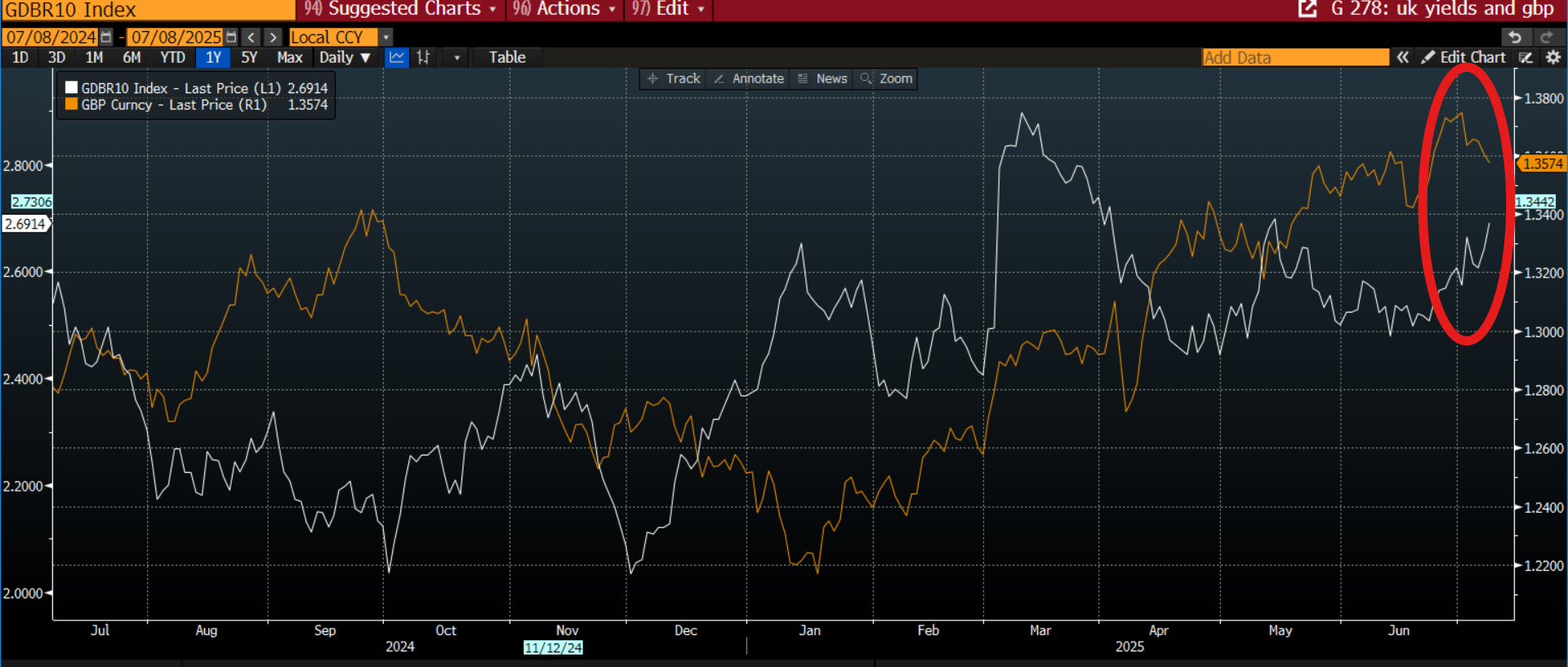
Source: XTB
Author

Kathleen Brooks
XTB UK
Kathleen has nearly 15 years’ experience working with some of the leading retail trading and investment companies in the City of London.