Gold steadies as haven demand offsets stretched momentum

Gold prices are holding firm near recent highs as persistent haven demand continues to offset signs of short term momentum fatigue. While the metal has struggled to generate clean upside follow through above the 5200 area, the broader macro backdrop remains supportive enough to keep downside pressure contained.
Recent market headlines reinforce this balance. Ongoing tariff uncertainty and intermittent geopolitical tensions are maintaining a defensive allocation bias across precious metals. At the same time, US real yields have failed to produce the kind of sustained breakout that typically triggers deeper gold corrections. The result is a market that is no longer accelerating higher but is also not showing the characteristics of a structural downturn.
From a macro perspective, the behavior of real yields remains the dominant variable. Gold tends to face its most persistent headwinds when inflation adjusted rates move decisively higher. That dynamic has not yet materialized. Recent yield moves have been uneven and lacking follow through, allowing the opportunity cost of holding gold to remain relatively contained.
Renko structure shows controlled rotation
Market structure is now starting to reflect a transition from impulsive strength to controlled consolidation. On the Renko 30 framework, price action shows repeated dip absorption, with the market consistently finding support above the 5175 region and rotating back toward the 5195 to 5200 resistance zone. This pattern is typical of a market that is digesting prior gains rather than entering distribution.
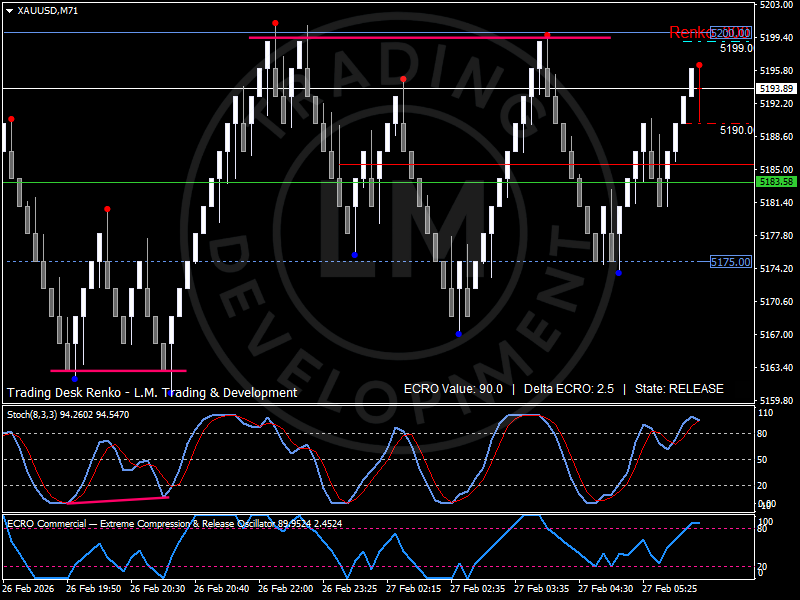
Importantly, the Renko sequence does not yet display the clean pattern of lower highs and expanding downside legs that would normally characterize a bearish regime shift. Instead, pullbacks remain shallow and relatively short lived. Sellers have so far struggled to secure acceptance below key structural support, reinforcing the view that the broader trend remains intact even as momentum cools.
ECRO signals a mature release phase
The Extreme Compression and Release Oscillator provides further confirmation that the market is entering a late stage phase of the current move. ECRO readings remain elevated and the state continues to register as release. Historically, this configuration tends to signal that the bulk of the directional impulse has already occurred.
However, an elevated ECRO reading should not be interpreted mechanically as a bearish trigger. More often, it indicates that the market is likely to transition into a period of sideways rotation or controlled pullback while internal momentum resets. This appears consistent with current price behavior, where gold is compressing just below resistance rather than breaking sharply lower.
Momentum indicators are also beginning to show early signs of cooling without yet confirming a full rollover. This reinforces the idea that the market is moving into a digestion phase. In many past cases, similar conditions have led to choppy range trading before the next directional decision emerges.
What could change the picture
The key levels to monitor remain well defined. Immediate resistance sits near the 5195 to 5200 band, where repeated tests have so far failed to produce clean acceptance. A sustained break above this zone would likely reopen the path toward fresh highs and signal that consolidation has resolved to the upside.
On the downside, the first structural support is located around 5175, with the more critical floor near 5150. As long as price continues to hold above this broader support region, the constructive medium term bias remains valid. A decisive break below 5150 would be required to signal that sellers are beginning to gain meaningful control.
Looking ahead, the primary macro risk to gold’s stability would be a coordinated move higher in real yields alongside a stronger US Dollar. Either development could begin to erode the current support structure by increasing the opportunity cost of holding the metal. For now, however, both variables remain contained and have yet to show the persistence required to drive a sustained bearish shift.
Outlook
In the near term, gold appears set to remain in a sideways to slightly higher regime. The combination of steady haven demand, contained real yields and a still constructive Renko structure suggests that the market is consolidating from a position of strength rather than preparing for immediate reversal.
Traders should watch whether the current compression resolves through time or through price. If momentum cools gradually while support levels continue to hold, the broader bullish framework is likely to remain intact. Conversely, a decisive loss of the 5150 area would mark the first meaningful structural warning that the balance is beginning to shift.
For now, the dominant signal remains one of controlled consolidation with an underlying supportive bias. Gold is no longer in a clean impulsive advance, but the evidence still falls short of indicating a durable bearish turn.
Author

Luca Mattei
LM Trading & Development
Luca Mattei is a market analyst focusing on FX, metals, and macroeconomic trends. He develops trading tools for retail and professional traders, coding indicators and EAs for MT4/MT5 and strategies in Pine Script for TradingView.














