Markets search for direction ahead of Powell testimony

When you’re all in, you’re all in. Michael ‘diamond eyes’ Saylor revealed MicroStrategy (MSTR) has doubled down on its double down by purchasing yet more Bitcoin. The company has bought an additional 13,005 Bitcoins for roughly $489 million in cash at an average price of $37,617 per coin. “As of 6/21/21 we #hodl ~105,085 bitcoins acquired for ~$2.741 billion at an average price of ~$26,080 per bitcoin,” he tweeted. Shares declined almost 10% as investors fretted over this decision and watched Bitcoin prices skid to near the $30k support before paring losses to trade in the $32k area - 50% down from its all-time high in April. Whether he’s making the call of the century or he’s dead wrong is kind of irrelevant – how on earth can the CEO of a public company be allowed to take such a massive gamble on such a volatile asset? $30k will be defended to the death - if it goes expect a bloodbath, and Saylor’s bet will look like a monumental mistake. Meanwhile, China continues its clampdown with the PBOC telling Alipay and other banks not to provide any services such as trading, clearing, and settlement for crypto transactions and to do more to prevent speculation on cryptocurrencies. Whilst, not a new policy as such, it underlines how China is taking a very hard line on this, particularly in the wake of the mining clampdown.
Stocks recovered their poise on Monday with the Dow up 586pts and the S&P 500 rallying 1.4%. The FTSE 100 is back above 7,000 this morning as the unwind in reflation bets reversed and higher oil prices helped the majors. WTI rose above $73 and Brent above $75, levels not seen since Oct 2018. Benchmark US 10-year yields traded back at 1.5%, having slipped as low as 1.36%. A lot of the unwind we saw last week post the FOMC has been clawed back after a sterling Monday session – I fear there is too much uncertainty to have much conviction and we are back in a market that will chop up both longs and shorts, just as we were in March.
New York Fed President John Williams reiterated that the US central bank is not moving quickly, despite what most saw as a hawkish statement last week. “It’s clear that the economy is improving at a rapid rate, and the medium-term outlook is very good. But the data and conditions have not progressed enough for the FOMC to shift its monetary policy stance of strong support for the economic recovery,” he said. The usually hawkish Dallas Fed president Robert Kaplan said making an adjustment to asset purchases sooner rather than later would be “healthier”.
Meanwhile in prepared remarks ahead of his Congressional testimony today, Fed chair Jay Powell reiterated that the Fed is not unduly concerned that hot inflation readings are here to stay. “[As] transitory supply effects abate, inflation is expected to drop back toward our longer-run goal,” he says. His testimony from 7 pm (BST) is likely to be market-moving – particularly if he says anything considered as hawkish. We will want to see whether he seeks to row back on the messaging the market took from last Wednesday.
It’s worth remembering that the bout of selling we saw in equity markets on Friday came after St Louis Fed President James Bullard said the Fed could raise rates as early as next year. There is a lot of uncertainty about the recovery – both its pace and duration – and what the Fed is thinking and where it should be a year, two years from now. For some time, the market had bought hook, line and sinker into the lower-for-longer mantra that average inflation targeting and the employment focus implied - without adjusting to the economic (and health) realities of the last three months that has brought forward the timing of tightening. Beware linear thinking – things change.
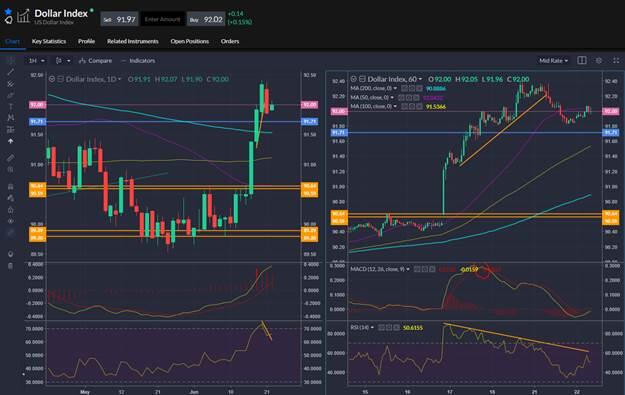
A lot of dollar shorts will have been cleared out by the rally but this is now on pause after a small pullback in yesterday’s session. A bullish crossover on the hourly MACD but it’s close to the zero line so not as forceful an indicator. 92 now acting as the near-term resistance.
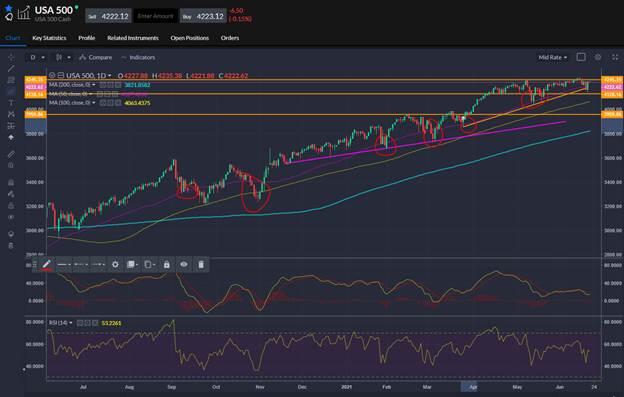
S&P 500: watch the bear traps at the 50-day line.
Author

Neil Wilson
Markets.com
Neil is the chief market analyst for Markets.com, covering a broad range of topics across FX, equities and commodities. He joined in 2018 after two years working as senior market analyst for ETX Capital.