Market mood settles, but fault lines remain

Mood settles
Currency markets tiptoe into the long weekend with the calm of a holiday lull, but don’t mistake the quiet for complacency. Volumes are thinning, ranges are compressing, but the tape still feels twitchy—like a coiled spring waiting for a trigger. Behind the scenes, the G7 finance ministers wrapped up in Banff with their usual communiqué niceties, but the subtext was sharper than the alpine air.
Their reaffirmation of floating exchange rates and warning against “unsustainable macro imbalances” was diplomacy-speak for calling out China’s persistent current account surplus and the U.S.’s ballooning twin deficits. It’s not new, but it’s timely. With trade tensions reawakening and capital flows getting pickier, FX traders are watching for signs that these coded messages could evolve into real policy pivots.
The dollar opens the London session on the back foot, with DXY grinding slightly lower and likely to meander within its familiar 99.30–100.30 cage. Despite the subdued price action, the underlying tone remains heavy, and not without reason. Beneath the surface, the cracks in U.S. rate markets are still spreading—none more glaring than the 10-year swap spread, which remains stubbornly above 55bp, flashing systemic stress like a warning buoy in a fogbound channel.
That dislocation isn't just a technical quirk—it's a signal. And the message is clear: liquidity's thinning, dealers are defensive, and the marginal bid for duration is evaporating. Confirming the drift, Fed custody holdings for foreign official accounts dropped another $10 billion last week, taking the drawdown since April to $30 billion. The steady bleed in sovereign demand isn’t just about Japan or China trimming the fat—it’s a broader indictment of confidence in the U.S. fiscal trajectory.
All eyes now turn to the April TIC data in mid-June, which could throw gasoline on this slow-burn selloff if it reveals which sovereigns are behind the retreat. If the unwind skews heavily toward Asia or Middle East accounts—particularly reserve managers historically seen as price-insensitive—it may confirm what the market’s already whispering: that the great rotation away from U.S. paper is no longer a risk—it’s underway.
The G7 may have stuck to the boilerplate on FX—no explicit dollar-talk, no fresh jawboning—but markets aren’t buying the neutrality. The absence of new language is itself a tell, and traders are reading between the Banff lines: the U.S. is still nudging for a weaker dollar, just without the headlines. After all, why rattle the cage when you can let positioning and policy divergence do the talking?
That strategic ambiguity is keeping implied vols bid. One-month EUR/USD is still hovering above 7%, while USD/JPY vol remains stubbornly north of 10%—hardly the backdrop of a market exhaling. The ghost of “Liberation Day” still looms large, with FX desks scarred from recent disorderly repricings and option markets pricing in further aftershocks.
There’s no smooth glide path back to low-vol summer trading. Between geopolitical tripwires and fiscal fault lines widening, this is a market braced for tail risk.
In euro land, the tone is decisively dovish but deceptively resilient. With June’s ECB rate cut fully baked in after soft PMIs and conciliatory minutes, the 25bp trim to 2.00% looks like a done deal—and markets are already eyeing a follow-up in December. But here’s the twist: the euro isn’t flinching. Instead of rolling over, EUR/USD is hanging tough, buoyed by repatriation flows and a subtle exodus from U.S. assets. March’s BoP data told the story loud and clear—eurozone investors dumped €40 billion in foreign equities, the biggest unwind since September 2022. This isn’t just technical rebalancing; it’s strategic repositioning.
Today’s flashpoint is ECB Chief Economist Philip Lane and the central bank’s wage growth update. If 2025’s negotiated wage projections show any cooling, it could clip the euro’s wings temporarily—but with a solid floor at 1.1275 and a ceiling near 1.1375, the single currency looks range-bound yet steady, a rare pocket of calm in FX.
Meanwhile, across the Sea of Japan, the yen is stealthily preparing for a regime shift. Core CPI just came in hotter than expected, and this isn’t just noise—it’s a flare in the dark. The BoJ, long the last holdout in global normalization, is now under pressure to break ranks. Odds are rising for a 25bp hike in July—not because they want to, but because inflation is giving them no choice.
Still, don’t confuse this for a full-blown pivot. With Trump’s tariff threats dangling over the global supply chain and domestic consumption still fragile, the BoJ isn’t about to start a hiking cycle. This is a tactical move, not a structural shift. Think “poke and pause,” not “lift-off and launch.”
Fault lines remain
The greenback is starting to look like the fall guy in the global bond rout. While all eyes are on exploding long-end yields—be it Treasuries or JGBs—it’s the dollar that’s quietly absorbing the spillover. After Moody’s pulled the trigger on a US sovereign downgrade, traders didn’t just yawn this time. The fiscal alarm bells rang a little louder, and the market’s response has been clear: sell dollars, buy volatility.
The dollar index is down nearly 1% this week and over 7% year-to-date—marking the worst annual kickoff since records began in 2005. That’s not just a pullback—it’s a statement. And what it's saying is that the fiscal decay narrative is starting to seep into price action. The combination of widening deficits, trillion-dollar issuance cycles, and no political appetite for restraint is finally starting to corrode confidence in the greenback as the “cleanest dirty shirt” in FX.
If these fiscal concerns persist—and with tax cuts and spending hikes on deck, that’s a safe bet—the dollar’s role as a global safe haven may erode further. Add in Treasury market dysfunction, swelling term premiums, and rising foreign reluctance to absorb US duration, and the dollar's vulnerability could extend well beyond a Moody’s downgrade headline.
The irony? The dollar’s fall isn’t about relative growth or rate differentials anymore. It’s about credibility. And when that goes, it doesn’t take a Fed pivot or recession to break the buck—it just takes enough capital questioning whether America’s fiscal trajectory is still sustainable. Right now, that question is getting louder.
The real bond market dumpster fire
The real bond market dumpster fire this week isn't in the U.S.—it's in Japan, where the JGB long-end just exploded, setting off alarm bells far beyond Tokyo. While traders were busy wincing at the U.S. 30Y yield kissing 5.15% after a limp Treasury auction, Japan’s 30Y and 40Y yields quietly spiked to all-time highs after a historic 20Y auction tail that reeked of desperation. If you were long JGBs, this was the kind of week that torches careers.
This isn't just a technical puke. It’s a full-blown regime shift in the JGB market—and it's being driven by a collapsing supply-demand equilibrium, most visibly at the long end. Life insurers—the traditional deep-pocketed buyers of duration—are walking away, spooked by negative duration gaps and new solvency rules that make 40Y JGBs effectively unbuyable. Many of them have flipped to net sellers. Throw in Japan’s flirtation with fiscal fireworks ahead of the Upper House election, and it’s no wonder there’s no natural bid. The BOJ may hold 52% of the market, but it’s not doing much when auctions start trading like penny stock placements.
Overlay that with a string of massive block reinsurance deals where foreign reinsurers dump JGBs to chase yield, and what you’ve got is the most toxic cocktail for back-end JGBs since the ‘80s. Swap spreads are screaming, 10s30s is steepening hard, and vol is finally showing up in swaptions—specifically at the 30Y point, which has decoupled violently from the rest of the curve. The result? A bidless void that’s shoving Japanese long-end rates into uncharted territory.
And here’s the kicker: this long-end carnage isn’t just a local story. Goldman’s variance decomposition model suggests that 30Y JGBs have thrown an 80bps curveball into G4 yields since April—yes, Japan is driving the global bond market selloff. Forget “Made in America”—the bear steepener is now a Japanese export.
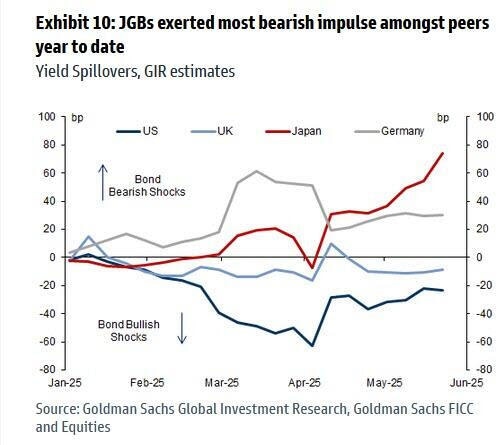
Yet unlike the U.S., where bond routs trigger equity cracks and dollar jitters, Japan's long-end stress is still siloed. For now. But that can change fast. The BOJ is boxed in. They can tweak QT or revive Rinban (read: stealth QE), but the bigger picture remains: Japan is waking up to inflation and a world where duration supply keeps rising while the demand base shrinks. The illusion of infinite JGB demand is unraveling.
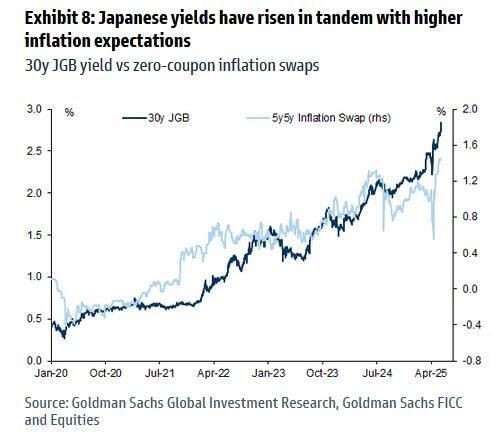
In the near term, market whispers suggest the MOF may reduce issuance or run off-the-run buybacks to restore order—but that’s tactical firefighting. The structural story is far darker. Lifers are out. Foreigners aren’t stepping in. And if Japan’s fiscal optics worsen—or the BOJ botches its June message—things could spiral.
The trade? For now, the 30Y JGB is the canary in the duration coal mine. Any relief rally is a fade unless the BOJ goes full dove. Until then, global back-ends are skating on Japanese ice, and any sharp reversal in JGB yields will likely ripple across Treasuries, Bunds, and gilts alike.
Author
Stephen Innes
SPI Asset Management
With more than 25 years of experience, Stephen has a deep-seated knowledge of G10 and Asian currency markets as well as precious metal and oil markets.