Last time ZEW index was so low, Draghi was saving Euro with his:”whatever it takes”

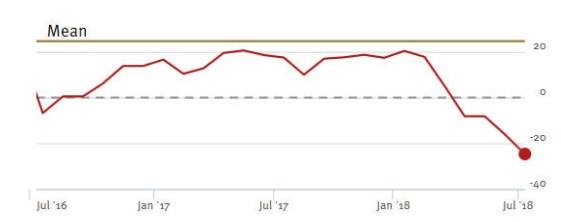
- German ZEW index of investors’ sentiment fell 8.6 points to stands at - 24.7 points in July, the lowest reading since August 2012.
- Investors sentiment in Germany is driven lower by expectations component that has declined steeply since the beginning of this year.
German ZEW index of investors confidence fell 8.6 points in July to -24.7, the lowest level since August of 2012 with the steepness of the curve indicating that recession is knocking on the German door, especially as the deviation of ZEW index from its long-term average of 23.2 is widening.
Particularly worrisome is the slide of the expectations sub-index of investors confidence that has sunk by a considerable 45.1 points since the beginning of the year. The assessment of the current economic situation in Germany decreased by 8.2 points, leaving the corresponding indicator at 72.4 points.
The last time German investors confidence stood at current levels back in August of 2012 it was the ECB President Mario Draghi with his famous “whatever it takes” statement that has become the strongest defense of the Euro up to now, prompting markets to rally.
On July 26, 2012, the ECB President Mario Draghi was speaking in London and gave few hints about the Eurozone economy. The Eurozone periphery bond yields were soaring at that time, and traders were in serious doubt about the ability of the national or EU-level institutions acting promptly to avert the economic disaster.
Newly appointed ECB President Mario Draghi convinced the international investors that the region’s economy wasn’t as bad as it seemed by saying: “Within our mandate, the ECB is ready to do whatever it takes to preserve the euro. And believe me, it will be enough.”
The Euro was trading at cyclical lows of 1.2100 in July of 2012 and Draghi’s surprising comment boosted the markets with Euro rising 10 big figures to 1.3100 by the end of September 2012.
With the ECB President Mario Draghi sounding optimistic on the economic growth in the Eurozone while delivering his testimony in the European parliament last week, there was no need to save Euro by using the extraordinary language as the ECB is heading towards the end of its asset purchasing program delivered and implemented under Draghi’s leadership as highly non-standard measure.
The slide of German investors confidence even as it weighs on Euro temporarily, it is not perceived by markets as the leading indicator for the economic development for the Eurozone. The reason is, that the sample in the survey is unique, rather small and represents the German bankers. Therefore there is no need to repeat “whatever it takes” with ZEW sliding lower.
Author

Mario Blascak, PhD
Independent Analyst
Dr. Mário Blaščák worked in professional finance and banking for 15 years before moving to journalism. While working for Austrian and German banks, he specialized in covering markets and macroeconomics.