Kiwi surges as RBNZ holds rates

NZD/USD rebounds to one-week high
The Reserve Bank of New Zealand kept its benchmark rate unchanged at 1% at this morning’s policy meeting while noting that the coronavirus is emerging as a downside risk for the local economy. Already the tourism industry is taking a hit, with Chinese nationals barred from entering the country, and other export markets could suffer.
In addition, the RBNZ adjusted its rate path higher, seeing the June 2020 Overnight Cash Rate (OCR) at 1.01% versus 0.9% previously and the June 2021 level at 1.1%, also from 0.9% prior.
Ahead of the meeting, most analysts were expected a no-change announcement but interest rate markets were implying an 80% chance of a cut, so the unchanged announcement and upward adjustment to the rate path meant the reaction post-meeting was greater than normal. The kiwi surged more than 1% versus the US dollar and Japanese yen, while AUD/NZD fell the most since November 13.
Q1 GDP forecast halved
In the subsequent press conference, Governor Orr mentioned that the Bank has assumed the coronavirus would last six weeks, but doubted there would be a need for policy adjustment due to the virus effect. The Bank had removed half of the expected GDP growth in Q1 from its forecasts. Westpac estimates the virus shock could trim Q1 GDP to just 0.1% while ASB Bank predicts a 0.1% contraction.
NZD/USD rose the most since December 2 and tested the 100-day moving average at 0.6470. The 200-day moving average sits above at 0.6501.
NZD/USD Daily Chart
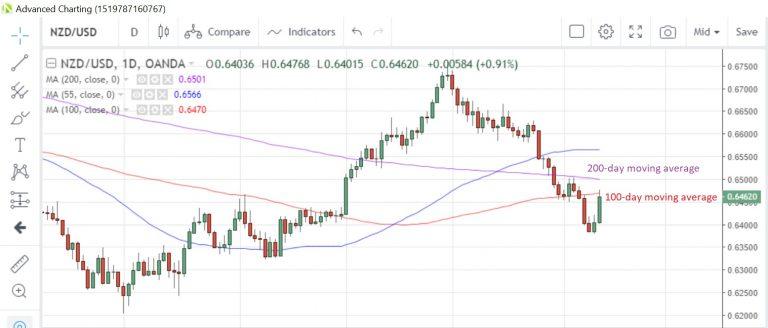
Source: OANDA fxTrade
Powell lifts Wall Street
In the first day of his semi-annual testimony, Fed Chairman Jerome Powell said the US economy seemed quite resilient, though the coronavirus outbreak remains an uncertainty. He added that as long as incoming information about the economy remains broadly consistent with the current outlook, the monetary policy stance will likely remain appropriate. He also didn’t mention any shift to current policy thinking that rates will remain on hold throughout 2020.
Most US indices crept higher yesterday, posting modest incremental gains to reach new record highs. The rally was extending during a quiet Asian session, with US indices adding between 0.11% and 0.20%. Asian equities were mixed, with the Japan225 index slipping 0.32% while the China50 index rose 0.03%, and the HongKong33 index gaining 0.17%.
Coronavirus update
Optimists looking at the coronavirus data will focus on the fact that the number of new cases in China rose at the slowest pace since January 30, and the increase in the number of virus-linked deaths slowed to 97 from 108 the previous day. Should we see the number of new cases grind to a halt in the not too distant future, that would a boon for risk appetite.
Powell part two
The data calendar is again quite barren today, with Powell’s second day of testimony the major highlight. He’s not likely to shift from the tone of yesterday’s testimony and it is the Q&A session which will garner more interest.
Euro-zone industrial production probably fell 1.6% m/m in December, wiping out November’s small increase of just 0.2%. ECB’s Lane is scheduled to speak today. The UK reveals its Autumn budget statement while Fed’s Harker speaks before Powell’s testimony.
Author

Andrew Robinson
MarketPulse
A seasoned professional with more than 30 years’ experience in foreign exchange, interest rates and commodities, Andrew Robinson is a senior market analyst with OANDA, responsible for providing timely and relevant market commentar