July flashlight for the FOMC blackout period – Rate cuts coming into view

Summary
Congress has given the Federal Reserve a dual mandate of "maximum employment" and "price stability." With inflation surging to a 40-year high in 2022, the FOMC largely has focused on its "price stability" mandate in recent years.
However, inflation is showing signs of moving back toward the FOMC's target of 2% on a sustained basis, and the labor market has softened somewhat recently. In short, the implicit weighting of the two objectives in the FOMC's reaction function seem to be moving back into balance.
We do not believe a consensus exists among FOMC members to cut rates at the upcoming meeting. But, we think the Committee will signal via its post-meeting statement that a rate cut could come as soon as its next meeting on September 18. Specifically, the FOMC likely will indicate it has seen more material improvement on inflation in recent months. We also expect the statement to acknowledge the Committee is now attentive to labor market risks as well, rather than focusing solely on inflation risks.
The real fed funds rate has crept higher in recent months as inflation has receded. This passive tightening of monetary policy is another reason for the FOMC to consider policy easing in the not-too-distant future.
In our view, the presidential election on November 5 will not preclude a rate cut on September 18, if conditions warrant. The historical record shows that political considerations do not seem to enter the FOMC's calculus.
The objectives of the Fed's dual mandate are moving into balance
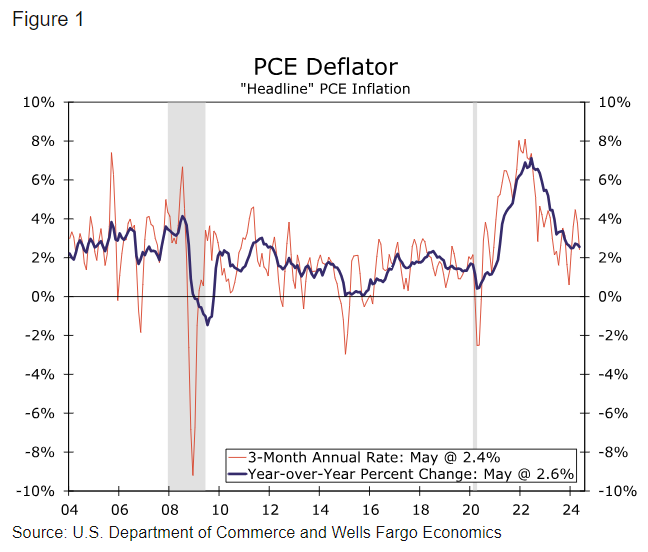
Congress has given the Federal Reserve a dual mandate: “maximum employment” and “stable prices.” The former is more of a theoretical concept than a precise target, but Fed officials have chosen to define the latter as a 2% annual change in the price index for personal consumption expenditures (PCE). Prior to the pandemic, when PCE inflation was consistently running at, or below, 2%, the Federal Open Market Committee (FOMC) seemed to have placed equal weight on these two objectives when setting the stance of monetary policy. However, the surge in the year-over-year rate of PCE inflation to a 40-year high of roughly 7% in 2022 led the FOMC to focus almost entirely on the price stability part of its dual mandate (Figure 1). Consequently, the FOMC jacked up its target range for the federal funds rate by 525 bps between March 2022 and July 2023, the fastest pace of monetary tightening since the early 1980s.
However, the implicit weighting of the two objectives in the FOMC's reaction function seem to be moving back into balance due to recent economic developments. For starters, inflationary momentum is slowing. The PCE price index rose at an annualized rate of 2.4% between February and May, down sharply from the 3.8% annualized rate that was registered in April (Figure 1). If our forecast of a 0.1% monthly increase in the PCE price index in June is accurate—the data are scheduled for release on July 26—then that three-month annualized rate of change will slow to only 1.3%. Inflation also appears to be back near the Fed's target when looking at the less volatile core PCE index, which we estimate rose at a 2.0% annualized rate in the three months through June. Over the 12-month period ending in June, we expect both headline and core PCE inflation to have risen 2.5% and 2.6%, respectively. Although still above the FOMC's 2% target, inflation has returned to a pace much more in line with recent history.
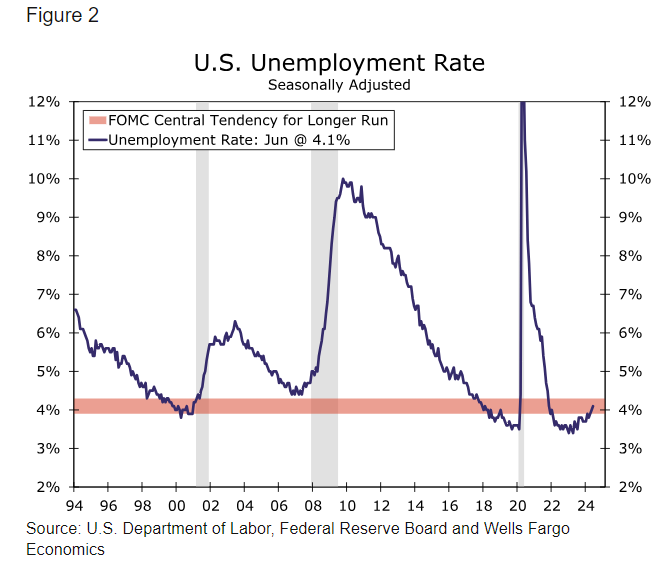
On the other side of the mandate, a number of indicators suggest that the labor market is softening. Growth in nonfarm payrolls slowed from an average monthly increase of 267K in the first quarter to 177K in the second quarter. The unemployment rate, which was as low as 3.4% in April 2023, has moved up to 4.1% (Figure 2). Continuing claims for unemployment insurance have risen to their highest level since November 2021, indicating it is taking longer for unemployed workers to find new jobs. The job openings rate, which measures total job openings as a percent of payrolls plus openings, has receded considerably over the past two years and currently stands near its level of late 2019.
Author
Wells Fargo Research Team
Wells Fargo