July and the no good, very bad jobs report
Summary
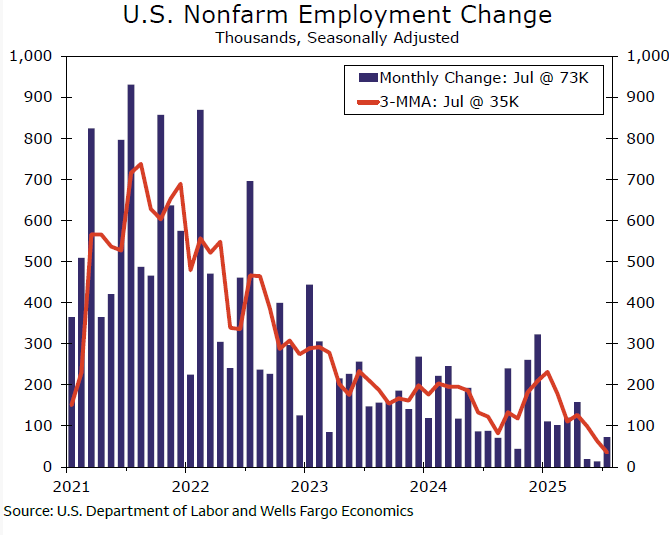
The July employment report was a dud. Nonfarm payrolls rose by 73K in July, coming in short of the consensus forecast of 104K. Employment growth was approximately zero outside the health care and social assistance industries. Revisions to job growth in the previous two months were substantial and shaved 258K off of total employment growth in May and June. In the household survey, the unemployment rate rose from 4.1% to 4.2%, but the rounding masks that the unemployment rate just barely missed reaching a cycle-high of 4.3% (4.248% to be exact). The rise in the unemployment rate came despite another tick lower in the labor force participation rate, the third consecutive monthly decline.
Coming into today's report, our base case forecast was that the FOMC would cut the federal funds rate by 25 bps at its September, October and December meetings, with no additional rate cuts in 2026. Based on today's data, we are inclined to leave that projection unchanged for the time being. Given both the downside risks to the Fed's employment mandate and the upside risks to inflation, we think the Committee will move monetary policy toward a more neutral stance in the coming months to better reflect the two-way risks to the economy.
Clear signs of weakness
The "solid" state of the labor market described by the FOMC earlier this week looks more questionable after the July employment report. Nonfarm payrolls rose a weaker-than-expected 73K in July. More jarring, the below-consensus print came with the steepest downward net revision to the prior two months data (-258K) since May 2020. The three-month average of payroll growth was 150K coming into this report, and when incorporating revisions, the pace has lurched lower to just 35K.
Downward revisions to the prior months were broad-based. June's initially reported 74K gain in private sector hiring was shaved down to a scant 3K rise, with notable declines in retail trade and professional & technical services. Similarly, updated information from government agencies led June's solid 73K gain in total government payrolls to be revised down to a much more modest 11K increase. In short, hiring was not as stable as previously thought.
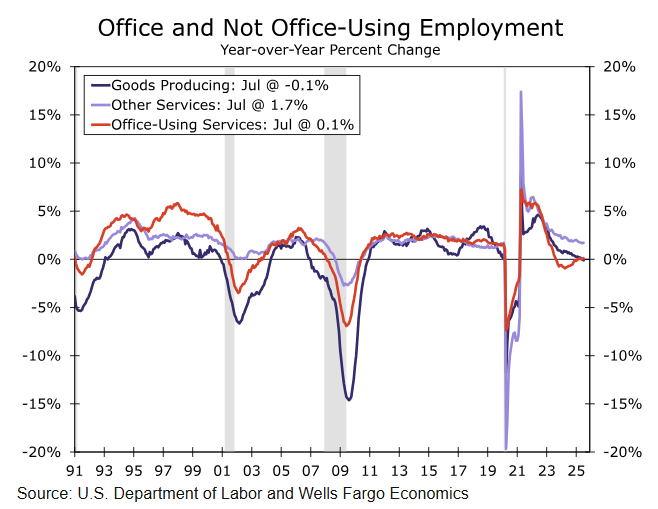
Hiring weakness across industries carried into July. The ongoing federal government hiring freeze pulled total government payrolls into the red in July (-10K), leaving employment down 84K since the start of the year (chart). Outside government, private sector hiring rebounded to a 83K gain, but the details continue to point to a narrow range of industries expanding headcount. Healthcare & social assistance (+73K) continues to be the stalwart of growth, but "white collar" jobs like professional & business services (-14K), information (-2K) and finance continue to struggle (chart). Goods related industries also remain under pressure, as shown by additional declines in wholesale trade (-8K) and manufacturing (-11K). The industry mix is illustrative of cyclically sensitive industries wobbling underneath the weight of stalling demand.
Author

Wells Fargo Research Team
Wells Fargo