|

Japanese Yen surges amidst potential interventions

The Japanese yen showed significant strength against the US dollar late last week, with the USD/JPY pair currently stabilizing around 157.86. This marks the lowest level for the currency pair in nearly a month.

The yen's recent surge is attributed to widespread market speculation regarding potential interventions by Japanese authorities. Analysts believe that Japan may have conducted two separate interventions to bolster the yen, although these could also involve large-scale position closings on exchanges, known as "stop triggers."

Reports indicate that the Bank of Japan may have expended between 3.37 and 3.57 trillion yen ($21.18 to $22.00 billion) last Thursday alone, with Friday's expenditures yet to be confirmed. This marks a short interval since the last currency intervention by the BoJ.

Additionally, the BOJ's recent inquiries into bank exchange rates could have preemptively influenced market movements, sometimes seen as a precursor to formal interventions.

USD/JPY technical analysis
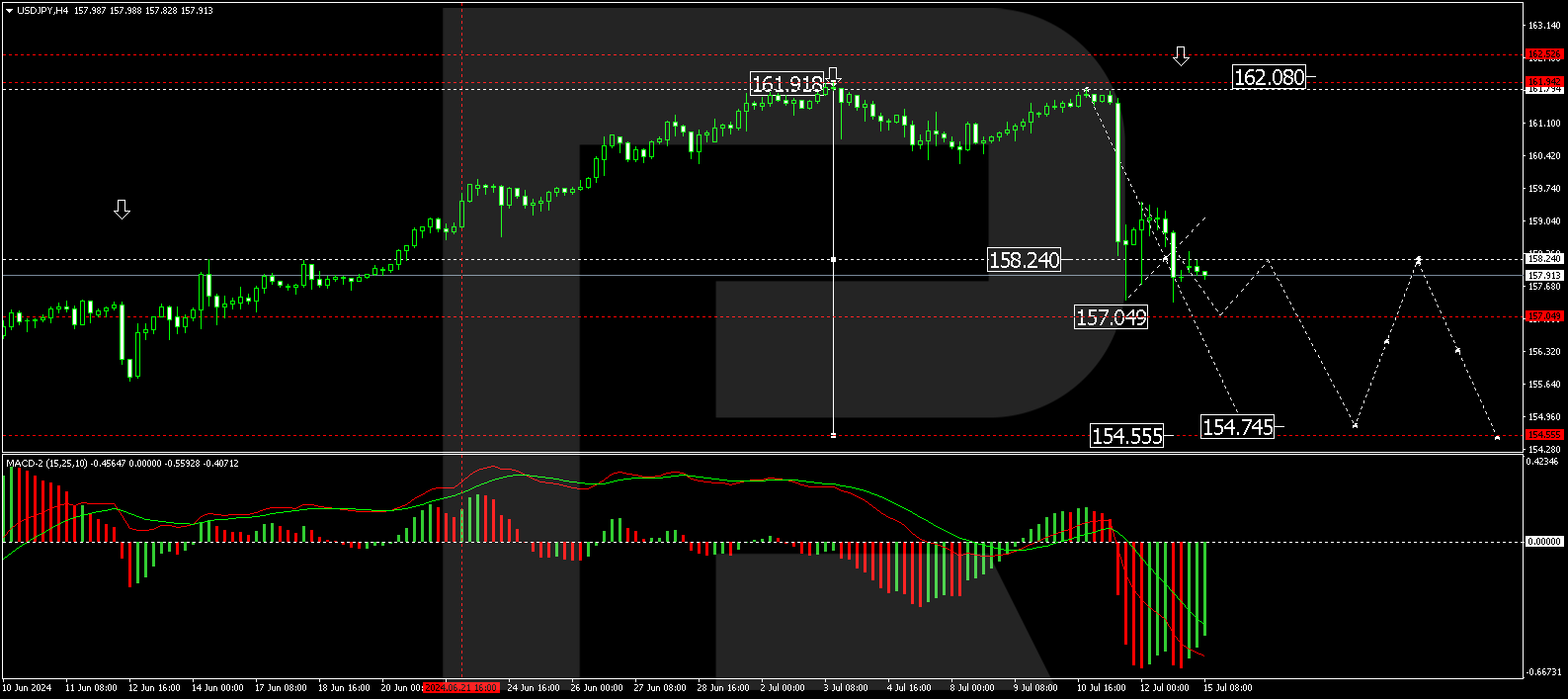
Chart

The USD/JPY pair is currently navigating a consolidation phase around the 158.24 level. We anticipate a potential decline to 157.05, followed by a rebound to 158.76. A subsequent drop to 154.74 is expected, which could prompt a corrective movement back to 158.24. The MACD indicator supports this bearish outlook, with its signal line positioned below zero and indicating a downward trajectory.
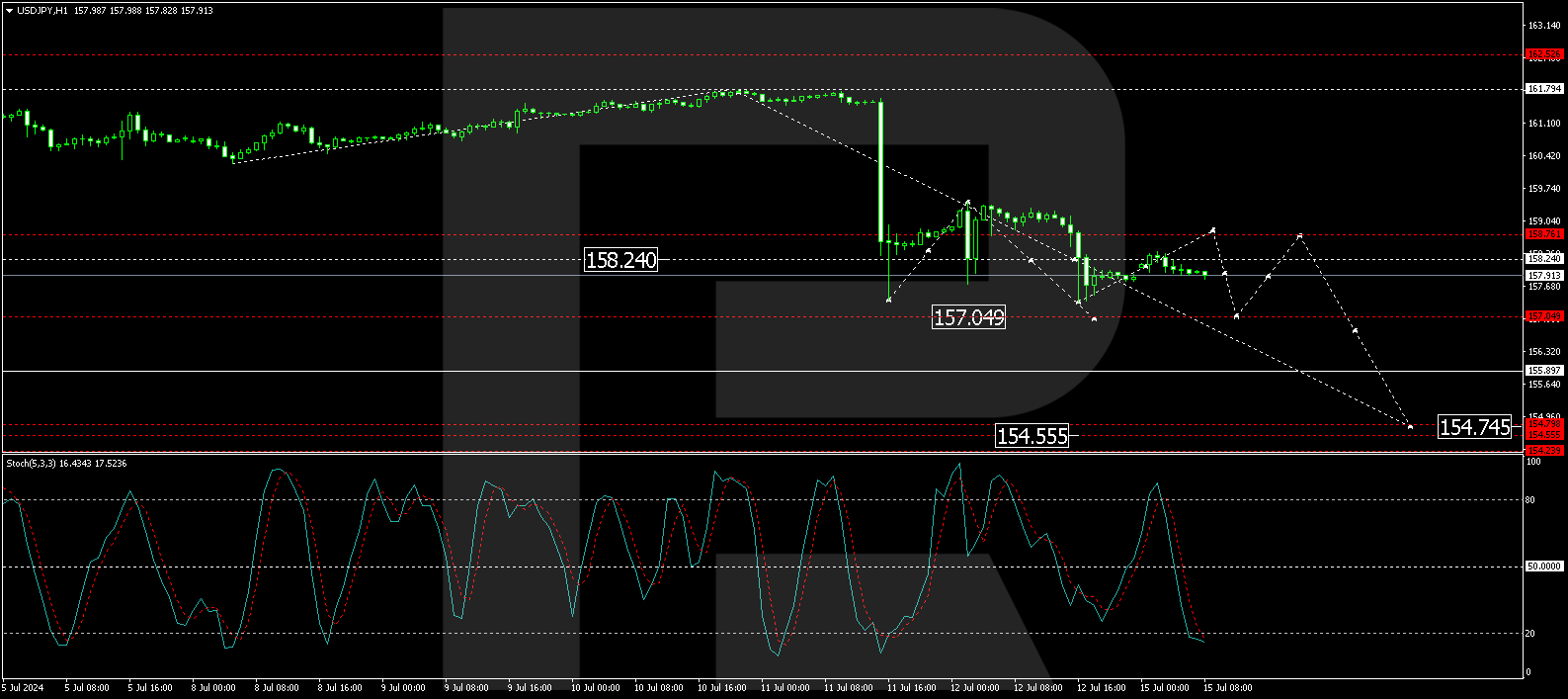
USDJPY

On the H1 chart, the USD/JPY is forming a downward wave towards 157.04. Upon reaching this level, a rise to at least 158.24 may occur, followed by another decline to 154.74. This bearish pattern is corroborated by the Stochastic oscillator, with the signal line preparing to ascend from below 20 to around 50, suggesting potential brief recoveries amid overall downward momentum.

Market participants will closely monitor upcoming releases and statements from the Japanese government and the BOJ for confirmation of these interventions and further insights into future monetary policy actions.

Author

Andrey Goilov

Andrey Goilov

RoboForex

Higher economic education. Andrey Goilov has been working on the Forex market since 2005. A financial analyst and successful trader. Preference in trading is highly volatile instruments.


More from Andrey Goilov
Share:

Editor's Picks

GBP/USD hits multi-week tops around 1.3560

GBP/USD gathers fresh steam and advances to new three-month peaks near the 1.3560 zone on Friday. Cable’s sharp move higher comes after three daily drops in a row and follows the increasing selling pressure hurting the Greenback.

EUR/USD pops to fresh two-month highs, targets 1.1600

EUR/USD advances markedly, revisiting the upper 1.1500s for the first time since mid-June. The pair’s sharp uptick comes on the back of a strong retracement in the US Dollar amid BoJ intervention chatter and despite steady uncertainty in the Middle East.

Gold picks up pace, approaches $4,400

Gold rebounds toward the $4,400 mark per troy ounce on Friday, reversing the previous day’s pullback. The precious metal’s recovery comes as fresh and intense weakness keep weighing on the US Dollar, while traders keep assessing easing expectations of an imminent Fed interest rate hike and the situation from the Middle East.

Pi Network Price Forecast: PI extends consolidation as bulls eye $0.10
Pi Network (PI) price holds steady on Friday, maintaining a consolidating tone for three consecutive days. Mild retail strength in the PI token remains stable, with Open Interest above $9 million, while social buzz eases. PI token’s technical outlook is mixed, as bearish momentum wanes to neutral, with bulls eyeing the $0.1000 psychological level.
 Weekly focus: Some relief in US inflation concerns

Actual inflation data for July came out as expected with a 0.1% m/m increase in headline CPI and 0.2% excluding food and energy. Annual headline inflation remains too high at 3.4% and means that wage earners are experiencing stagnating spending power at best, and core inflation is a bit higher than the inflation target of two percent would suggest.

Why is Crude Oil priced for a reopening the ships haven't made?
Fourteen vessels crossed the Strait of Hormuz on Tuesday. Before the war, the count ran near 120 a day. In the sessions since the waterway was publicly declared open, Brent has drifted back to $87 and West Texas Intermediate (WTI) to $81, both a little lower again on Wednesday, with daily momentum on each unwound from the top of its range in late July to the low twenties now.