Is Turkey a Canary in the Emerging Market Coal Mine?

Some other individual emerging market (EM) economies could have their own financial problems à la Turkey. But we think any financial crises in the EM world would be individual episodes rather than systemic.
Are External Debt Problems in Developing Economies Systemic?
Turkish assets have been hammered over the past few days due largely to concerns about the amount of Turkey's foreign currency-denominated debt, and fear of "contagion" has led to selling pressure on other emerging market (EM) assets more broadly. Are other EM economies vulnerable to an external debt crisis à la Turkey? Is Turkey the canary in the EM coal mine like Thailand was in 1997?
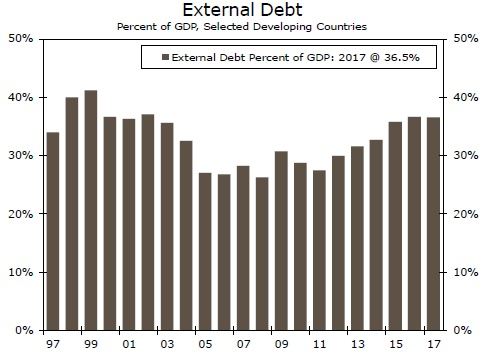
In this report, we update an analysis that we did last year.1 Yes, the external debt of a sample of 19 large developing economies (less China) has swelled from less than $2 trillion in 1997 to more than $5.0 trillion today. Those economies have grown over the past two decades, which has increased their capacities to incur debt, so we should scale their external debt by their GDP. But there still may be cause for concern because their collective external debt-to-GDP ratio is 37 percent, which is higher than in 1997 (top chart).
But in our view, many developing economies are better equipped to deal with their external debt loads than they were 20 years ago. For starters, most developing economies allow their currencies to float at present, rather than maintain fixed exchange rates, as they did heading into the financial crises of 1997-1998. Consequently, central banks can allow the exchange rate to adjust gradually downward, and they do not need to jack up interest rates to defend their currencies to the same extent as they would under fixed exchange rate regimes. Less monetary tightening means that their economies are more resilient than they would be under fixed exchange rates.
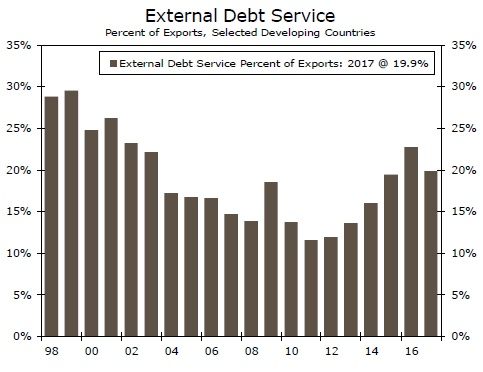
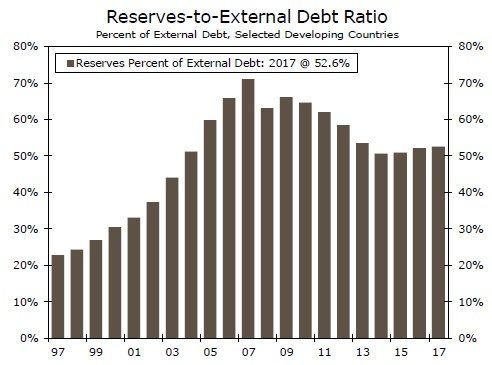
Furthermore, the ability of many EM economies to service their external debt is a bit better today than it was two decades ago. In 1997, the debt service-to-export ratio of the developing economies in our sample was nearly 30 percent (middle chart). It is only 20 percent today. In addition, EM economies have larger war chests of foreign exchange reserves, which they can use to counter some of the downward pressure on their currencies. Reserves as a percent of external debt stand at 53 percent today, more than twice as high as it was twenty years ago (bottom chart).
That said, some individual economies other than Turkey could potentially face financing challenges. In the report we wrote last year, we developed a simple methodology that we used to order countries that may be most vulnerable to a financial crisis. Interestingly, our methodology ranked Turkey as one of the most vulnerable countries to financial crisis, and we refer interested readers to our earlier report to the full list of countries. Vulnerable counties could experience their own external debt crises if their currencies continue to come under downward pressure and/or if the Fed hikes rates further. But we think that any other Turkey-like financial crises would be country specific rather than systemic à la 1997-1998.
Author
Wells Fargo Research Team
Wells Fargo