Is the United States printing money to buy its own debt?

Last Wednesday, a student wrote to me with a single line: “Is this the beginning of the end for the dollar?”
I told him I don’t think so. But I also told him his question was better than he realized, and that the full answer takes a few minutes.
I’d like to ask you for those minutes too.
What treasury did
Secretary Scott Bessent announced he is doubling the Treasury bond buyback at the long end. From $2 billion to $4 billion per operation, running September through November.
When I saw the headline, my first reaction was the same as most people’s: they’re printing money to buy their own debt. It took me a while to work out that this wasn’t it, and I’d like to save you that while.
The Treasury Department does not print money. It has no such power. The Federal Reserve does — a different institution, with a different chair and a different agenda. What Treasury does when it buys back is swap one debt for another: it repurchases thirty-year bonds and pays for the operation by selling short-term bills, or by drawing cash from its account, which currently holds close to $950 billion.
That is what happened here. A maturity swap.
And here’s another figure that may cut against what you’ve been reading: there are buyers for American debt. In June alone, foreign investors purchased a net $207.1 billion in long-term U.S. paper, and foreign holdings sit near record highs.
So where is the problem?
This is where it gets interesting.
There is appetite for American debt. What’s scarce is appetite for American debt at thirty years. The investors who left the long bond didn’t run to gold or to Germany — they moved into short-term Treasury bills. They’re still lending to the United States. They just won’t lend for three decades anymore.
It’s a small distinction and it changes the entire read. If you trade this week thinking “confidence in the dollar is gone,” you’ll misread every chart in front of you.
And while we’re here, look at who actually owns that $40 trillion. The split is not what most people picture.
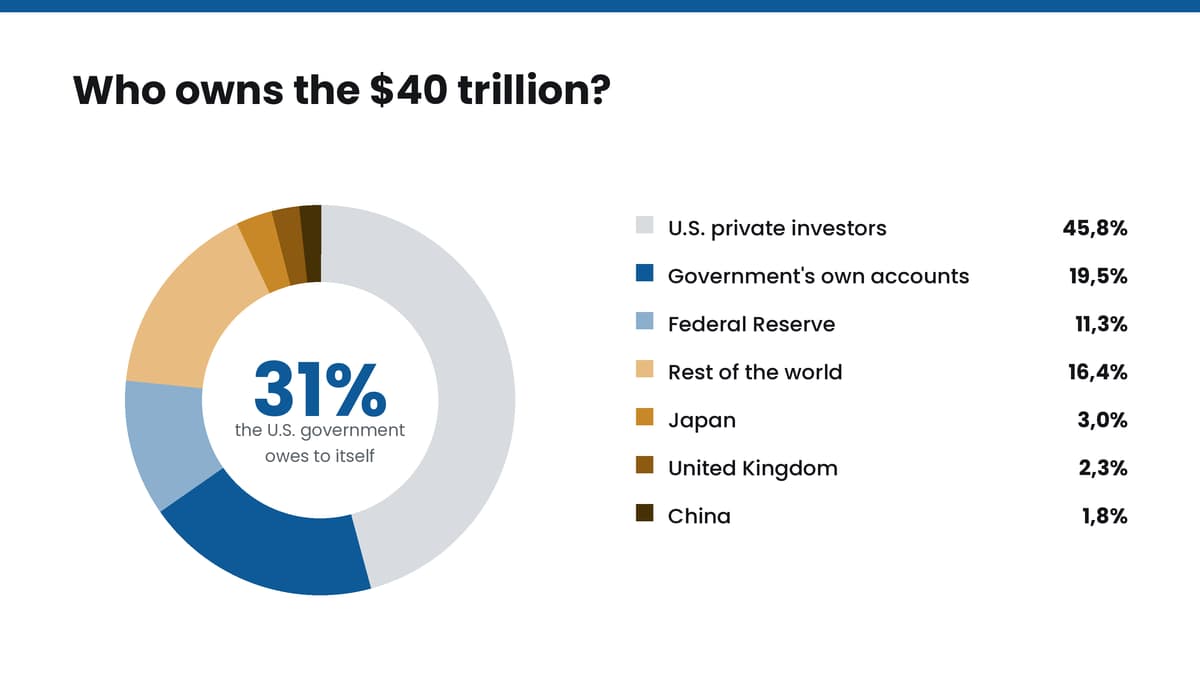
Sources: U.S. Treasury and Federal Reserve, 2026 data.
Nearly a third of it belongs to the United States itself. Roughly $7.8 trillion sits in the government’s own accounts — Social Security, Medicare, federal retirement funds — and another $4.5 trillion is held by the Federal Reserve. A further 46% is in the hands of American private investors: pension funds, mutual funds, banks, insurers, and ordinary savers.
And China, which shows up in every headline? 1.8%. Japan, the largest foreign creditor in the world, holds 3%.
Keep that in mind the next time you read that China could sink the dollar by dumping Treasuries. It could do damage, certainly. But it doesn’t own the house. American debt is financed, above all, by Americans.
Picture this
Imagine a thirty-year mortgage at 5.2% with a payment that’s strangling you. You find a way out: get a credit card with a promotional rate, pay the mortgage off in full, and now you owe the card instead.
This month’s payment dropped. And that’s real relief — I won’t pretend otherwise. Anyone in that spot would do the same thing.
But the promo expires in six months. And when it does, you no longer hold comfortable thirty-year debt. You hold debt that must be rolled over immediately, at whatever rate exists that morning, ready or not.
You didn’t eliminate the cost. You traded it for fragility.
That’s exactly what Treasury did. It lowered the yield you can see today by shortening the average maturity of its debt. And shorter debt means every rollover hurts more if rates don’t come down.
How the market voted
This is the part I find most interesting, because the market answered fast — and it answered twice.
On Wednesday, the move worked. The thirty-year yield dropped from 5.26% to 5.18%. The ten-year fell from 4.68% to 4.63%. Bessent got exactly what he was after, and for a few hours it looked settled.
But watch where the bill showed up that same day.
The dollar fell. The Bloomberg dollar index lost as much as 0.8% and touched its lowest level since May 12. The DXY sat at 98.8. And gold surged more than 3%, with December futures reaching $4,557.60 an ounce, the highest since June 2.
Sit with that combination for a second, because it’s the heart of this piece. The market didn’t say “great idea.” It said something more uncomfortable: if you’re going to hold yields down artificially, the adjustment will come out somewhere else. And it came out through the currency. You can repress the price of a bond. You cannot repress the price of everything at once.
Equities, incidentally, barely moved that day. The S&P 500 closed up just 0.2%, the Nasdaq 0.16%. They rose early and drifted lower all afternoon.
Two days later the market undid all of it. The thirty-year was back at 5.2224% and the ten-year at 4.6723% — precisely where they started. The Dow shed more than seven hundred points, the S&P 500 closed down 0.87%, the Nasdaq fell 1%.
I owe you some honesty about that equity drop: it isn’t all the buyback’s fault. Walmart collapsed 9% that day on its own results, and oil climbed on tensions with Iran. If someone tells you the Nasdaq fell “because of Bessent,” don’t fully believe them — I don’t either.
But the bond has no such excuse. The bond was the stated target of the operation, and it returned to its exact starting point in forty-eight hours.
And there’s one detail from that Wednesday I find the most telling of the whole week: the same morning Treasury announced it would support the long end, it auctioned twenty-year debt at the second-highest yield since that bond was created.
In the morning it promised to hold the price up. By the afternoon it paid the highest price in that bond’s history.
The part that does worry me
When I laid all this out for my student, he pushed back: “But what happens when that account runs dry?”
He was right about the thing that matters, and this is the part I want you to take with you.
That $950 billion is not infinite. If the day comes when the long end still can’t find buyers and Treasury has no cash left to prop it up, the pressure doesn’t vanish. It moves. And it moves to the Federal Reserve.
And the Fed can create money. When the Fed buys Treasury bonds in the market, it generates reserves that did not exist before. That happened on an enormous scale in 2020 and 2021, and we all know how that ended.
Economists call it fiscal dominance: when the central bank ends up financing the government, not because it wants to, but because nobody else will. That would be dollar dilution in the real sense.
Are we there today? I don’t think so. The Fed ended its balance sheet reduction program last December and has been flat since — not buying. Warsh has publicly called for a smaller balance sheet, not a larger one.
But the road exists. And if we ever take it, the person to watch won’t be Bessent. It’ll be Warsh.
How I read it
There’s an arithmetic reason the market undid this, and it’s almost comic once you write it down.
The U.S. national debt is $40 trillion. Each buyback operation is $4 billion. That works out to one hundredth of a cent for every dollar of debt. And even if Bessent drained his cash account entirely — which he can’t, because federal salaries and Social Security come out of it — he’d be moving about 2% of the total.
It’s a tugboat pushing a supertanker. The tug is not useless: it can nudge the heading a few degrees, and on Wednesday it genuinely did. But it has to keep pushing, and the second it lets go, the tanker resumes its course on sheer momentum.
Wednesday the tug pushed. Friday it let go.
And when you have to come out two days running to promise more buying — because on Thursday Bessent went on television to say the operations could be even larger — the problem didn’t get solved. It got postponed. Postponing it until November, with midterms in between, carries a political value I won’t argue with anyone about.
It’s also possible Bessent is right, and current yields don’t reflect the economy’s fundamentals. That’s a defensible position and serious people hold it. Price voted otherwise for now — but price changes its mind too.
Meanwhile the Fed stands in the opposite corner. Annual inflation runs at 3.4%, above the 2% target. Rates held in July, but three regional presidents voted to raise them — the first split like that since 2016. This Friday, Warsh speaks at Jackson Hole for the first time as Chair.
One practical warning: this year’s symposium theme is financial innovation and payments, not rates. He may talk institutional framework and never mention September. Be ready for both.
For your trading
Historically, government intervention in price buys time, not direction. But that’s a historical tendency, not a law, and anyone positioning thirty days out on it may be in for a shock. Between now and November there’s a speech, a jobs report, a CPI print, and a Fed meeting on September 16. Any one of them turns the chart in minutes.
That’s why we work with long context and short execution. Context tells you where price is headed. Short execution is what keeps you alive while it gets there.
I’ll close with something I honestly don’t know. If Treasury itself has to make a market in its own thirty-year bonds, who is pricing that debt? I have a suspicion. I don’t have an answer.
How do you read it? Write to me below. This week I’m more interested in hearing from you than in being right.
Author

Juan Maldonado
Elliott Wave Street
Juan Maldonado has a University degree in Finance, and Foreign trade started his trading career in 2008. Since 2010 has been analyzing the markets using Elliott Wave with different strategies to spot high probability trades.