Is the UK an economic outlier?
- After a series of weak economic data, is the UK performing worse than its peers?
- What does a rapidly rising unemployment rate mean for the future.
- What negative data surprises are worse for the UK than elsewhere.


UK labour market data for the three months to September was weak, and the signs also point to weakness for October. The number of people on the payroll is falling, and the unemployment rate rose in Q3 to a pandemic high. Although the number of job vacancies is stable, the number of candidates per job is rising, and it could be harder to find work if the current labour market trends continue. The question now is, what is causing the labour market slowdown, is it global factors, or is the UK in a unique position?
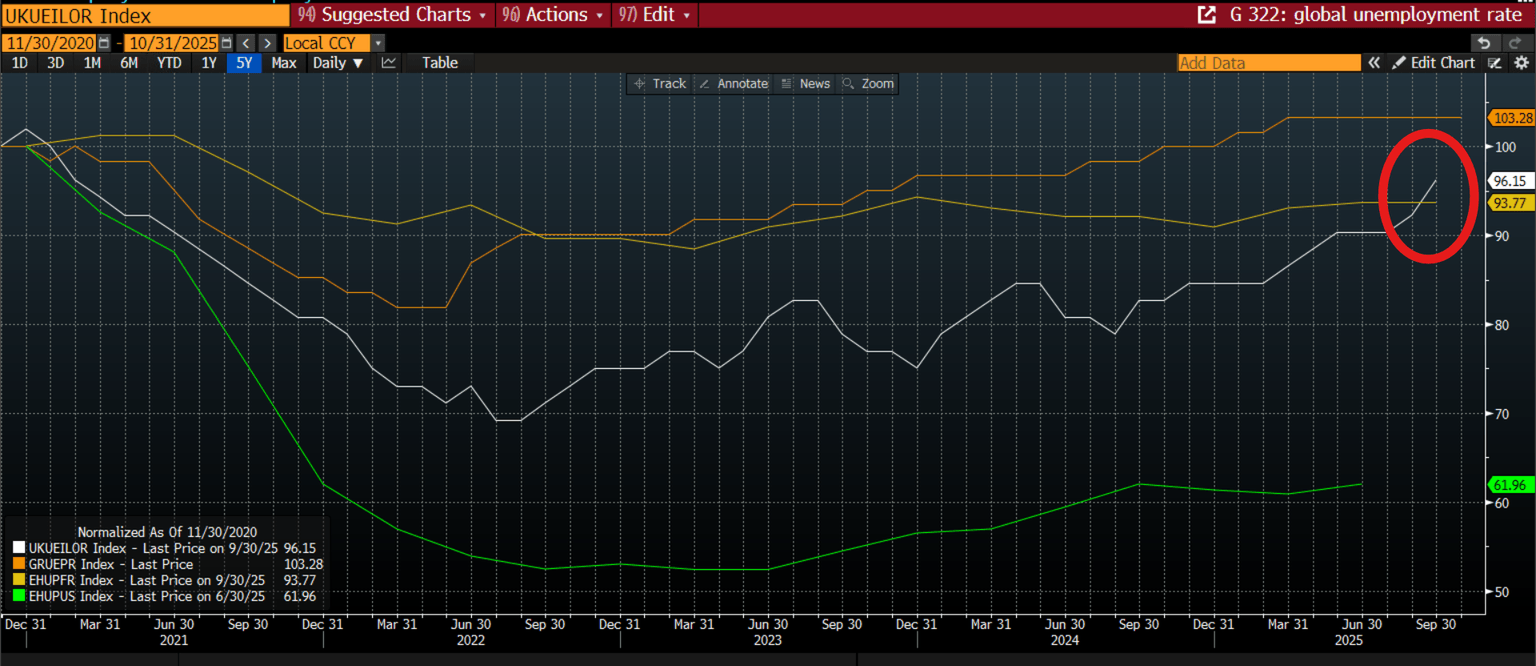
We have analyzed two data sets to try and answer this question. The first is looking at the UK’s unemployment rate versus its peers. As you can see in the chart below, the UK does not have the highest unemployment rates. Germany and France have significantly higher rates of unemployment than the UK, in France it stands at 7.6% and in Germany, the rate is 6.3%. It’s obviously difficult to compare the UK to the US right now, since economic data releases have been delayed due to the government shutdown. However, prior to the government shutdown, the August unemployment rate in the US was 4.3%.
The chart below has been normalized to show how the unemployment rates in the US, UK, France and Germany move together, and this is where the picture starts to look murky for the UK. There has been a steeper uptrend in unemployment in the UK since the start of the year vs. its peers, and the pace of increase is now faster than France’s.
Thus, the direction of travel seems to be a rapidly deteriorating labour market picture in the UK, that is worse than its main global peers.
UK (white line), France and Germany unemployment rates, normalized to show how they move together
Source: XTB and Bloomberg
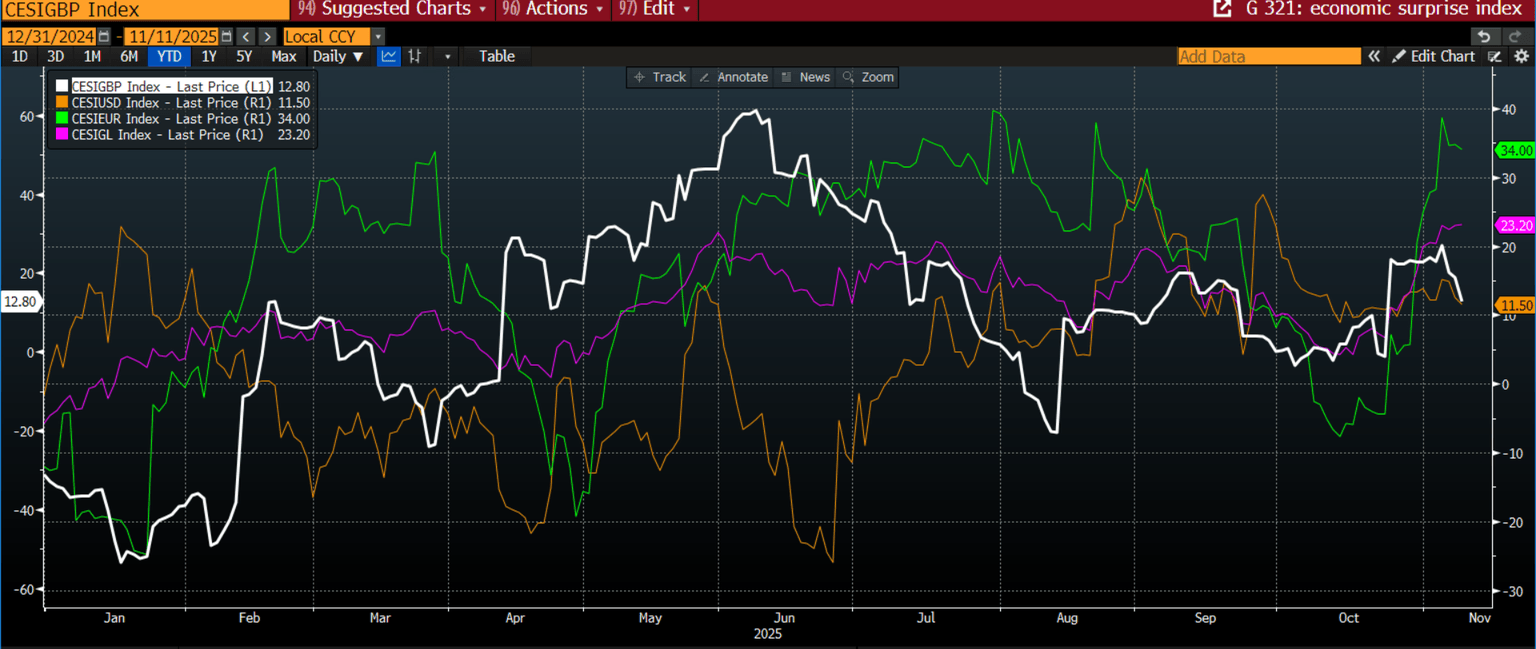
But is the UK an outlier by other measures? Another way to compare the UK economy is to look at the UK’s economic surprise index relative to its peers. The chart below looks at the Citi Economic Surprise Index for the US, UK, Eurozone and Global. As you can see, there is clear gap, with economic data in the US and the UK surprising on the downside, while Eurozone and global data are surprising on the upside.
However, the UK’s economic surprise index has turned sharply lower, and is worse than its peers. This suggests that the economic picture is deteriorating in the UK, and it is worse than global trends.
Citi economic surprise index for UK, Eurozone, US and Global
Source: XTB and Bloomberg
What the future holds
Overall, these two data sets suggest two things: 1, that the path of least resistance is for a weaker economy in the UK, so there could be further bad news to come. 2, the pre-budget media storm is not giving many pro-growth vibes, so there is nothing to stop the UK economy from deteriorating further.
Some will argue that the government’s decisions, for example, higher employer national insurance, large increases to the national living wage, and an employee rights bill, all in a matter of months, is breaking the UK labour market. The data would support this. Added to this, higher income taxes in this month’s budget could trigger even more economic decline.
Author
Kathleen Brooks
XTB UK
Kathleen has nearly 15 years’ experience working with some of the leading retail trading and investment companies in the City of London.