Is the bond market forcing the Fed's hand to hike faster?

In a word, no. Let's discuss what's really going on.
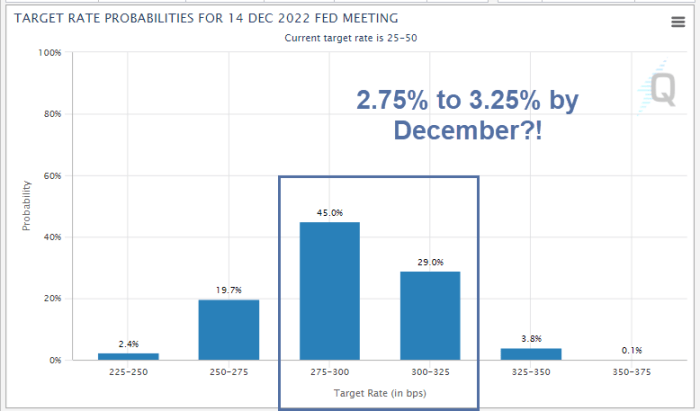
Rate hike probabilities for December 2022
Half-point rate hikes in May and June?
Yesterday, I noted Half-Point Rate Hikes in May and June? That's What's Priced In!
A couple of my readers misinterpreted that as if the bond market was forcing the Fed.
That's not really what's happening. Rather, the Fed does what it wants 100% of the time and will make excuses to get what it wants.
If anything is forcing the Fed it's inflation, but inflation marched higher for over a year with the market barely moving at all.
Fed's primary tool is communication
The Fed's primary tool is communication. If the bond market and Fed Funds Futures don't do what the Fed wants, the Fed communicates endlessly.
That's why despite surging inflation, yields barely moved for a long time.
Big swift kick in the pants
Recall that 50% was a 90% chance for March until a parade of Fed presidents walked it back.
There is no functioning market here. The Fed views communication as its primary tool. The market front runs Fed communication.
Recall my February 11 post The Fed Uncertainty Principle and a Big Swift Kick in the Pants
Does the Fed follow the market's lead? Most believe so, but it's not quite that simple.
Bullard gave the market a kick. The market responded by pricing in a 50 basis point hike for March.
For whatever reason, Powell didn't like it. Then a literal parade of Fed presidents walked back the hike to 25 basis points.
Does the Fed follows the market?
Most think the Fed follows market expectations.
However, this creates what would appear at first glance to be a major paradox: If the Fed is simply following market expectations, can the Fed be to blame for the consequences? More pointedly, why isn’t the market to blame if the Fed is simply following market expectations?
This is a very interesting theoretical question. While it’s true the Fed typically only does what is expected, those expectations become distorted over time by observations of Fed actions.
The observer affects the observed
The Fed, in conjunction with all the players watching the Fed, distorts the economic picture. I liken this to Heisenberg’s Uncertainty Principle where observation of a subatomic particle changes the ability to measure it accurately.
The Fed, by its very existence, alters the economic horizon. Compounding the problem are all the eyes on the Fed attempting to game the system.
A good example of this is the 1% Fed Funds Rate in 2003-2004. It is highly doubtful the market on its own accord would have reduced interest rates to 1% or held them there for long if it did.
What happened in 2002-2004 was an observer/participant feedback loop that continued even after the recession had ended. The Fed held rates rates too low too long. This spawned the biggest housing bubble in history. The Greenspan Fed compounded the problem by endorsing derivatives and ARMs at the worst possible moment.
The Fed has so distorted the economic picture by its very existence that it is flawed logic to suggest the Fed is simply following the market therefore the market is to blame. There would not be a Fed in a free market, and by implication there would be no observer/participant feedback loop.
Fed uncertainty principle
The Fed, by its very existence, has completely distorted the market via self-reinforcing observer/participant feedback loops. Thus, it is fatally flawed logic to suggest the Fed is simply following the market, therefore the market is to blame for the Fed’s actions. There would not be a Fed in a free market, and by implication, there would not be observer/participant feedback loops either.
Corollary number one
The Fed has no idea where interest rates should be. Only a free market does. The Fed will be disingenuous about what it knows (nothing of use) and doesn’t know (much more than it wants to admit), particularly in times of economic stress.
Corollary number two
The government/quasi-government body most responsible for creating this mess (the Fed), will attempt a big power grab, purportedly to fix whatever problems it creates. The bigger the mess it creates, the more power it will attempt to grab. Over time this leads to dangerously concentrated power into the hands of those who have already proven they do not know what they are doing.
Corollary number three
Don’t expect the Fed to learn from past mistakes. Instead, expect the Fed to repeat them with bigger and bigger doses of exactly what created the initial problem.
Corollary number four
The Fed simply does not care whether its actions are illegal or not. The Fed is operating under the principle that it’s easier to get forgiveness than permission. And forgiveness is just another means to the desired power grab it is seeking.
Inflation 2020-present
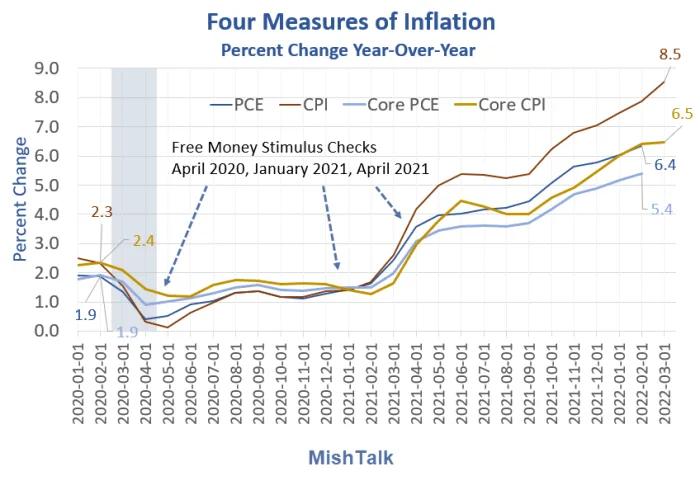
PCE data from BEA, CPI data from BLS, chart by Mish
Would a free market in rates have ignored 7% inflation in 2021?
US treasury yields
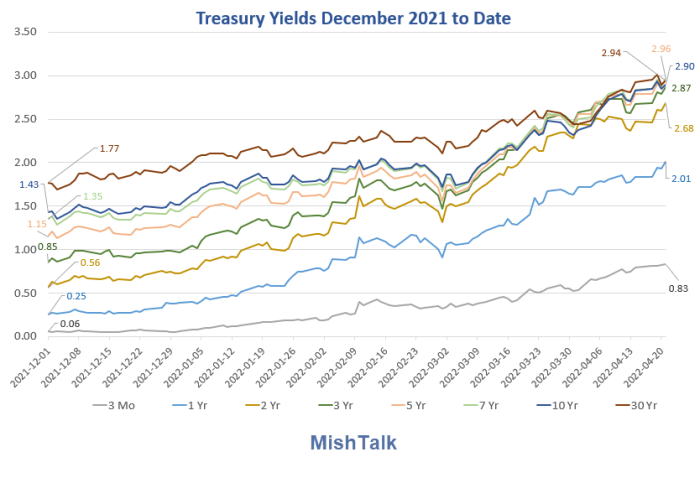
US Treasury Yields from New York Fed
Not only did we have surging inflation, we also had QE until the announced bitter end, holding down rates!
In December, the 30-year bond yield was only 1.77% with the CPI over 7%!
Via communication and QE, the Fed controlled rates.
Those sure as hell were not market rates.
Hikes now?
These arrogant economic illiterates are going to do whatever they want. Nothing has changed.
For now, the Fed has decided it wants faster hikes. The market went along. If the market didn't go along then there would have been more communication.
In March, Powell was then not ready for 50 basis points despite raging inflation. The result was a parade of Fed presidents walking back Bullard's comments.
At long last, the Fed has finally signaled it wants faster hikes.
So faster hikes are now priced in (until of course the Fed changes its mind).
Do I think we see 2.75% to 3.25% by December?
No, my call remains: Recession will hit first and the Fed will walk back hikes that are now priced in.
Admittedly, I did not expect even 1.5% this cycle. Yet, for most of the last decade, it's been correct to fade Fed dot plots of rate hike expectations.
In case you missed it please see The Fed Uncertainty Principle because it explains what's going on.
Perhaps it's finally different this time on rate hikes even though history has strongly favored the skeptics.
Author
Mike “Mish” Shedlock's
Sitka Pacific Capital Management,Llc