Iran war jeopardizes global food prices
You think soaring Oil prices are the main problem? Are you worried about the impact of energy prices on inflation? Think again.
The closure of the Strait of Hormuz amid the Iran war has reduced transit through the critical shipping bottleneck by over 95%. Everyone is looking at skyrocketing Oil prices and trying to assess the impact of energy costs on prices. But there’s more to worry about. Around a third of the world’s fertilizers pass through the Strait, according to the United Nations.
Flows of fertilizers — such as urea, potash, ammonia and phosphates — collapsed at the same pace as Oil tankers. These substances are used to increase crop yields and increase resistance to disease.
Iran, Saudi Arabia, Qatar, the United Arab Emirates and Bahrain have emerged as giants in fertilizer production and export due to the abundance of natural gas in the region. According to a report from the London International Fertilizer Association, these countries collectively supply one-third of the world’s trade in urea, as well as nearly one-fourth of ammonia, and nearly one-fifth of phosphate fertilizers.
The following infographic from S&P Global shows exports from the Middle East and how prices have soared due to the ongoing war.
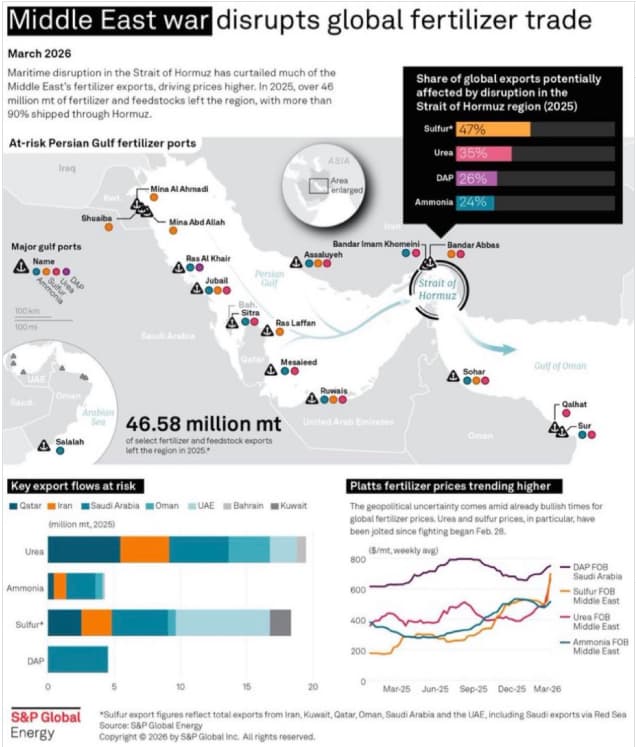
Source S&P Global
The supply shock has already sent fertilizer costs on a tear. Benchmark New Orleans nitrogen was going for $350 a short ton in late December. As of March 10, the price had pretty much doubled to about $600.
Fertilizers are a significant farming cost and are considered quite volatile. The Middle East war is not only making prices more expensive but also interrupting supplies. Crop production is likely to suffer a major setback after a month of disruption, and food prices are going to rise to account for the supply gap.
The timing of the war could not have been worse: it is springtime in the Northern Hemisphere, meaning the main planting season for major crops like corn, soybeans, and spring wheat. It’s also fall in the other half of the world, which means the Southern Hemisphere is focused on winter wheat, cruciferous vegetables, and hardy greens.
Inflation can be expected to receive a double whammy from energy and food prices. Funny enough, major central banks tend to make their monetary policy decisions in core inflation readings, those that specifically exclude food and energy prices, precisely because of their volatility. They won’t be able to ignore them this time.
American farmers feeling the pain
The American Farm Bureau estimates that the US imports roughly 25% of its fertilizer. Prices were already elevated as the Russia-Ukraine war pushed nitrogen values up in the second half of 2025, and fertilizer can account for 20% of total production expenses, according to the US Department of Agriculture (USDA). Meanwhile, a couple of record losses in the last couple of years exacerbate this new financial strain on American farmers.
So, at this point, America is risking a good chunk of its corn and soy production, part of which is dedicated to exports. Soybean exports fell to record lows in 2025 as the US's largest buyer is China, and the trade war US President Donald Trump launched early in 2025 hit the sector hard. In 2024, China accounted for over 46% of US soybean exports, but that figure plummeted below 19% in 2025. Indeed, diversification has helped moderate what could have been a far more severe reduction, with the US increasing exports to the European Union, Mexico, and some African and Asian countries.
Corn exports, on the contrary, improved in 2025, with volumes exceeding 2024 levels, also moderating the negative impact of reduced China soybean buying.
But it is not just about shrinking US exports. Americans will have to pay more for lower-quality food. And the world’s food supply will inevitably be reduced, hitting developing economies harder.
The longer the Iran war continues and the Strait of Hormuz remains closed, the harder it will be to avoid global inflation-related suffering. But to be sure, the damage is already done.
Author

Valeria Bednarik
FXStreet
Valeria Bednarik was born and lives in Buenos Aires, Argentina. Her passion for math and numbers pushed her into studying economics in her younger years.

















