Gold Weekly Forecast: Not out of the woods yet despite strong rebound
- Gold recovered sharply after touching a fresh 2026 low near $4,000.
- The Fed’s rate decision and revised dot plot will be key for XAU/USD.
- The technical outlook suggests that the bearish bias remains intact despite a decisive rebound.
Gold (XAU/USD) remained under heavy bearish pressure in the first half of the week and touched its lowest level since November near $4,200 before staging a decisive recovery. Nevertheless, XAU/USD remains on track to register weekly losses for the second consecutive week as markets await fresh developments surrounding the United States (US)-Iran conflict and gear up for next week’s critical Federal Reserve (Fed) policy meeting.
Gold drops to fresh 2026 low on Middle East escalation
Following a quiet start to the week and Monday’s choppy action, Gold declined sharply and lost about 6% in a two-day span, before touching a fresh 2026 low at $4,023 during the Asian trading hours on Thursday.
On Tuesday, Iran's Islamic Revolutionary Guard Corps (IRGC) announced that they were ready for a decisive response to any further attacks from the US and said that they targeted Ali Al Salem Air Base in Kuwait with drones. Citing a US official, Reuters reported that the US struck nearly 20 targets, and nearly all missiles and drones launched by Iran were intercepted. Gold lost more than 1% and extended its slide on Wednesday.
Data from the US showed that annual inflation, as measured by the change in the Consumer Price Index (CPI), rose to its highest level in three years at 4.2% in May. In the meantime, tensions in the Middle East escalated further after US President Donald Trump said that Tehran was taking too long to make a deal and the US military announced that it launched attacks "against multiple targets in Iran." In response, the IRGC targeted US forces in bases in Kuwait, Bahrain, and Jordan.
Gold lost more than 4% on Wednesday and continued to stretch lower as Trump threatened to hit Iran "very hard tonight." While speaking to Fox News, Trump reiterated that there would be more bombing and said that he would prefer taking the Kharg Island. Later in the American session, the precious metal staged a decisive rebound and rose about 3.5% as Trump called off strikes and claimed that they were close to reaching an agreement with Iran.
Friday’s headlines painted a mixed picture and allowed Gold to remain in a consolidation phase near $4,200. Citing senior officials familiar with talks, Bloomberg reported that the US and Iran are edging closer to signing a Memorandum of Understanding (MoU) to open the Strait of Hormuz as early as this Sunday in Geneva, just before the G7 summit starts on Monday. Iran’s IRNA news agency said that according to the terms in the MoU, Iran makes no commitment regarding the transfer of management of the Strait of Hormuz and sees the future administration of the Strait as a regional matter to be resolved later, through dialogue and joint decision-making between Tehran and Oman.
Gold investors await Fed meeting
The Federal Open Market Committee (FOMC) will conduct its two-day policy meeting and announce its decisions on Wednesday. The Fed is widely expected to leave rates unchanged, but the revised Summary of Economic Projections (SEP) could provide key insights into the policy outlook.
March’s SEP showed that policymakers’ projections pointed to a 25 basis points (bps) interest rate cut in 2026 and a further 25 bps reduction in 2027. Surely, the revised SEP will highlight a hawkish tilt, and that by itself shouldn’t be a surprise. According to the CME FedWatch Tool, markets are currently pricing in about a 60% probability that the Fed will raise the policy rate at least once by the end of the year. In case the SEP shows that multiple policymakers project two or more rate hikes this year, US Treasury bond yields could push higher with the immediate reaction and trigger another leg lower in Gold.
Conversely, a dovish SEP, with a majority of policymakers still not projecting a rate hike this year, could have the opposite effect and open the door for a rally in XAU/USD.
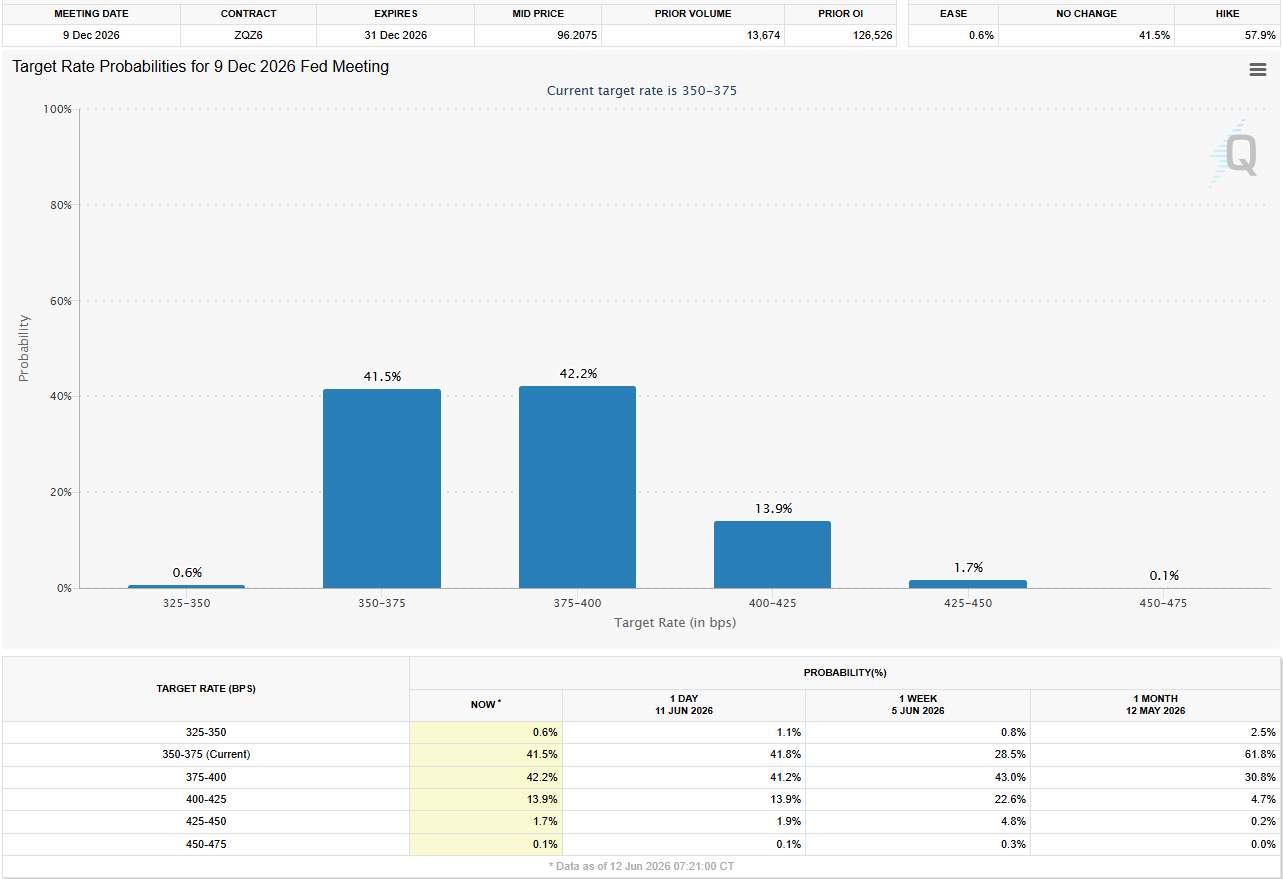
Comments from new Fed Chairman Kevin Warsh will also be scrutinized by market participants. Consecutive months of strong employment data and the persistent increase in inflation put Warsh in a tough spot. The chairman could have a difficult time justifying a dovish policy stance in the current economic environment. In case he emphasizes taming inflation, instead of trying to convince the market of the need for lower rates, the US Dollar (USD) could hold its ground and cap XAU/USD’s upside.
Previewing the upcoming Fed meeting, "we continue to expect that, due to inflation risks, calls for interest rate hikes will grow louder in the coming months, but that this will not become the prevailing view within the FOMC,” said Commerzbank’s Bernd Weidensteiner and Christoph Balz.
“If the situation in the Persian Gulf eases and oil prices—and thus the inflation rate—fall again, sentiment is likely to shift and the question of interest rate cuts will resurface. Starting around the middle of next year, the Fed will likely begin cutting interest rates, by 75 basis points through the end of 2027,” they added.
In the meantime, investors will continue to pay close attention to news surrounding the US-Iran conflict. If the US and Iran reach an MOU, as Bloomberg claimed, and reopen the Strait of Hormuz, the immediate reaction is likely to fuel a steady rebound in Gold. If that were to happen before the Fed meeting, policymakers’ projections and Warsh’s remarks could turn dovish in anticipation of a steady decline in inflation and fuel an extended leg higher in XAU/USD.
Gold technical analysis: Short-term outlook highlights a bearish stance
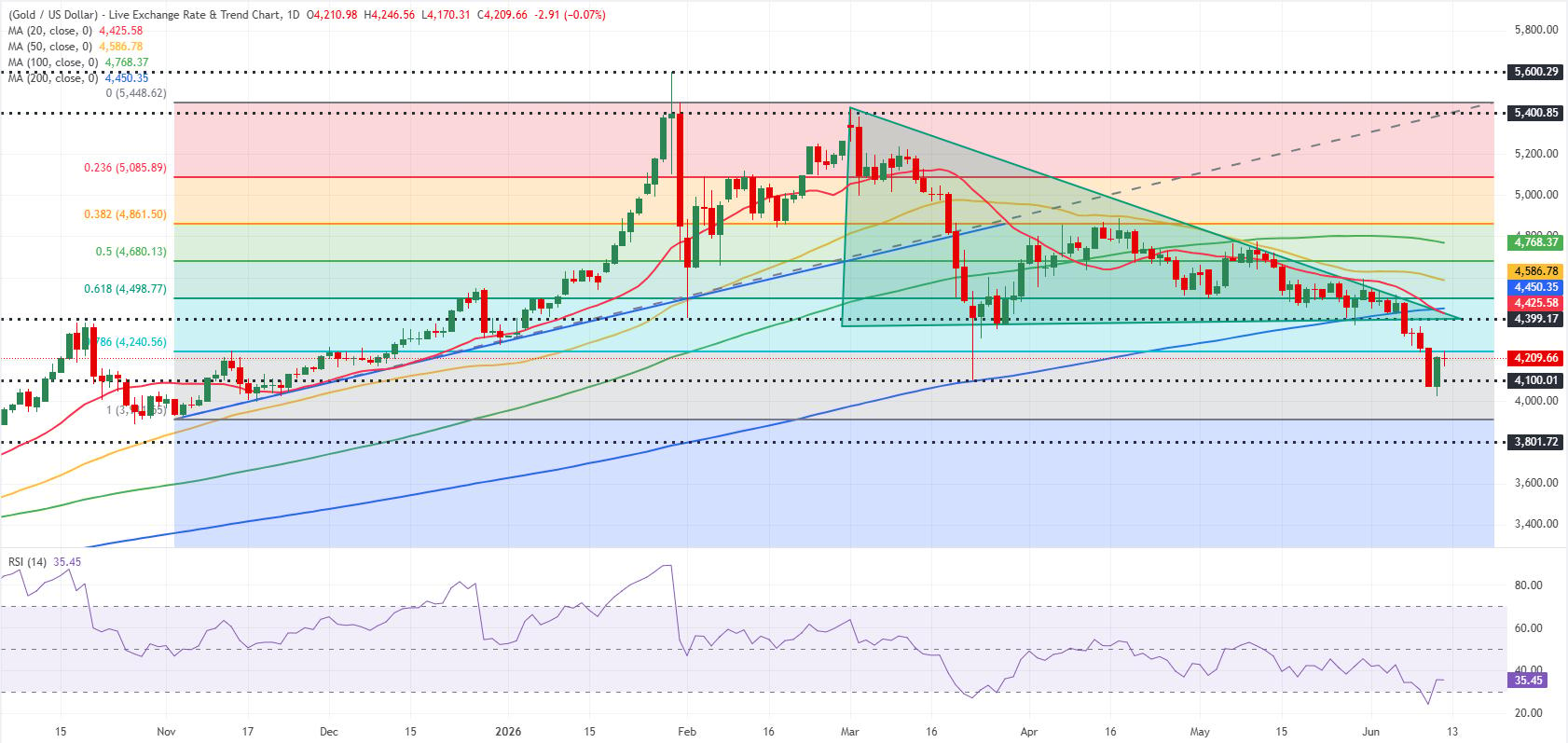
Gold broke below the 200-day Simple Moving Average (SMA) and pierced through the bottom line of a descending triangle on the daily chart, a bearish continuation pattern. The Relative Strength Index (RSI) indicator remains well below 40 after recovering from oversold territory, suggesting that the latest rebound, from a technical perspective, appears to be a correction rather than the beginning of a bullish reversal.
Looking south, $4,100 and $4,000 static levels could be seen as near-term static supports ahead of $3,910-$3,900 (the beginning point of the November-February uptrend, round level), and $3,800 (static level, round level).
Looking north, the immediate resistance could be spotted at $4,240 (Fibonacci 78.6% retracement) before the $4,400-$4,450 region, where the broken triangle bottom, the 20-day SMA, the descending trend line and the 200-day SMA converge. A daily close above this latter resistance could attract technical buyers and pave the way for an extended rebound toward $4,500 (Fibonacci 61.8% retracement) and $4,585-$4,600 next (50-day SMA, round level).
Gold FAQs
Gold has played a key role in human’s history as it has been widely used as a store of value and medium of exchange. Currently, apart from its shine and usage for jewelry, the precious metal is widely seen as a safe-haven asset, meaning that it is considered a good investment during turbulent times. Gold is also widely seen as a hedge against inflation and against depreciating currencies as it doesn’t rely on any specific issuer or government.
Central banks are the biggest Gold holders. In their aim to support their currencies in turbulent times, central banks tend to diversify their reserves and buy Gold to improve the perceived strength of the economy and the currency. High Gold reserves can be a source of trust for a country’s solvency. Central banks added 1,136 tonnes of Gold worth around $70 billion to their reserves in 2022, according to data from the World Gold Council. This is the highest yearly purchase since records began. Central banks from emerging economies such as China, India and Turkey are quickly increasing their Gold reserves.
Gold has an inverse correlation with the US Dollar and US Treasuries, which are both major reserve and safe-haven assets. When the Dollar depreciates, Gold tends to rise, enabling investors and central banks to diversify their assets in turbulent times. Gold is also inversely correlated with risk assets. A rally in the stock market tends to weaken Gold price, while sell-offs in riskier markets tend to favor the precious metal.
The price can move due to a wide range of factors. Geopolitical instability or fears of a deep recession can quickly make Gold price escalate due to its safe-haven status. As a yield-less asset, Gold tends to rise with lower interest rates, while higher cost of money usually weighs down on the yellow metal. Still, most moves depend on how the US Dollar (USD) behaves as the asset is priced in dollars (XAU/USD). A strong Dollar tends to keep the price of Gold controlled, whereas a weaker Dollar is likely to push Gold prices up.
Author

Eren Sengezer
FXStreet
As an economist at heart, Eren Sengezer specializes in the assessment of the short-term and long-term impacts of macroeconomic data, central bank policies and political developments on financial assets.

















