Investors brace for US CPI inflation data amid increasing trade tensions


Market participants will closely monitor February’s CPI inflation report (Consumer Price Index), scheduled to be released tomorrow at 12:30 pm GMT. The consensus anticipates that headline and core metrics will demonstrate signs of cooling.
Economists anticipate that year-on-year CPI inflation has eased to 2.9% (down from 3.0% in January) and that core inflation has cooled to 3.2% (from 3.3% in January). Between January and February, month-on-month headline inflation is expected to have slowed to 0.3% (down from 0.5%), with the core reading also forecast to cool to 0.3% (from 0.4%).
Most will probably agree that US President Donald Trump’s back-and-forth on tariffs is challenging to keep track of, and the uncertainty is impacting risk assets. Last Tuesday, the US administration imposed levies on three of America’s largest trading partners: Canada, Mexico, and China, only to see some goods exempted the following day (for one month), with additional items added to the exempted list on Thursday of the same week. During an interview with Fox News on Sunday, uncertainty mounted when Trump sidestepped whether he was expecting a recession this year, stating ‘he hates to predict things like that’ and adding that there would be a ‘period of transition’. As a result of tariffs enforced in February, this week’s CPI inflation release could be a turning point. Although tariffs did not take effect in February (except for China), given the 30-day reprieve, businesses have been preparing to bear tariffs by raising prices. Both the ISM (Institute for Supply Management) manufacturing and services PMIs (Purchasing Managers’ Indexes) showed that the prices paid sub-indexes pushed higher. While the ISM manufacturing index dropped to 50.3 from January’s reading of 50.9 – along with the employment and new orders indexes dipping into contractionary territory to 47.6 and 48.6, respectively – the prices paid index surged to the upside, coming in at 62.4 from 54.9 in January. If this week’s report indicates rising price pressures, I believe this presents a noteworthy upside risk to inflation, potentially influencing rate pricing, which may result in a bid in US Treasury yields and the US dollar (USD).
Fed unlikely to move based on February’s CPI print
Should data report as expected, although this would mark signs of cooling inflation, it provides the US Federal Reserve (Fed) with little incentive to begin easing policy at this juncture given the current uncertainty ahead.
According to market pricing, this month’s meeting (19 March) will unlikely see any rate adjustment; investors currently have their eye on June’s meeting for the next 25 basis point (bp) cut (-34 bps). As a note, Fed speak will be limited until the next meeting as the central bank limits the extent to which Fed officials speak publicly – known as the ‘blackout period’.
Nevertheless, Fed Chairman Jerome Powell made the headlines on Friday. Speaking at the University of Chicago Booth School of Business Monetary Policy Forum in New York, Powell reiterated that the Fed is not in a rush to cut rates, commenting: ‘Our current policy stance is well positioned to deal with the risks and uncertainties that we face in pursuing both sides of our dual mandate’.
Precipitous USD decline
As per the US Dollar Index, the USD is down nearly 4% this month, and, according to the monthly chart, sellers could strengthen their grip at least until reaching the 50-month simple moving average at 101.72. A similar picture is seen on the daily chart following the breach of support from 103.94 (now marked resistance); an absence of support is reasonably clear until 101.92, levels not seen since October 2024. So, given the lack of support on the bigger picture, any pullbacks will likely be sold into until price action reaches possible support between 101.72 and 101.92.
Lower-than-expected data, of course, would likely support USD downside and see investors increase rate cut bets, though should data surprise to the upside, this could see an unwind in short positions (note that positioning is also relatively overstretched to the downside) as traders seek mean-reversion strategies. On the other hand, although a short-term burst to the upside could be seen, this may be tricky as an increase in price pressures could also stimulate stagflation concerns.
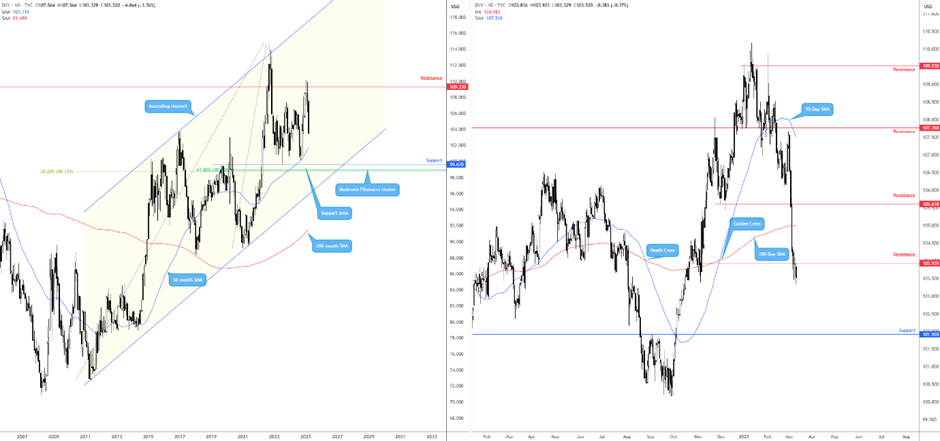
Charts created using TradingView
Author
Aaron Hill
FP Markets
After completing his Bachelor’s degree in English and Creative Writing in the UK, and subsequently spending a handful of years teaching English as a foreign language teacher around Asia, Aaron was introduced to financial trading,