Industrial Production Unexpectedly Weak: Manufacturing Declines 0.4 Percent


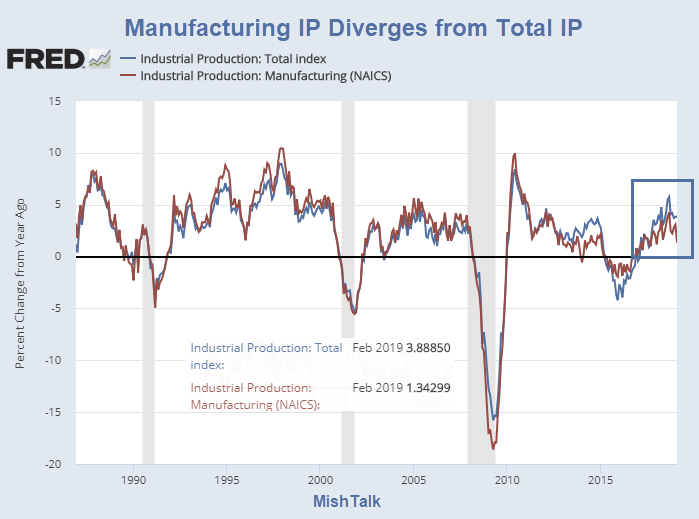
Without a cold February and a resultant surge in utilities, industrial production would have been negative.
The Econoday consensus expected a bounce in manufacturing of +0.4%. They got the number right, unfortunately with the wrong sign. Without a boost in utilities, the overall number would have been negative.
The Federal Reserve G.17 Industrial Production Report for February shows Industrial production edged up 0.1 percent in February after decreasing 0.4 percent in January.
Manufacturing production fell 0.4 percent in February for its second consecutive monthly decline. The index for utilities rose 3.7 percent, while the index for mining moved up 0.3 percent.
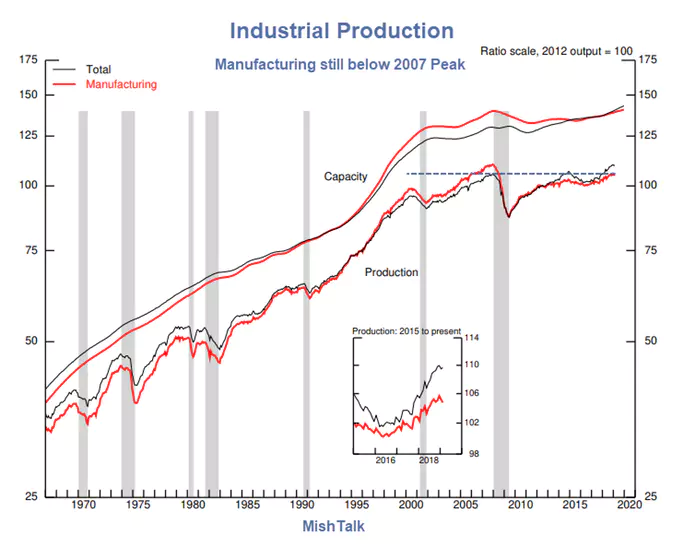
Market Groups
The major market groups recorded mixed results in February: Increases for materials, for business supplies, and for defense and space equipment were accompanied by decreases for consumer goods, for business equipment, and for construction supplies. The output of consumer goods just edged down, reflecting a small drop in non-energy nondurable goods. The index for business equipment fell more substantially, with losses for transit equipment and for industrial and other equipment. The increase for materials reflected gains for both durable materials and energy materials; the output of nondurable materials fell.
Manufacturing
Manufacturing output decreased 0.4 percent in February after falling 0.5 percent in January. In February, the index stood 1.0 percent above its year-earlier level. The output of durables edged down. Losses of 11/2 percent or more were registered by nonmetallic mineral products, by machinery, and by furniture and related products, while gains of more than 1 percent were registered by computer and electronics products, by aerospace and miscellaneous transportation equipment, and by miscellaneous manufacturing. Nondurable goods production fell 0.7 percent. Most major nondurable goods industries posted decreases; the only increases were recorded by paper and by food, beverage, and tobacco products. Production of other manufacturing (publishing and logging) increased 0.5 percent but remained well below its year-earlier level.
Utilities
The output of utilities rose 3.7 percent in February; the output of electric utilities rebounded from decreases in the previous two months. Mining output moved up 0.3 percent for its 13th consecutive monthly increase, and the index was 12.5 percent above its level of a year earlier.
Capacity
Capacity utilization for manufacturing declined 0.4 percentage point in February to 75.4 percent, almost 3 percentage points below its long-run average, with losses for durables and for nondurables but a gain for other manufacturing (publishing and logging). The utilization rate for mining decreased to 94.6 percent but remained well above its long-run average of 87.1 percent. The rate for utilities jumped to 78.6 percent, but it was still nearly 7 percentage points below its long-run average.
Author
Mike “Mish” Shedlock's
Sitka Pacific Capital Management,Llc